There is no straight line in nature — Hundertwasser said so, and then he built the evidence.
Udo has always been the island people pass through. A ferry from Seongsan, a circuit on an electric car, a cone of peanut ice cream by the beach, and back. The small island east of Jeju has coasted on that rhythm for years. Hundertwasser Park arrived with a different proposal: stay longer. Look harder. It is not a subtle proposal.
Three Domes Over an Island That Has None
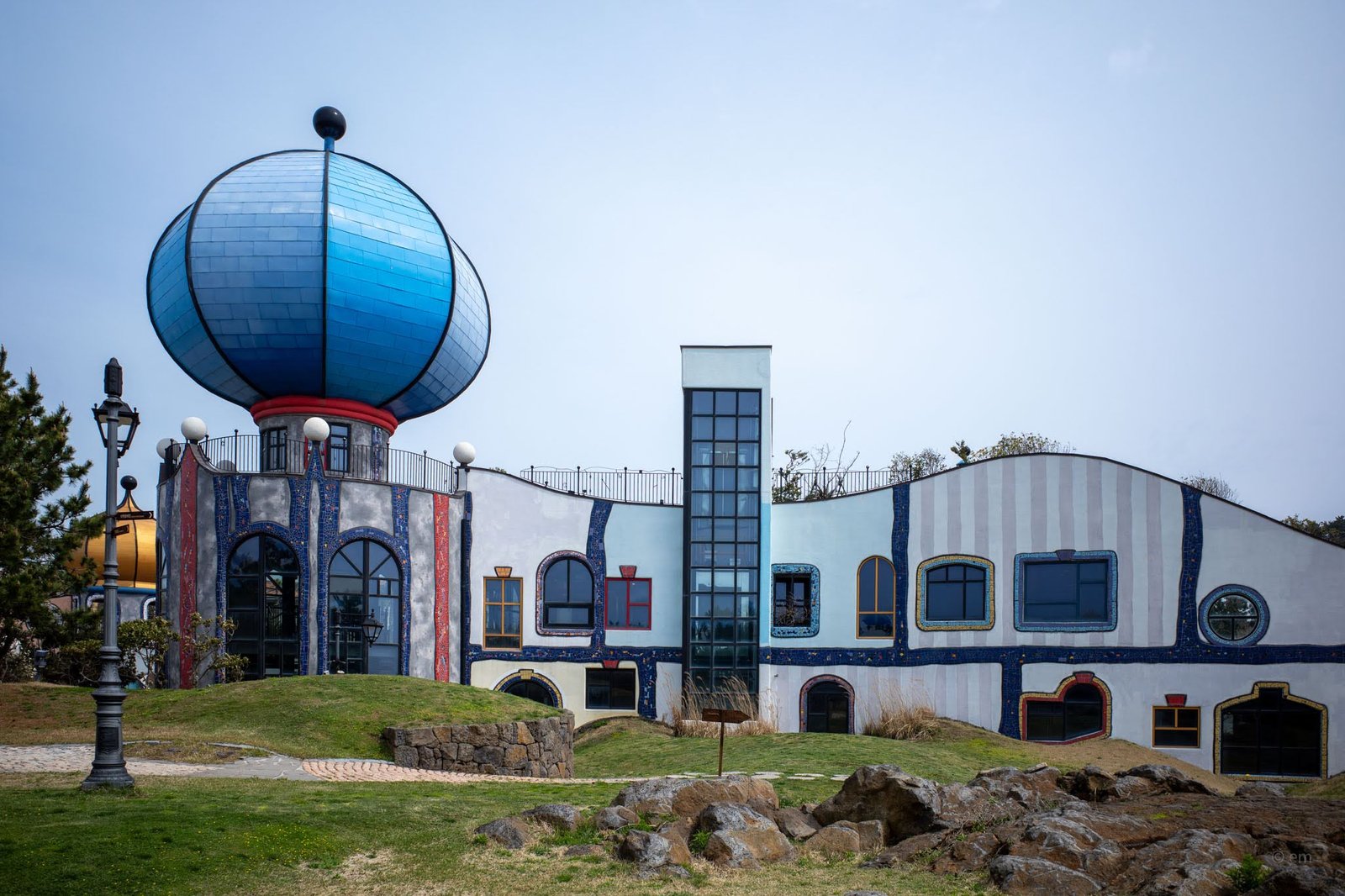
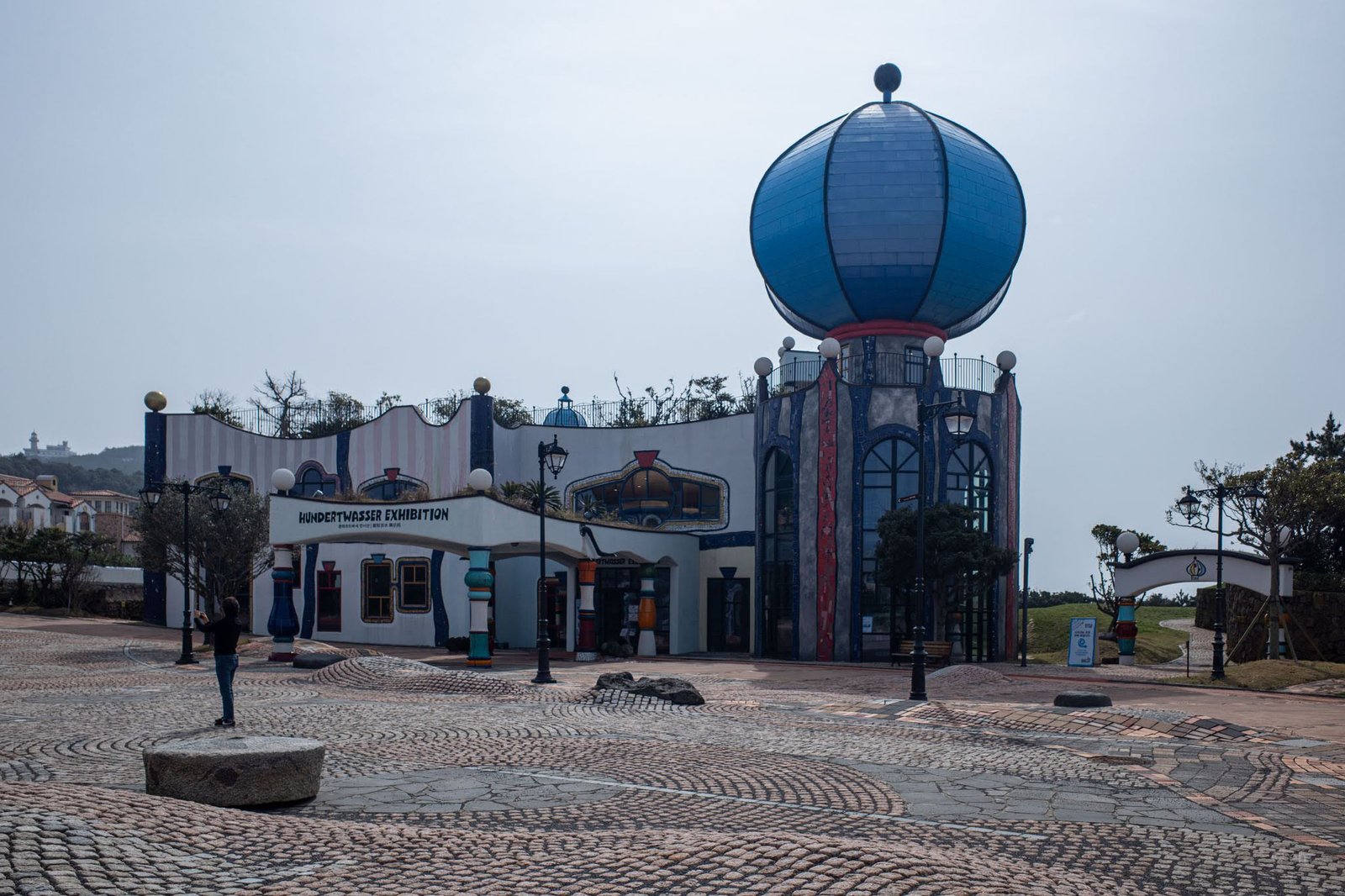
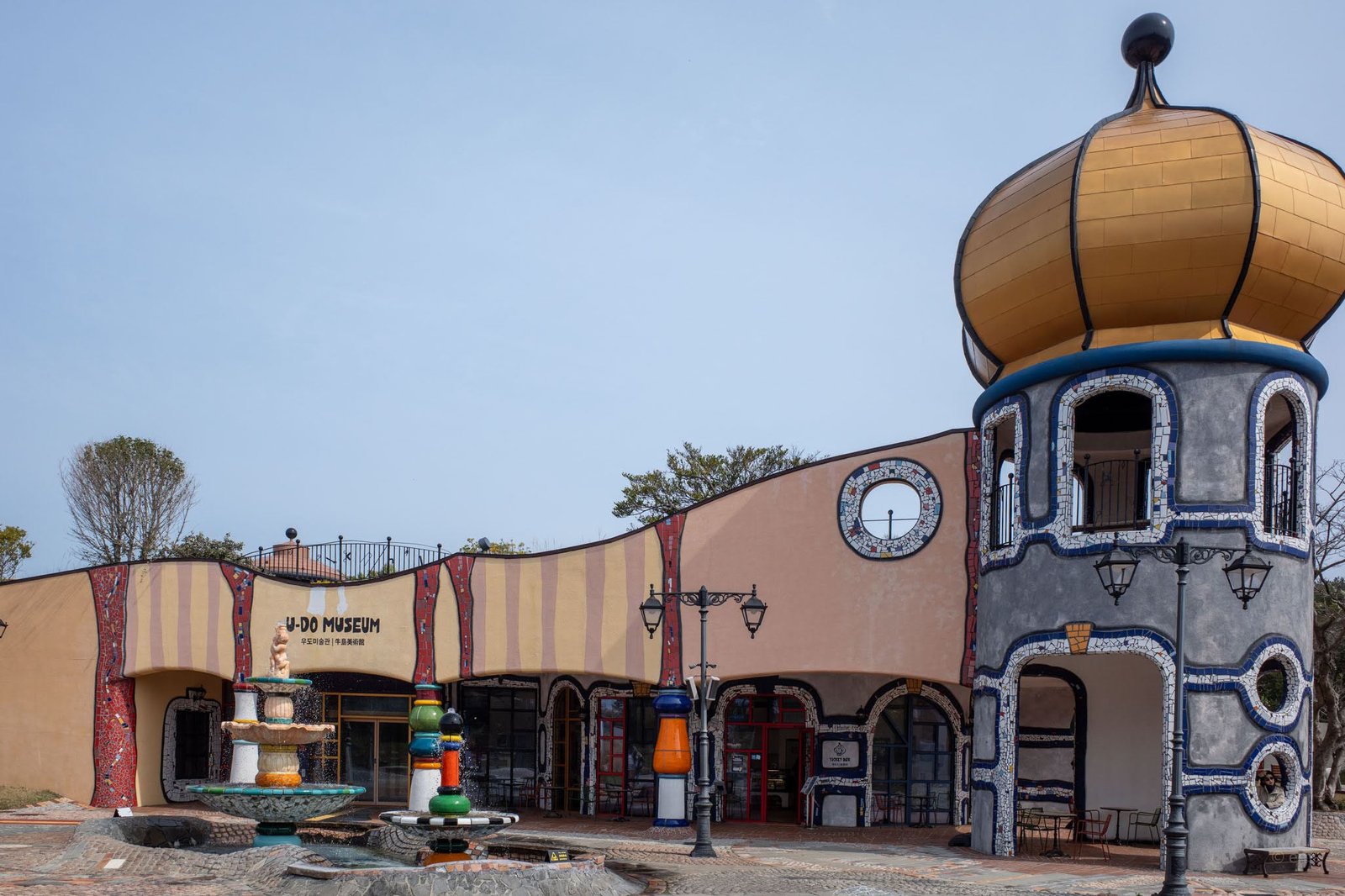
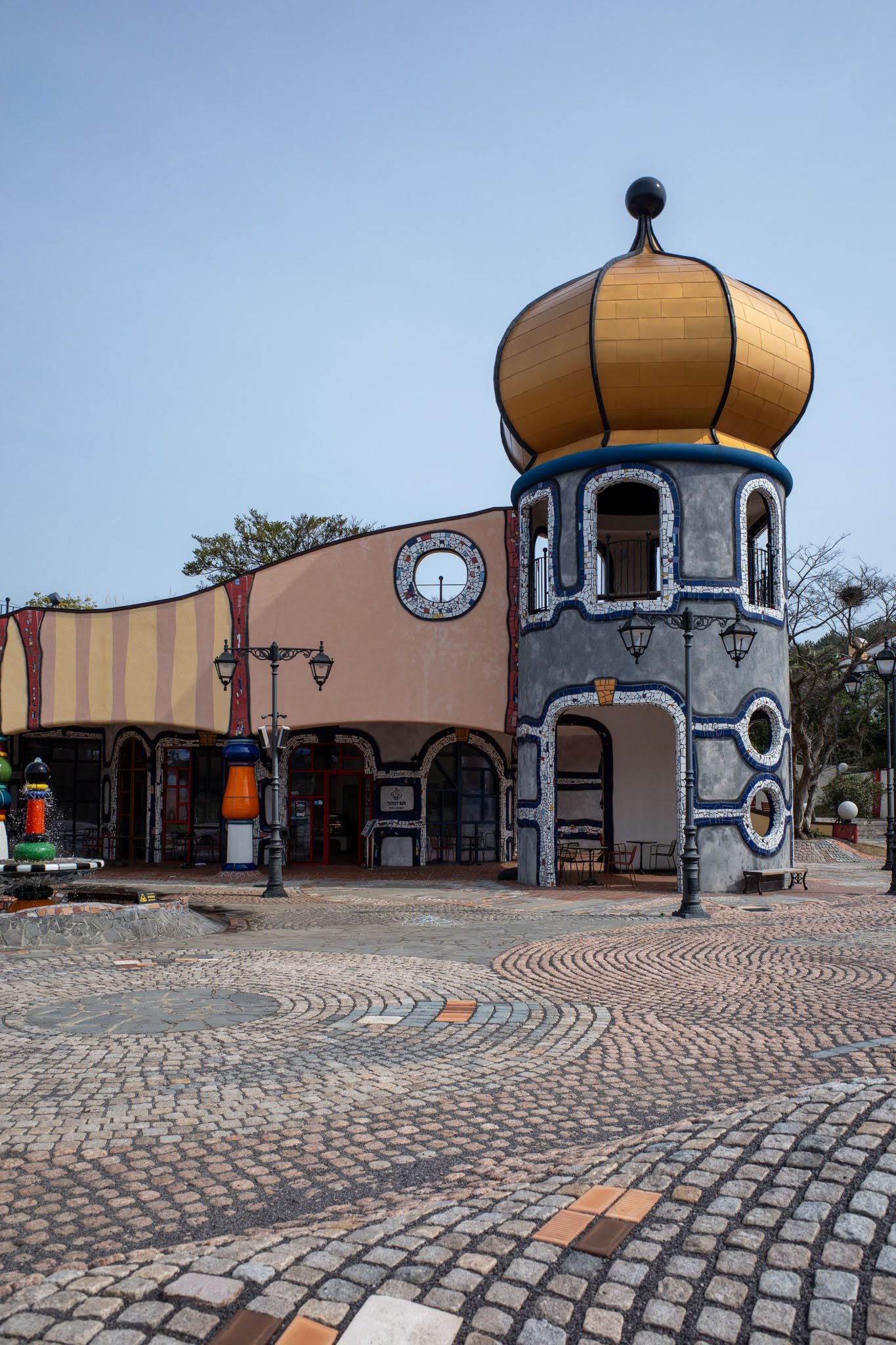
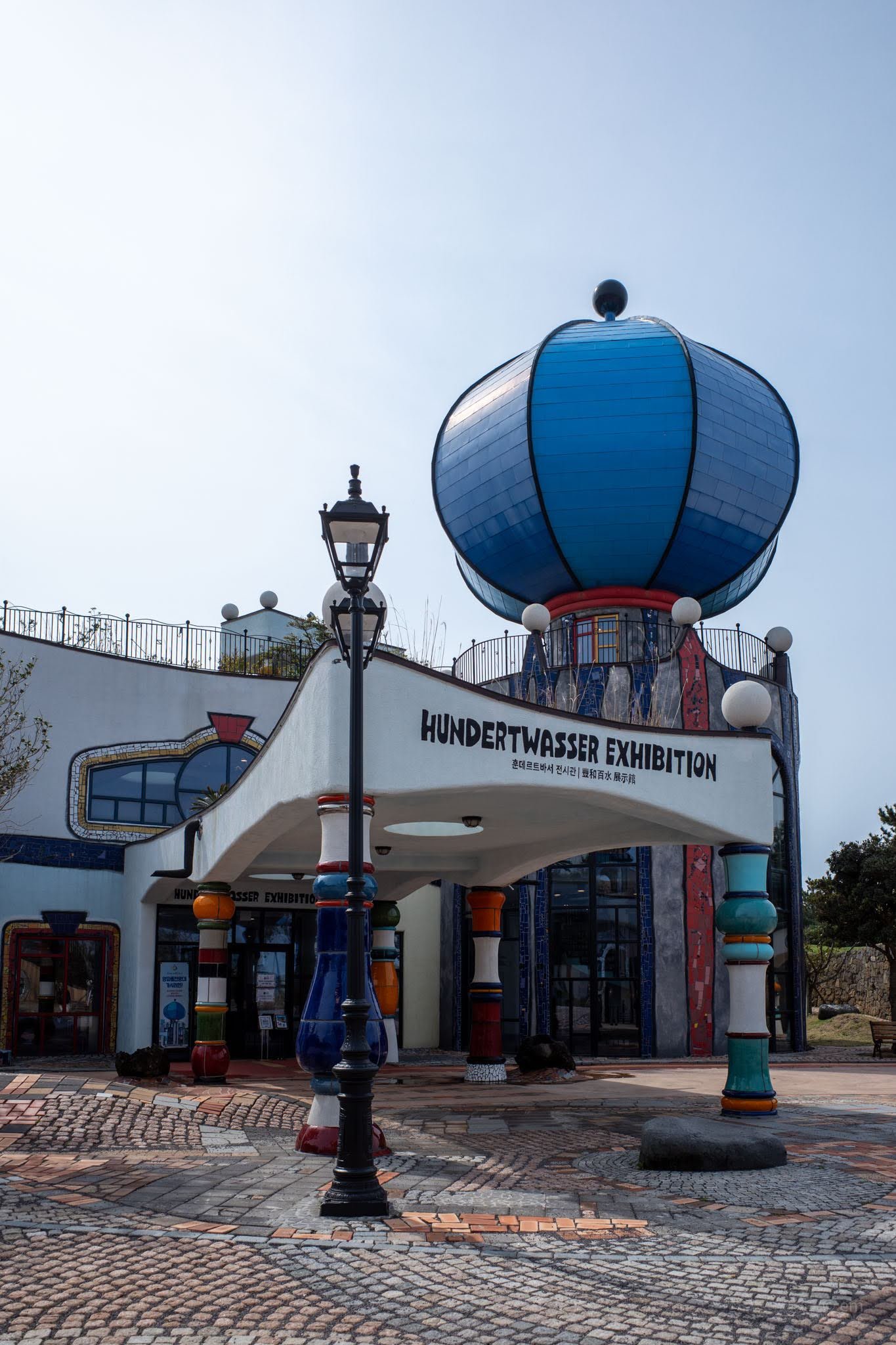
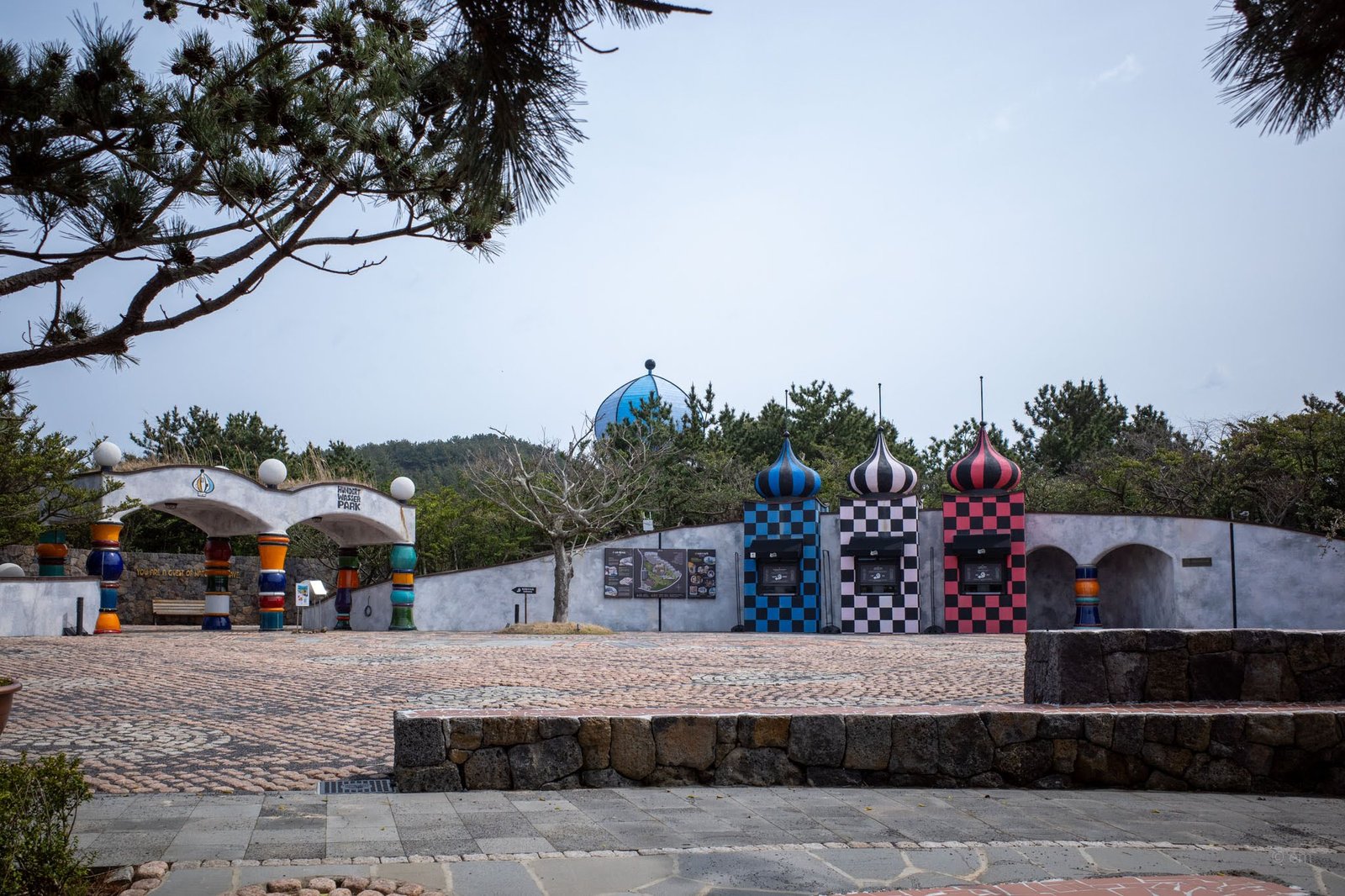
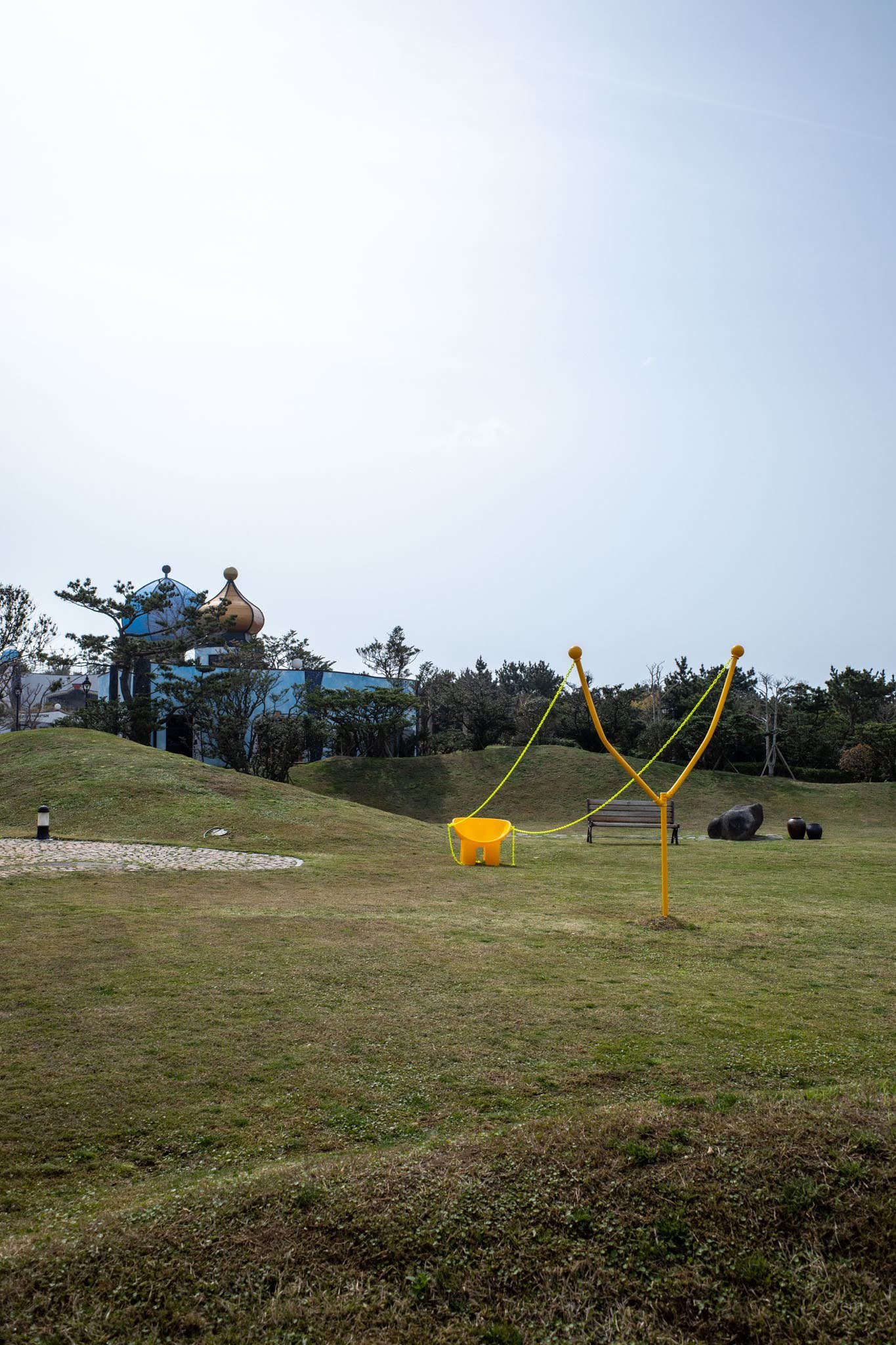
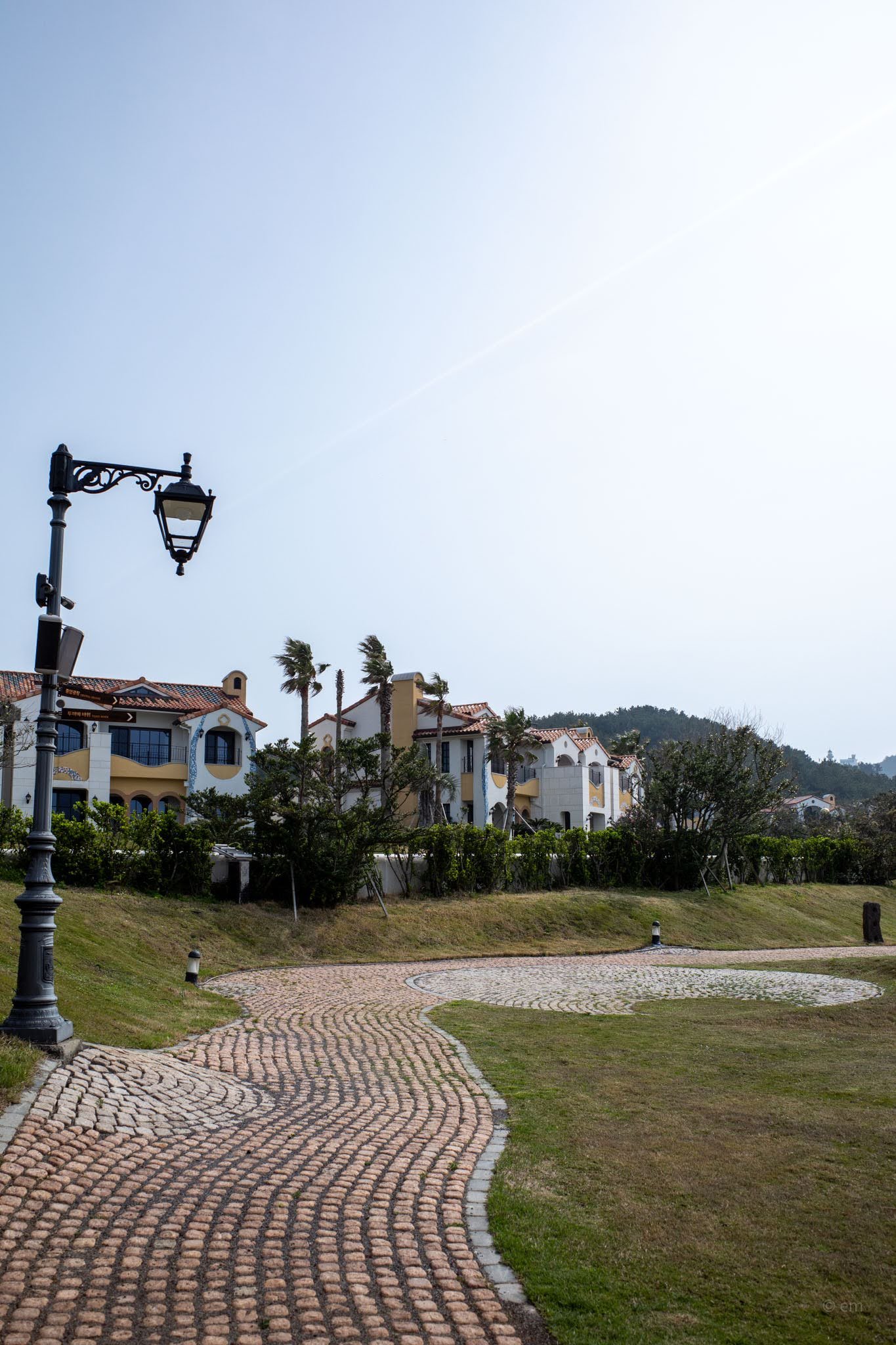
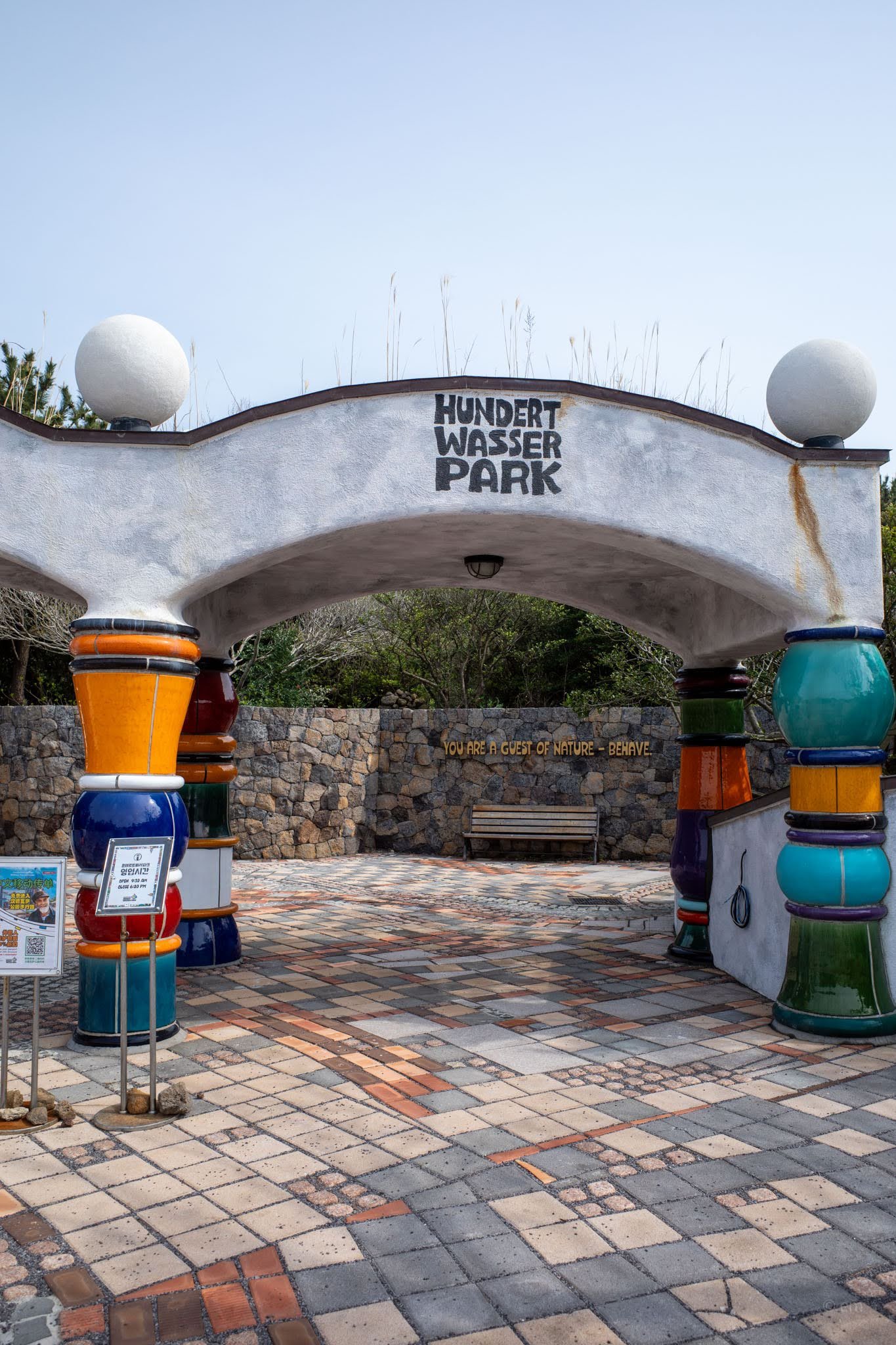
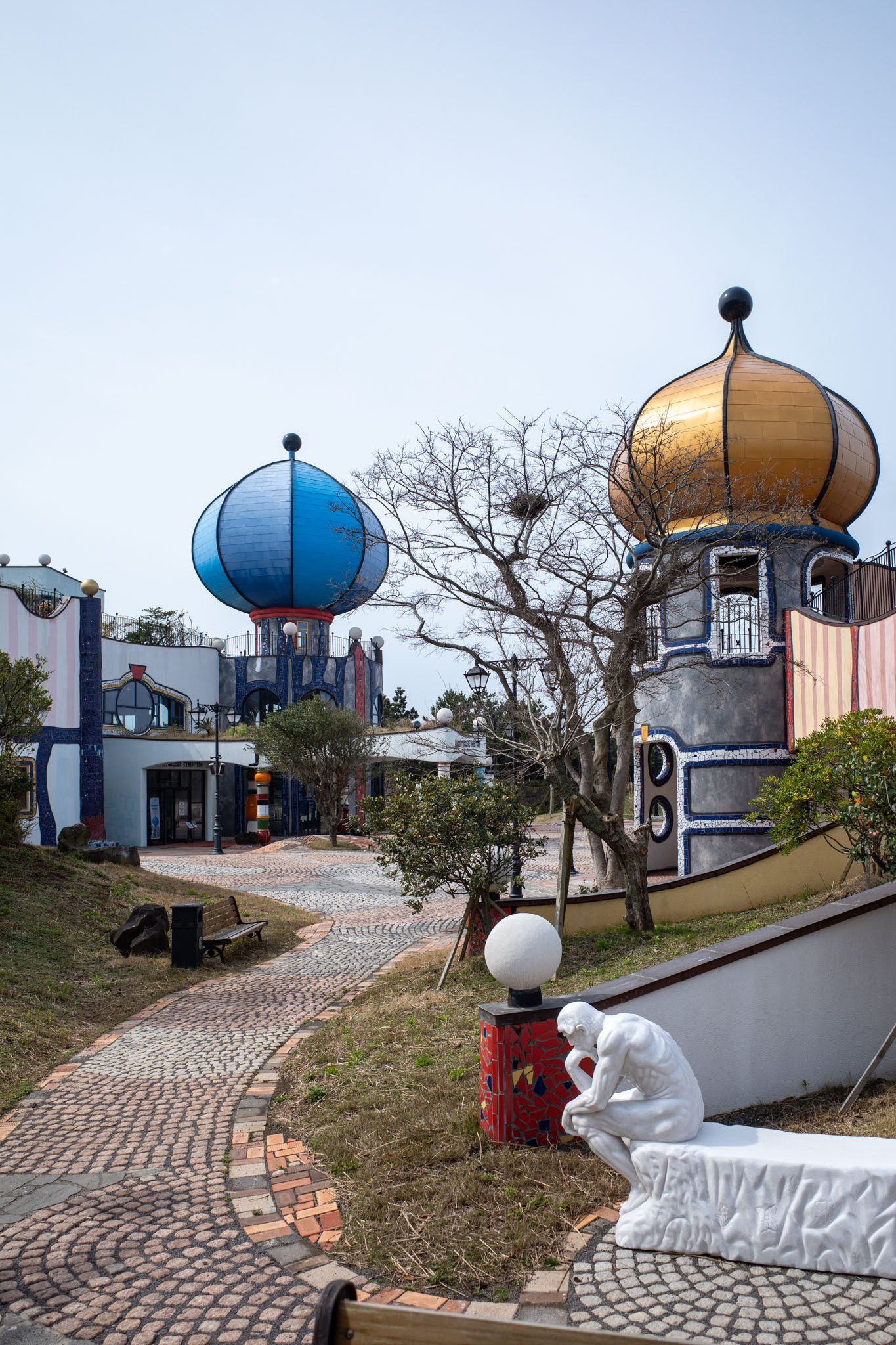
The entrance announces itself with checkerboard onion-dome kiosks in blue-black and hot pink — ticket booths that look like something between a carnival and a Viennese fever dream. Beyond the arch, the park opens across rolling green grounds under a hazy coastal sky, and the domes appear in layers: a swelling cobalt sphere crowned with a black ball atop the Exhibition tower, a burnished gold dome ribbed like a Mughal turban over the U-Do Museum, a smaller gold dome above the Goods Shop. Three buildings, three domes, zero architectural precedent for a Korean island. The wind off the coast bends the palms in the adjacent resort villas. Mediterranean terracotta rooflines catch the light behind a winding cobblestone path. The disorientation is the point.
Friedensreich Hundertwasser (1928–2000) was an Austrian painter, architect, and committed eccentric who believed straight lines were a symptom of civilization’s fundamental wrong turn. He spent decades designing buildings, posters, postage stamps, and environmental manifestos around one idea: that the modern world had made itself hostile to nature, and that architecture was the most visible proof. The park on Udo is Korea’s only permanent monument to him — 78 ceramic columns, 131 windows with no two alike, curving facades that refuse to resolve into any flat plane, and mosaic work pressed into nearly every surface.
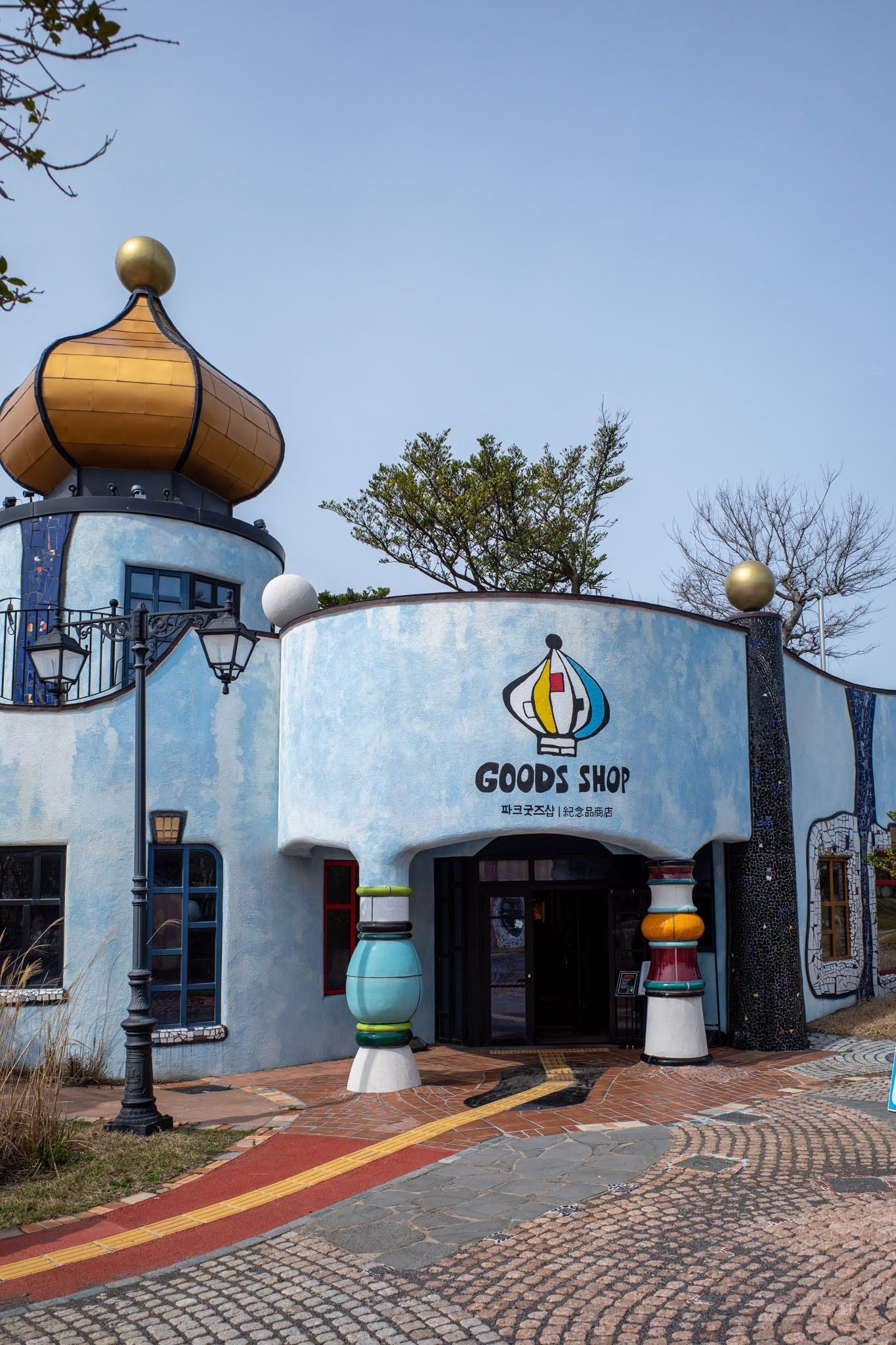
The Vocabulary of Curves
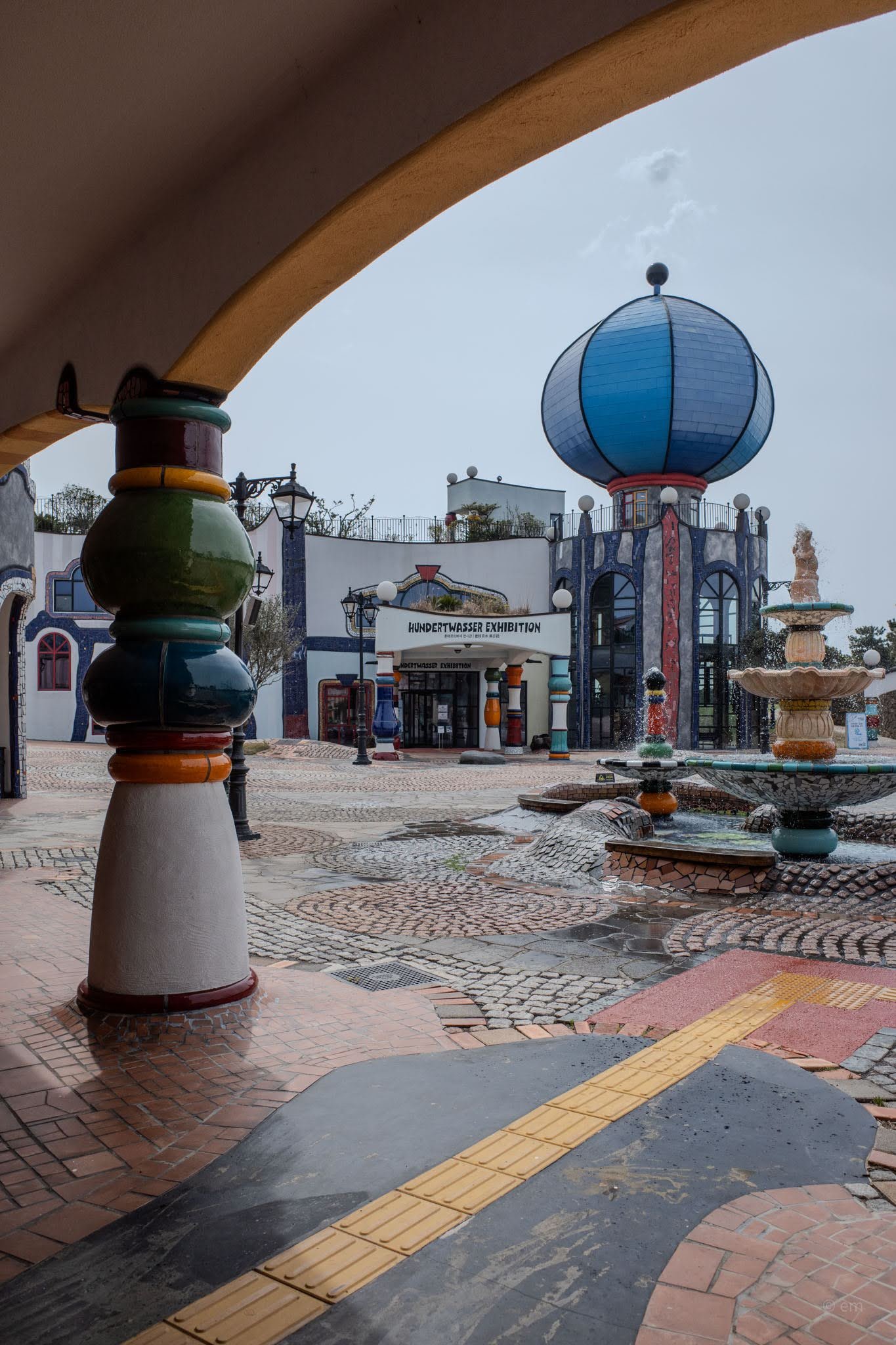
Walking through the main plaza, the buildings present themselves less as individual structures than as a single argument. The Hundertwasser Exhibition building carries the most architectural force: a low, wave-roofed body in white with blue and grey mosaic-tiled vertical columns, leading to the tower — a cylindrical drum ringed with arched openings, mosaic grids, and wrought-iron balconies, capped by the enormous blue sphere. Seen straight-on from the cobblestone plaza, the proportions are almost absurdist. The sphere is too large. That’s exactly right.
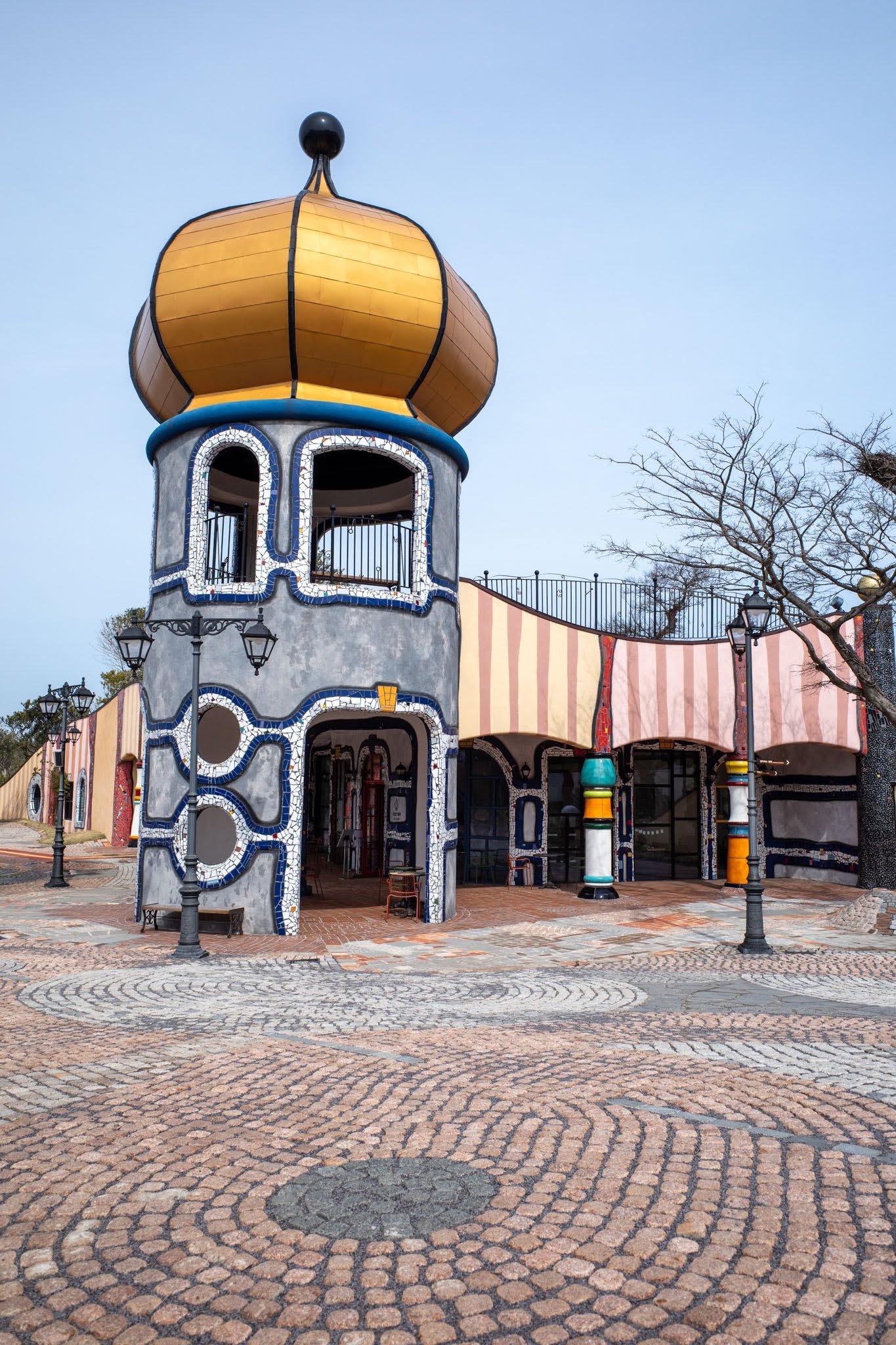
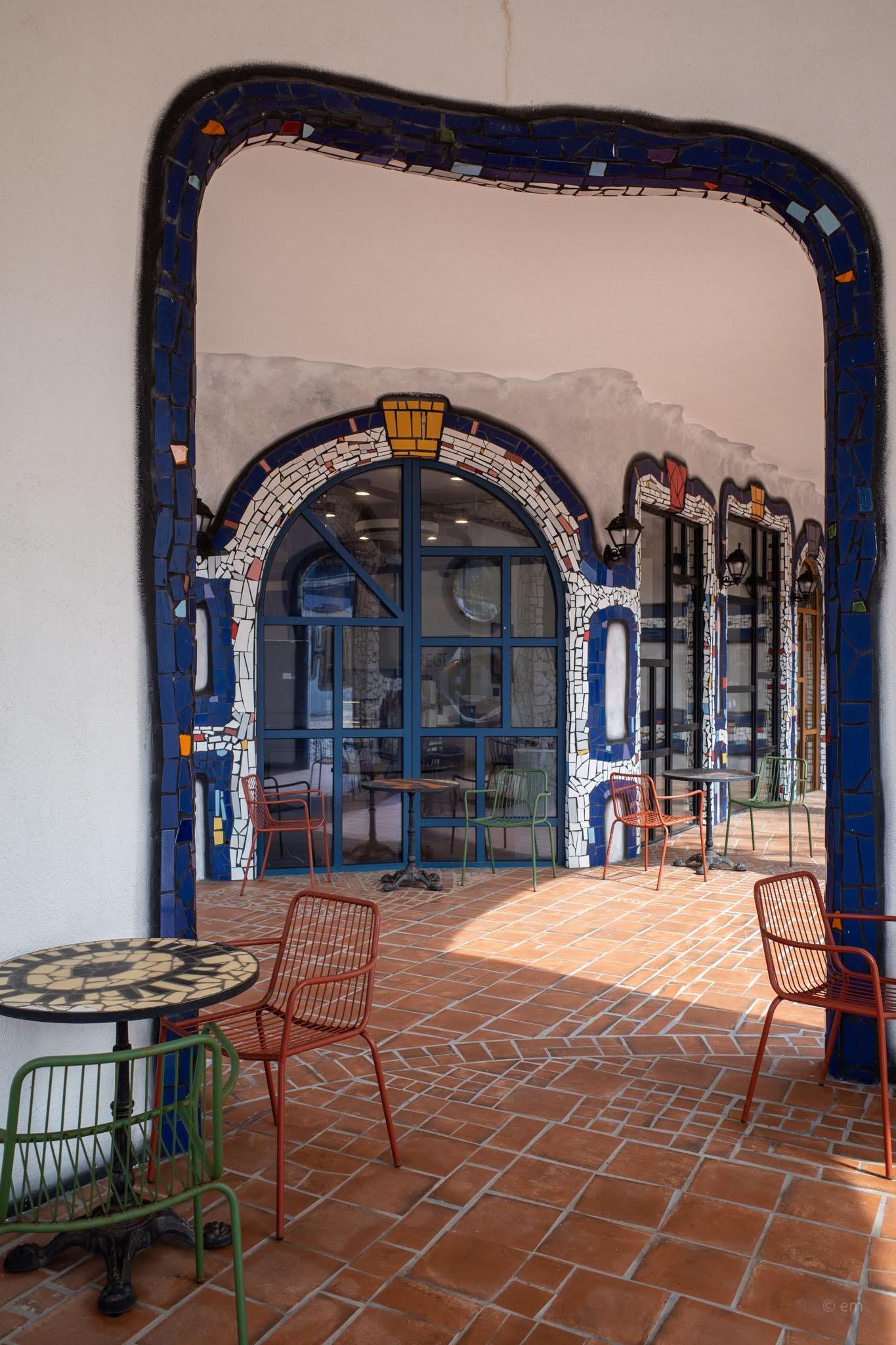
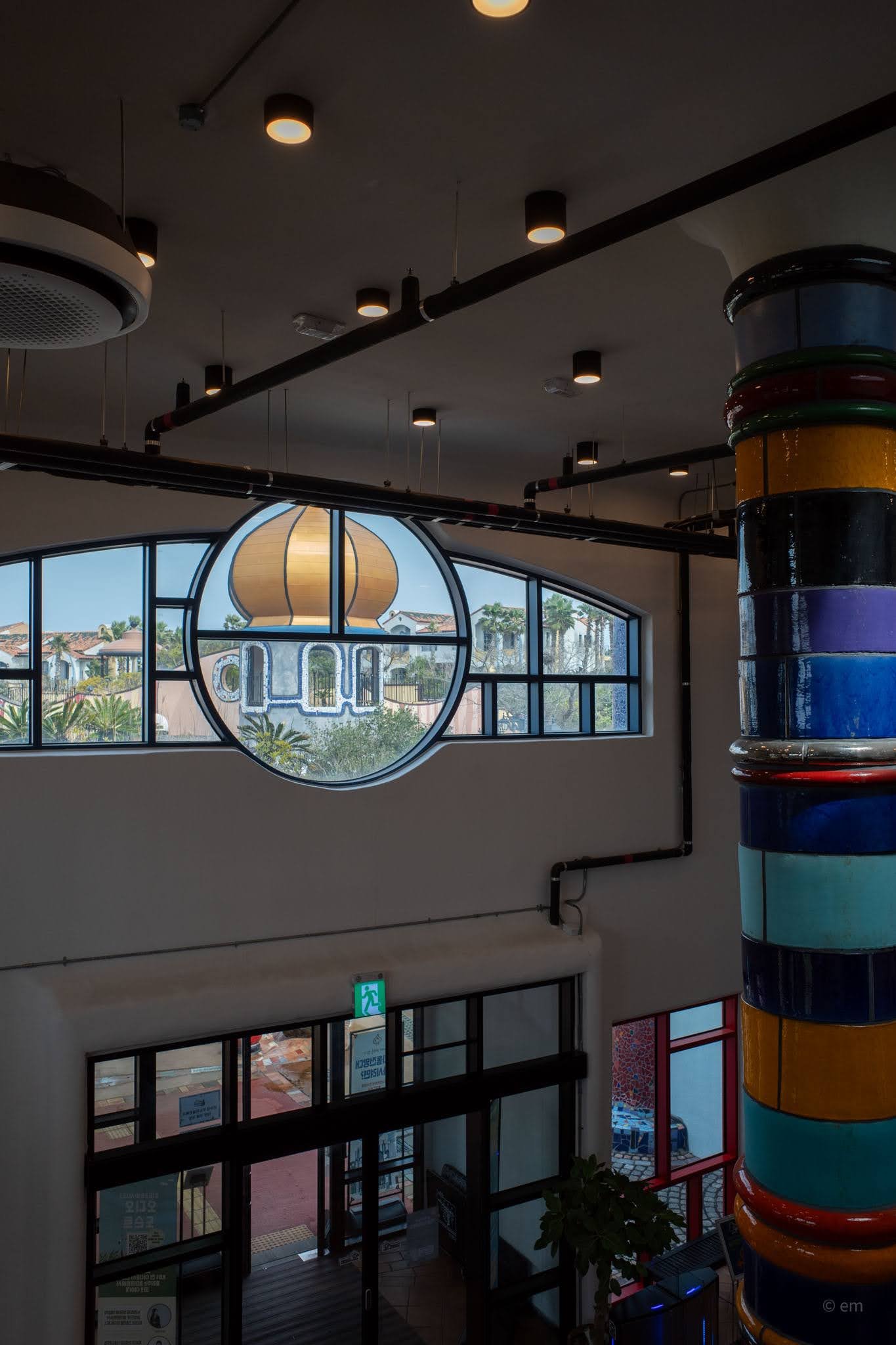
The U-Do Museum building across the square takes a warmer register — sandy terracotta tones, rounded arches, a rosette-windowed tower draped in blue tile and outlined in white mosaic chip, its gold dome catching the midday sky. Between and around the buildings, ceramic columns in every configuration of colour — alternating rings of orange, teal, red, cobalt, white — function simultaneously as structural elements and as freestanding sculpture. The column is Hundertwasser’s most recurring motif: the column that should not match any other column, the column as a declaration of individual difference.
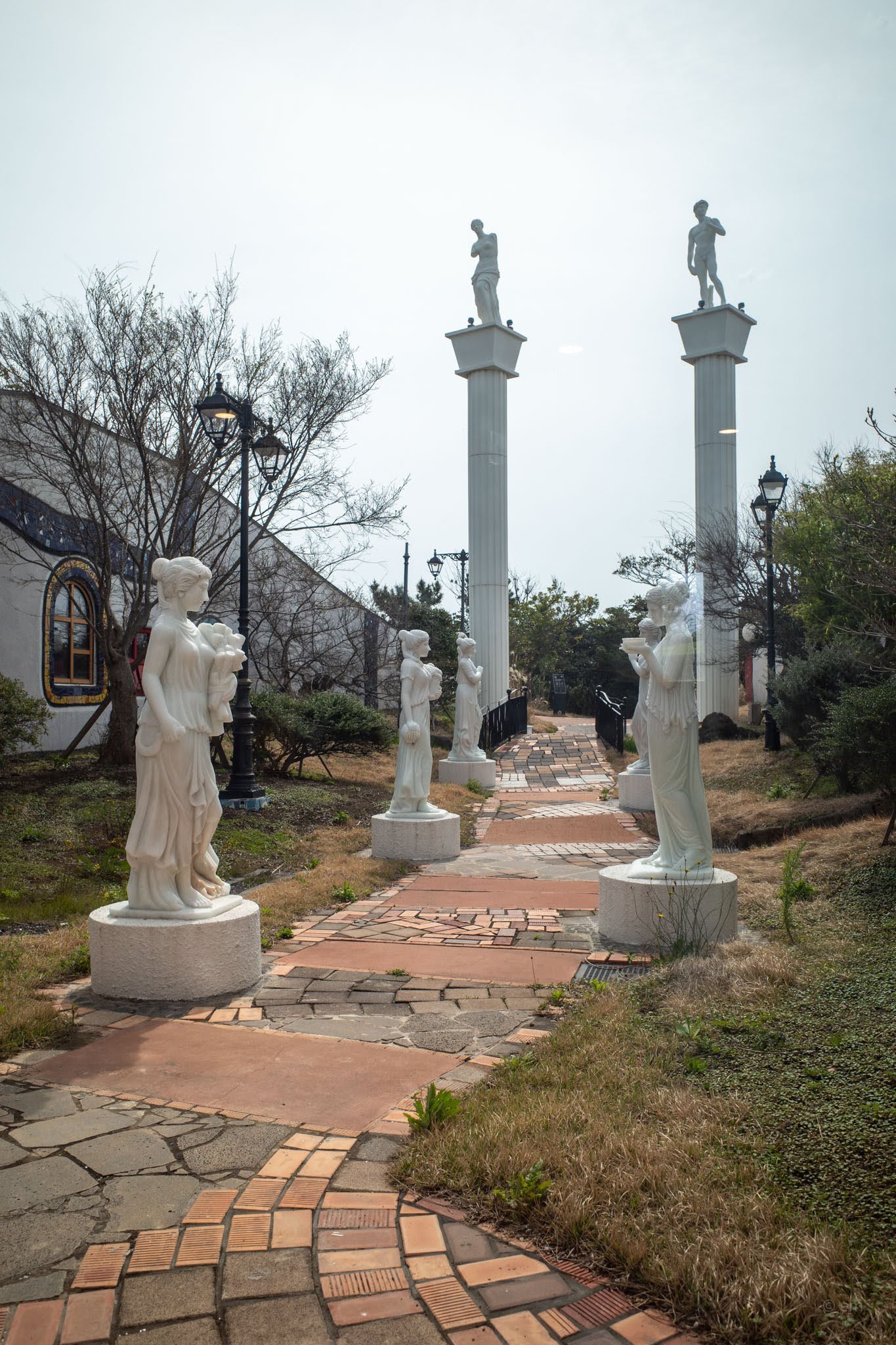
Flanking a brick-paved walkway between buildings, a processional of white classical figures — marble-effect reproductions of the Venus de Milo, draped female figures, and David-scale figures atop tall white plinths — cuts through the grounds in a straight line that feels incongruous within the park’s curvilinear logic. It’s the kind of collision this place thrives on: the classical European tradition standing at attention while everything around it refuses to sit still.
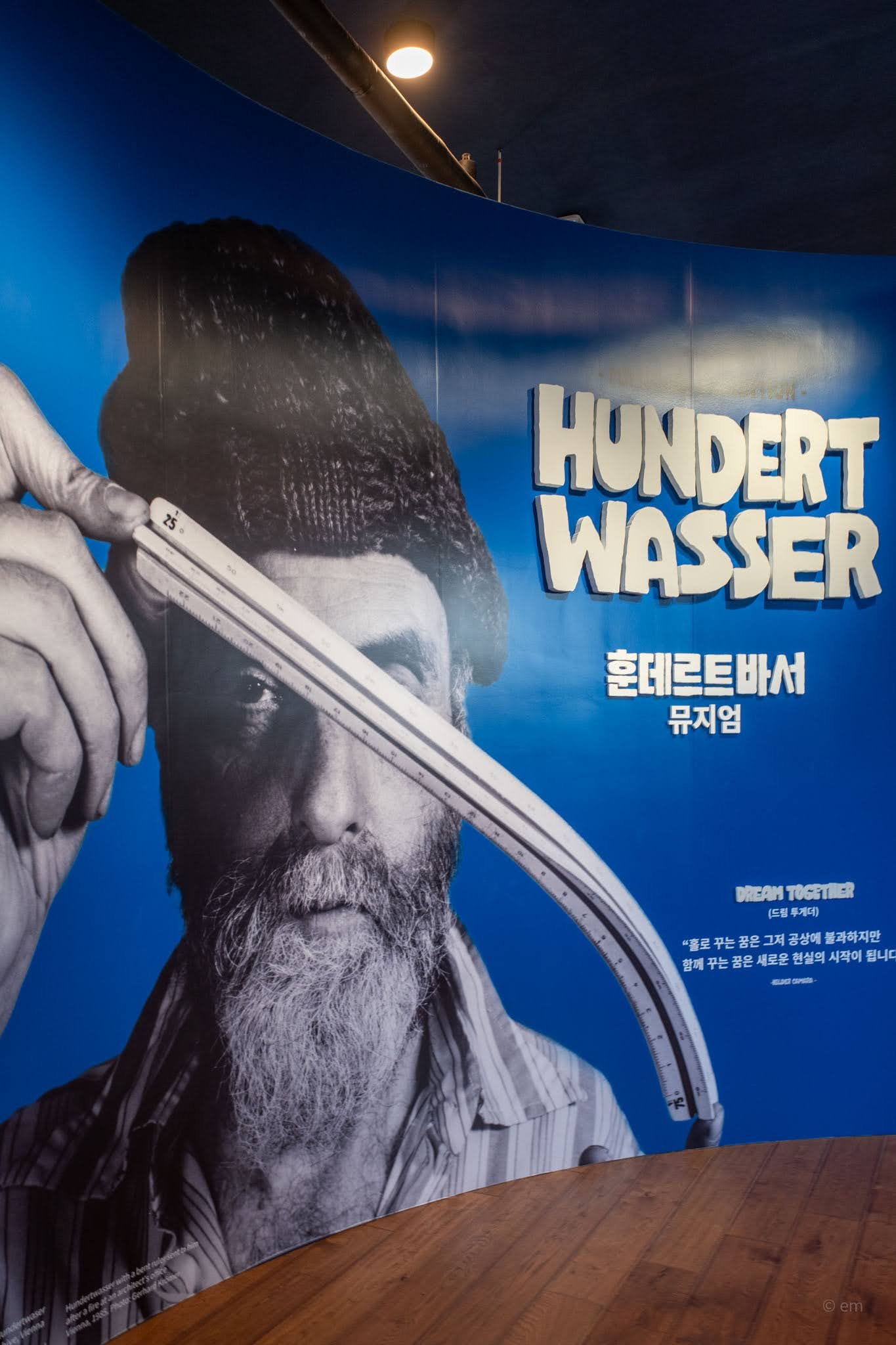
Inside the Blue Room
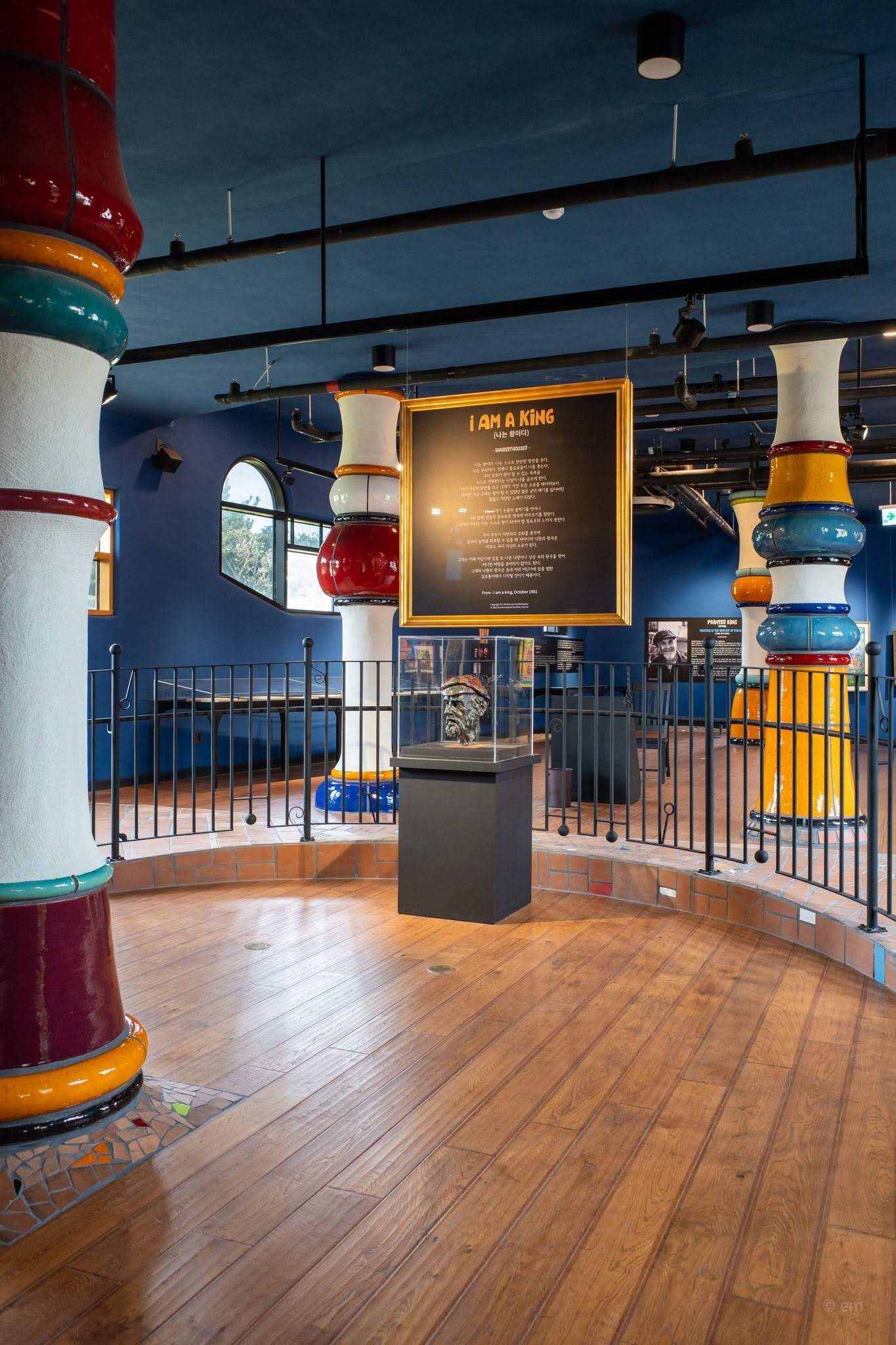
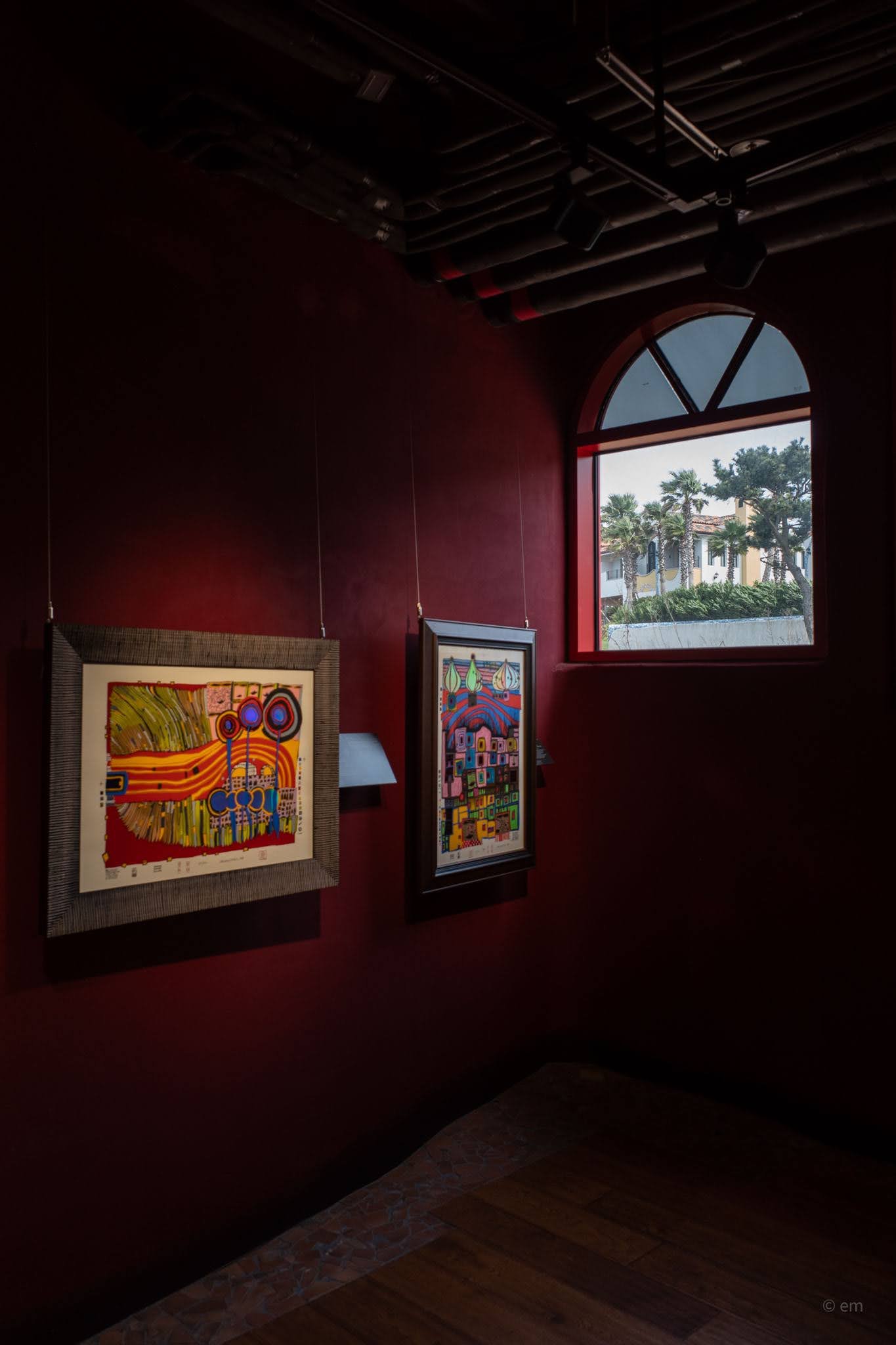
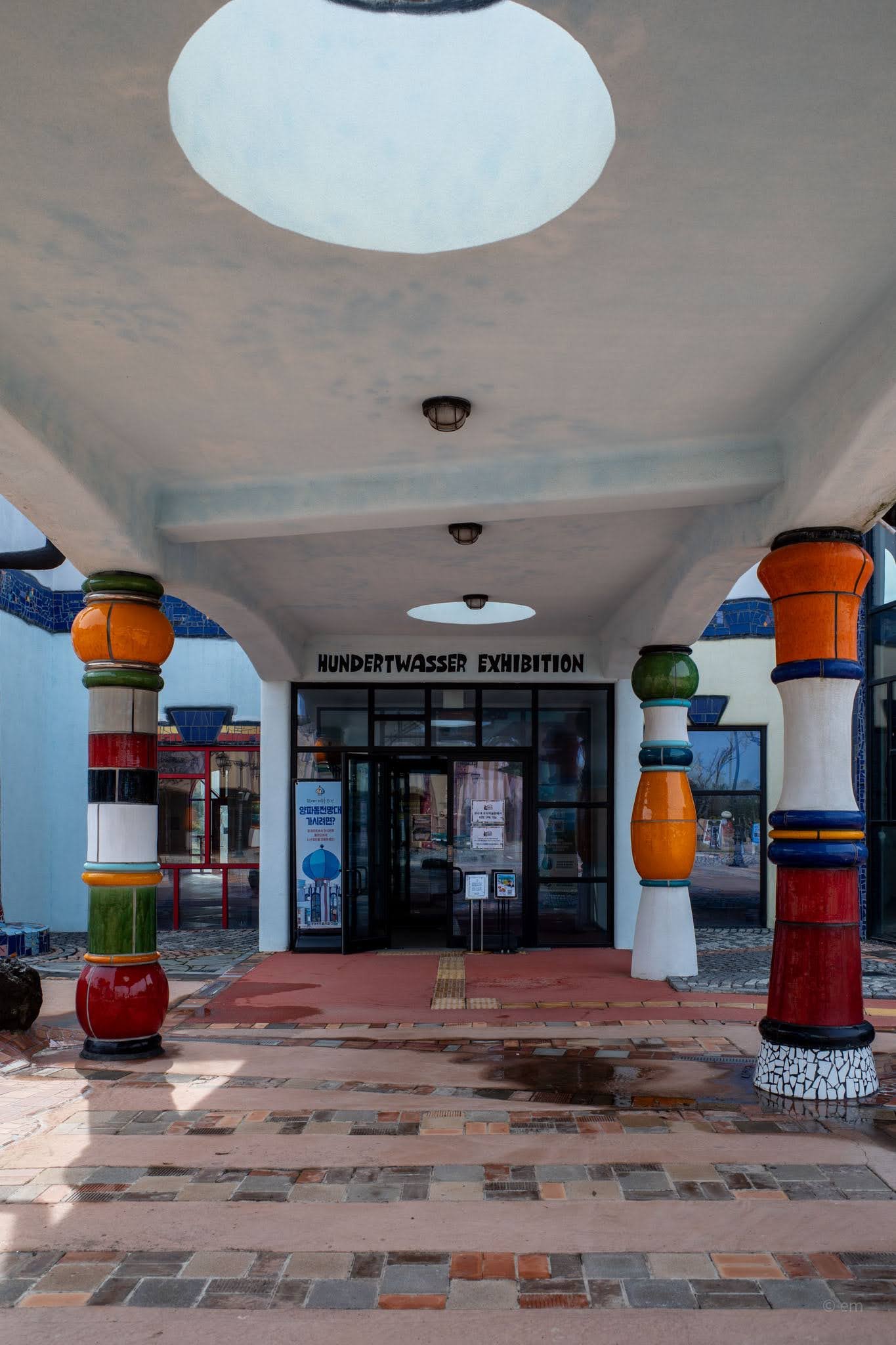
The Hundertwasser Exhibition occupies multiple levels inside the tower and its adjoining wing. Entrance is through a portico flanked by floor-to-ceiling ceramic columns in stacked bulb forms — orange, green, red, white — with a shallow oval skylight overhead. Through the glass doors, the circular interior of the tower unfolds under a deep navy ceiling. Hanging columns descend from above. A large framed panel displays the text of Hundertwasser’s I Am a King — his declaration of the self’s sovereignty over the straight line, over the uniform, over the street that belongs to everyone and therefore to no one.
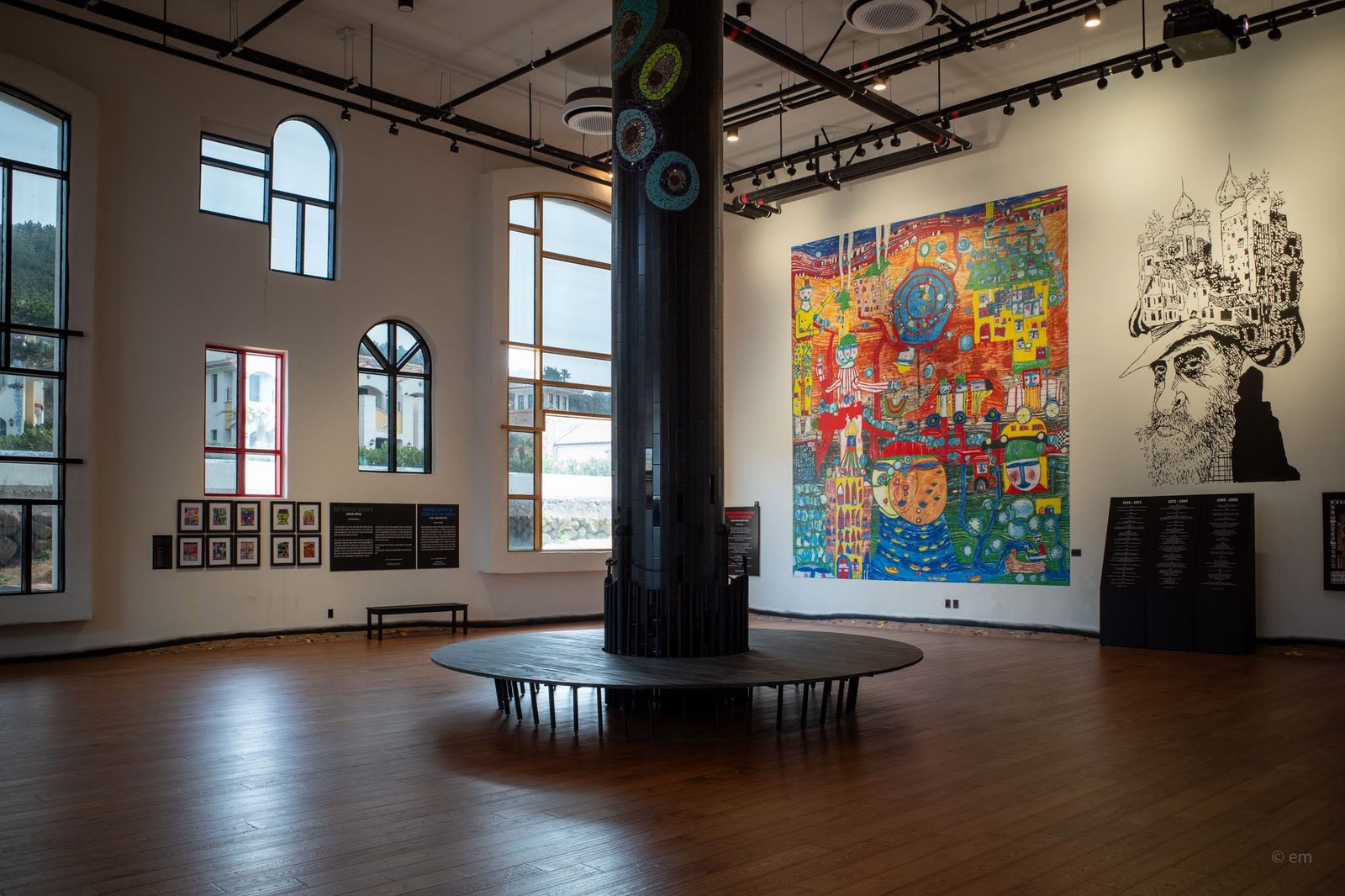
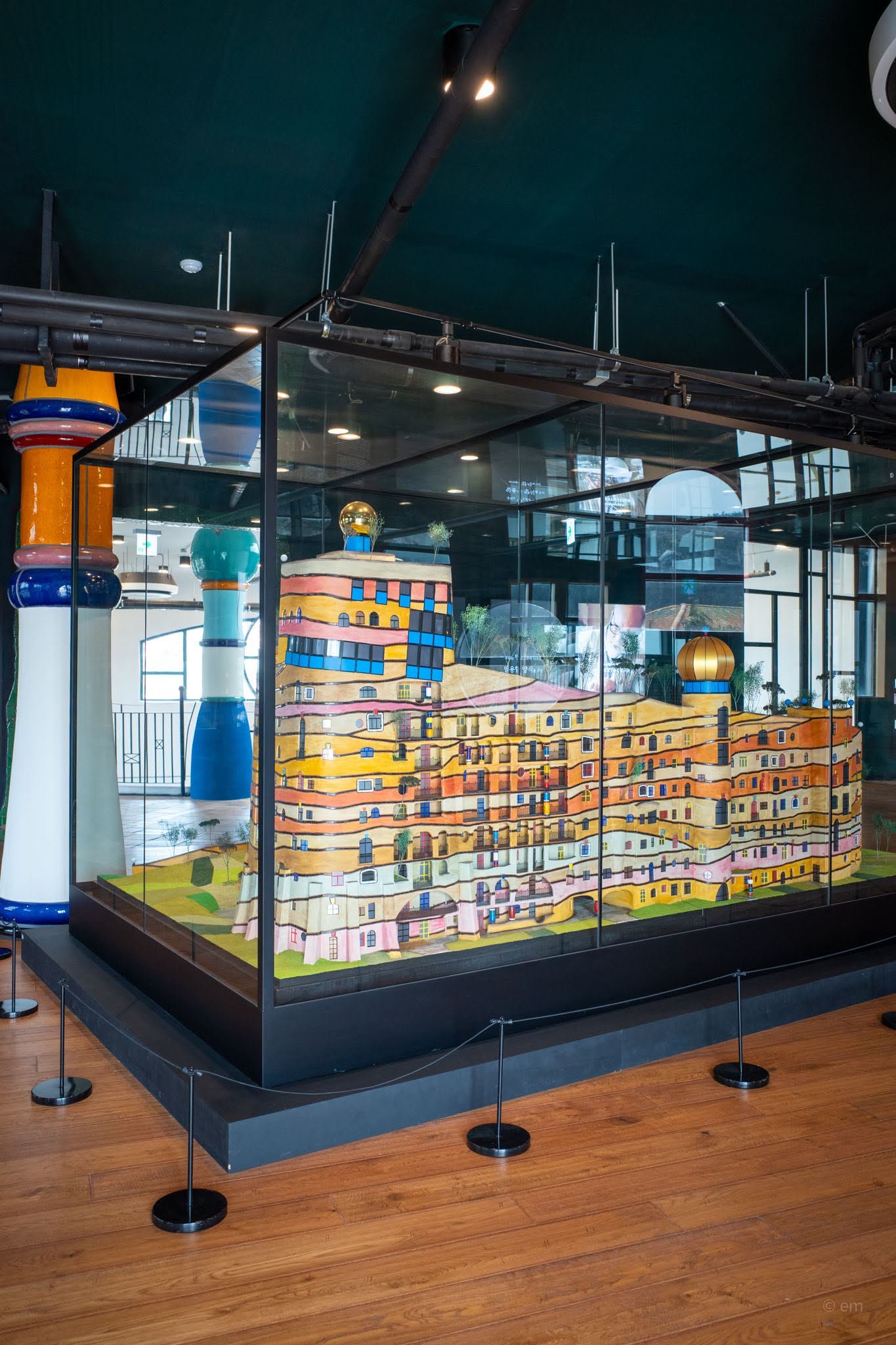
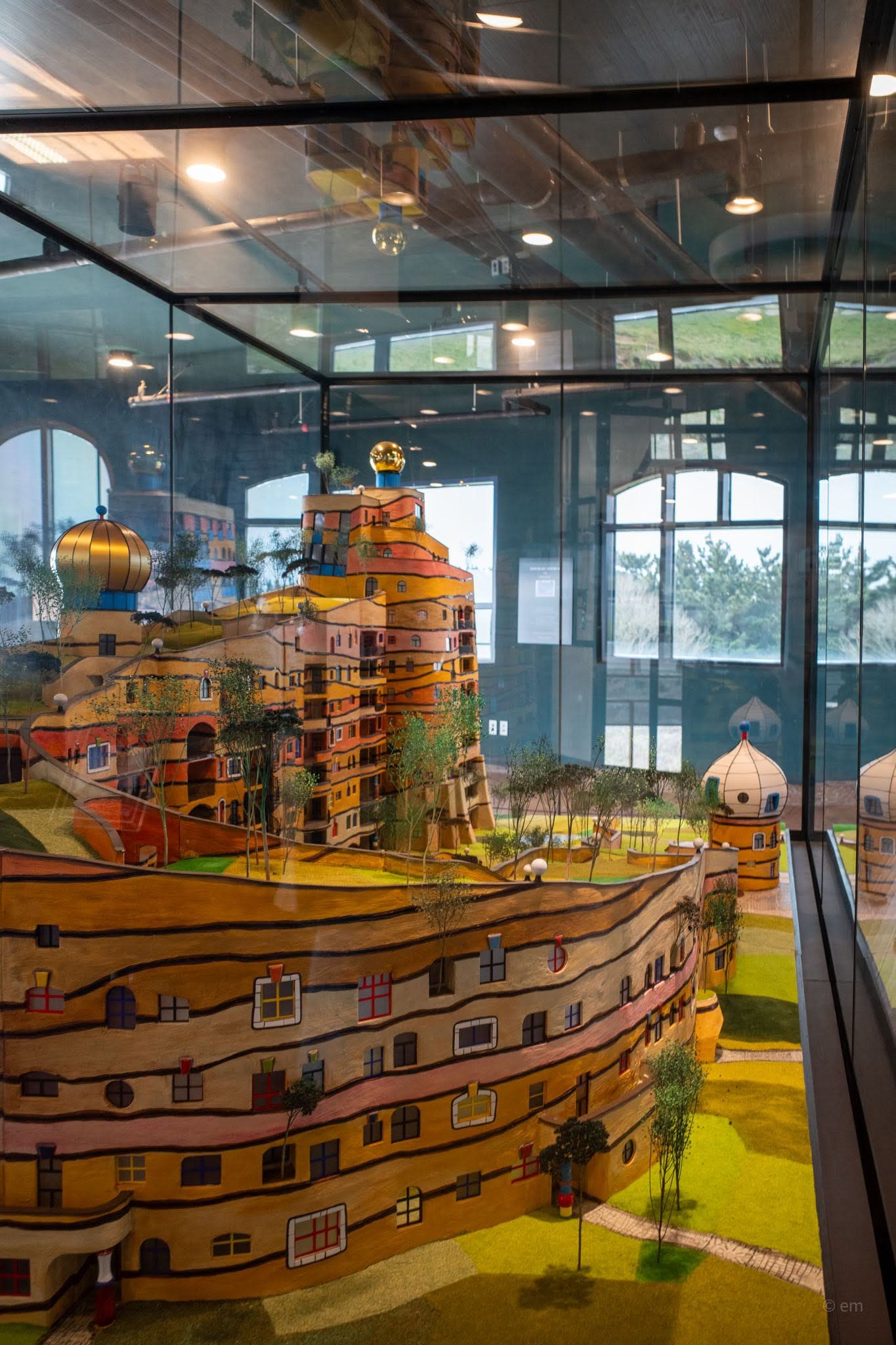
The larger exhibition wing opens into a double-height gallery with arched windows and a central mosaic column rising from a circular bench. One wall holds a large-scale reproduction of Hundertwasser’s painting — its teeming, flat-perspective city of faces and creatures and concentric spirals — beside a line-drawing portrait of the artist in profile, hat in place, building an impossible skyline on his own head. A glass vitrine nearby encloses a detailed architectural model of the park itself: the same wavy rooflines, the same domes, rendered in miniature with the same commitment to no two windows matching.
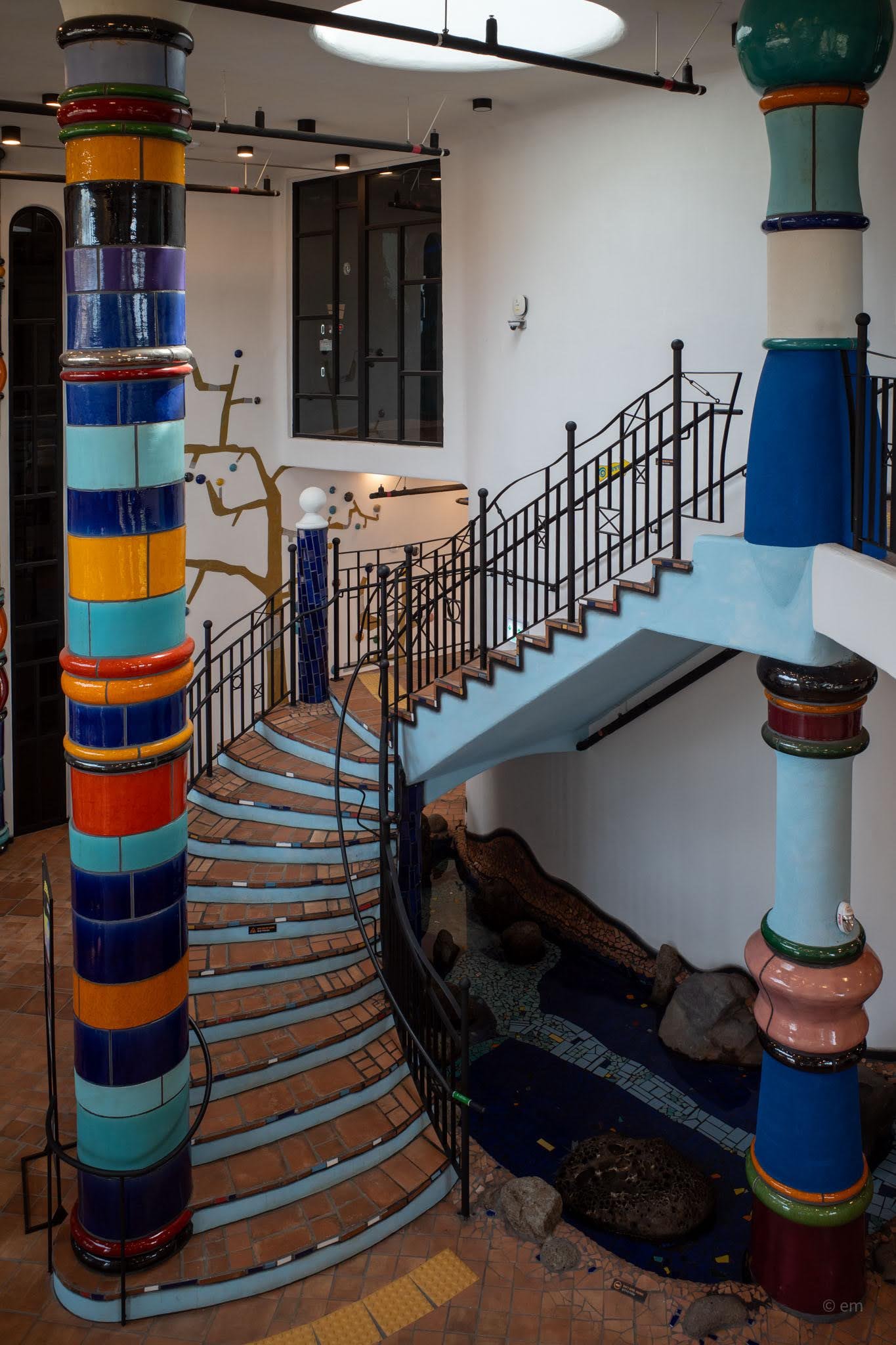
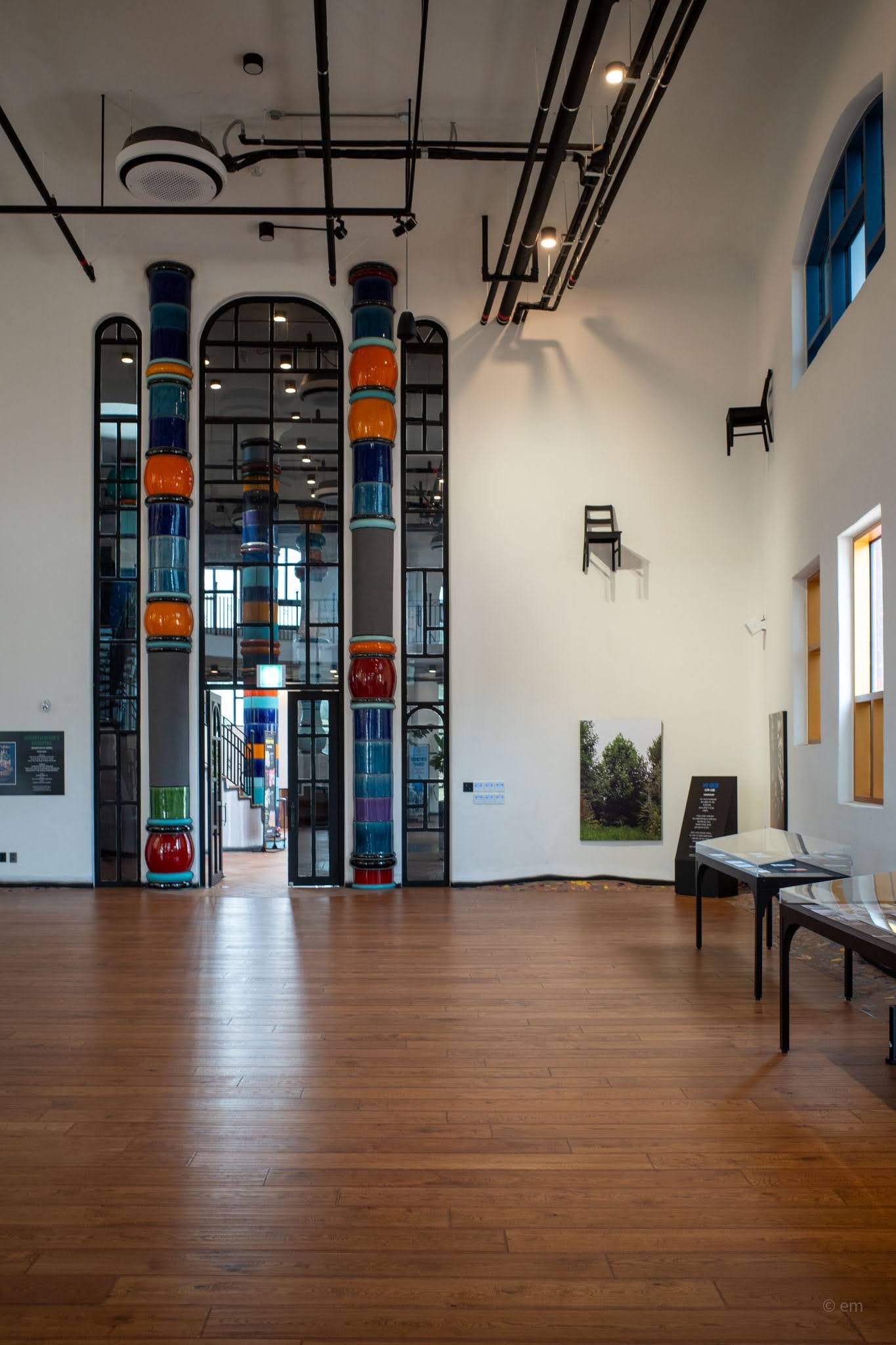
The interior staircase is a set piece in itself. Mosaic-tiled steps in terracotta and pale blue curl upward around a central stone and ceramic column, flanked by another floor-to-ceiling ceramic column, with a small rock garden settled into the well at the base. A round porthole window on the upper floor, punched through an interior wall, frames the gold dome of the U-Do Museum outside in a perfect circle — the building watching the building, the park folding back in on itself.
Empty on a Weekday
There were few people here. That fact carried its own atmosphere. A space this saturated with intention — this much mosaic, this many columns, this sustained an architectural argument over this much ground — deserves more traffic than it gets. The park lies at the southern end of Udo, slightly removed from the beaches and the ice cream stalls that generate the island’s foot traffic, and many visitors to Udo never arrive this far. Those who do tend to move through quickly, photographing the domes and leaving. The slower itinerary — the walk through the grounds, the time inside the tower, the staircase, the exit wall — belongs to almost no one on a weekday morning.
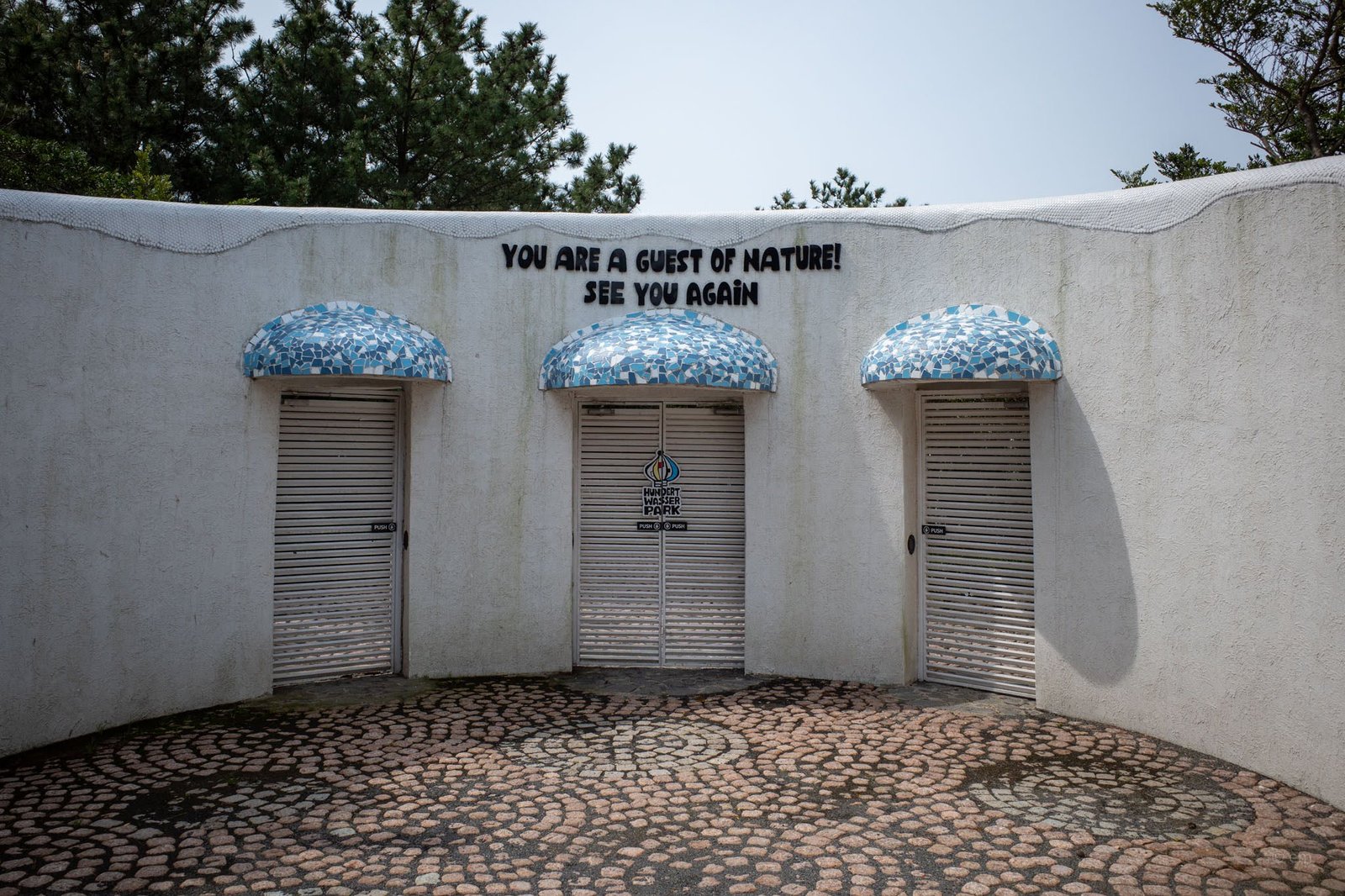
The exit sends visitors out through a curved white wall lined with three shuttered doors, each canopied in blue mosaic tile. Painted above them in blocky letters: YOU ARE A GUEST OF NATURE. SEE YOU AGAIN. It reads as farewell and as correction, simultaneously.
On the Grounds
Beyond the museum complex, Hundertwasser Hills — the resort accommodation — stretches across the hillside in low-profile Mediterranean-style villas: white render, terracotta tile, arched windows, palm trees caught mid-lean in the coastal wind. The resort operates separately from the museum, and its attached café (Hundertwasser Winds, with views toward Seongsan Ilchulbong) will be covered in a separate post. The grounds between all of this — gently rolling turf, cobblestone paths, lawn sculptures, a yellow slingshot swing — provide the connective tissue of the park, and enough open space to feel the wind coming in off Jeju Strait.
Hundertwasser Park
Address: 32-12 Udo Haean-gil, Udo-myeon, Jeju-si, Jeju
Hours: 9:30 AM – 6:00 PM (last entry 5:00 PM), open year-round
Admission: Adults 22,000 KRW / Youth 15,000 KRW / Children 11,000 KRW
Website: hundertwasserpark.co.kr
You are a guest of nature. The island knows.