A wall that has circled this city for six centuries, and the gate at its eastern end that still stands.
Seoul is a city that tends to bury its history under the next layer of itself. The Joseon-era alley paved over, the old neighborhood absorbed into the apartment block, the landmark marooned mid-intersection. But Hanyangdoseong — the Seoul City Wall — resists that logic. Eighteen-point-six kilometers of granite and granite-grey sky, tracing the ridgelines of four mountains around what was once the walled capital of Hanyang. The wall was built in 1396 under King Taejo, the founder of the Joseon dynasty, and significant portions of it have never come down. Walking it today is less a heritage tour than a navigation of something that simply kept going.
The Naksan Fortress Trail
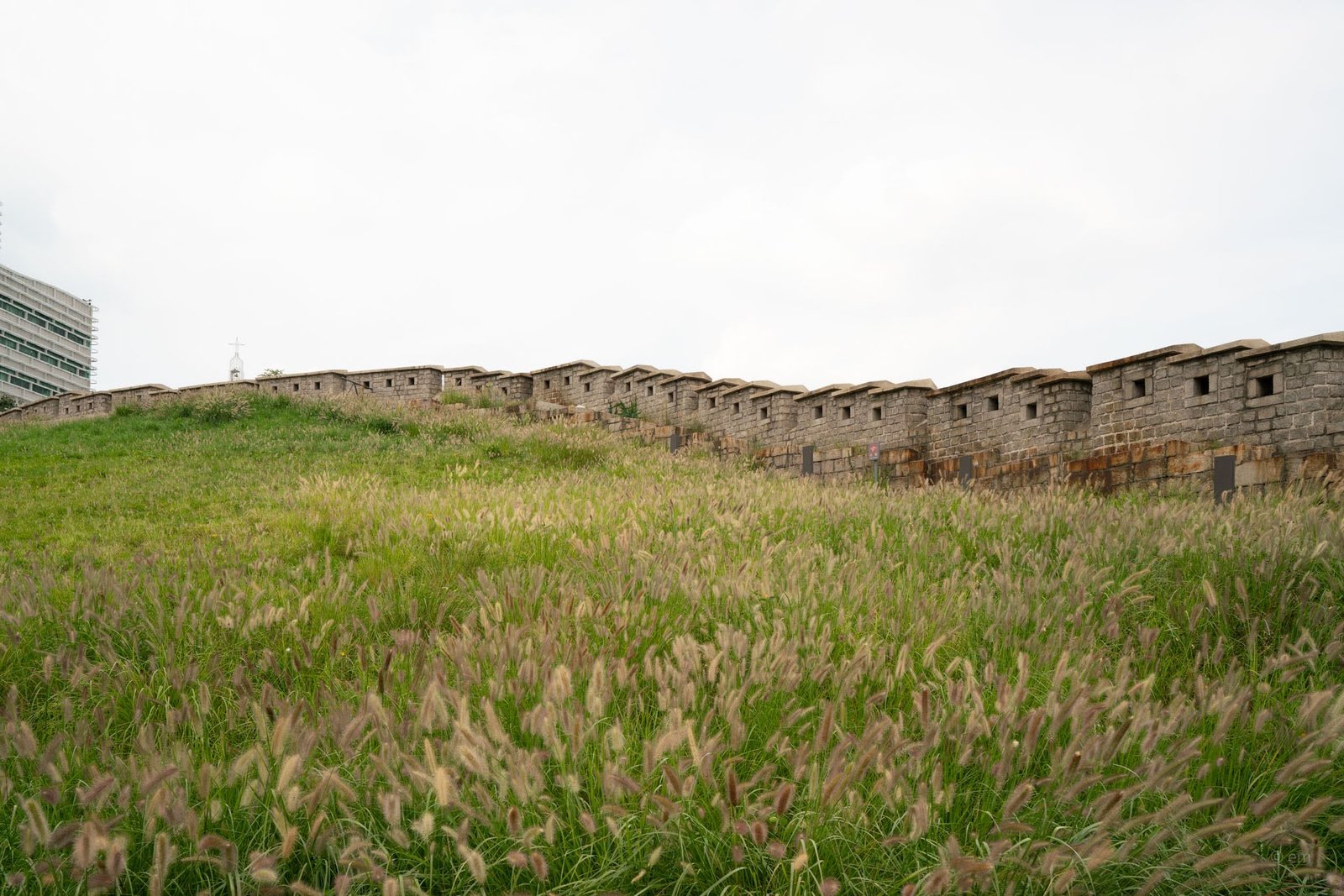
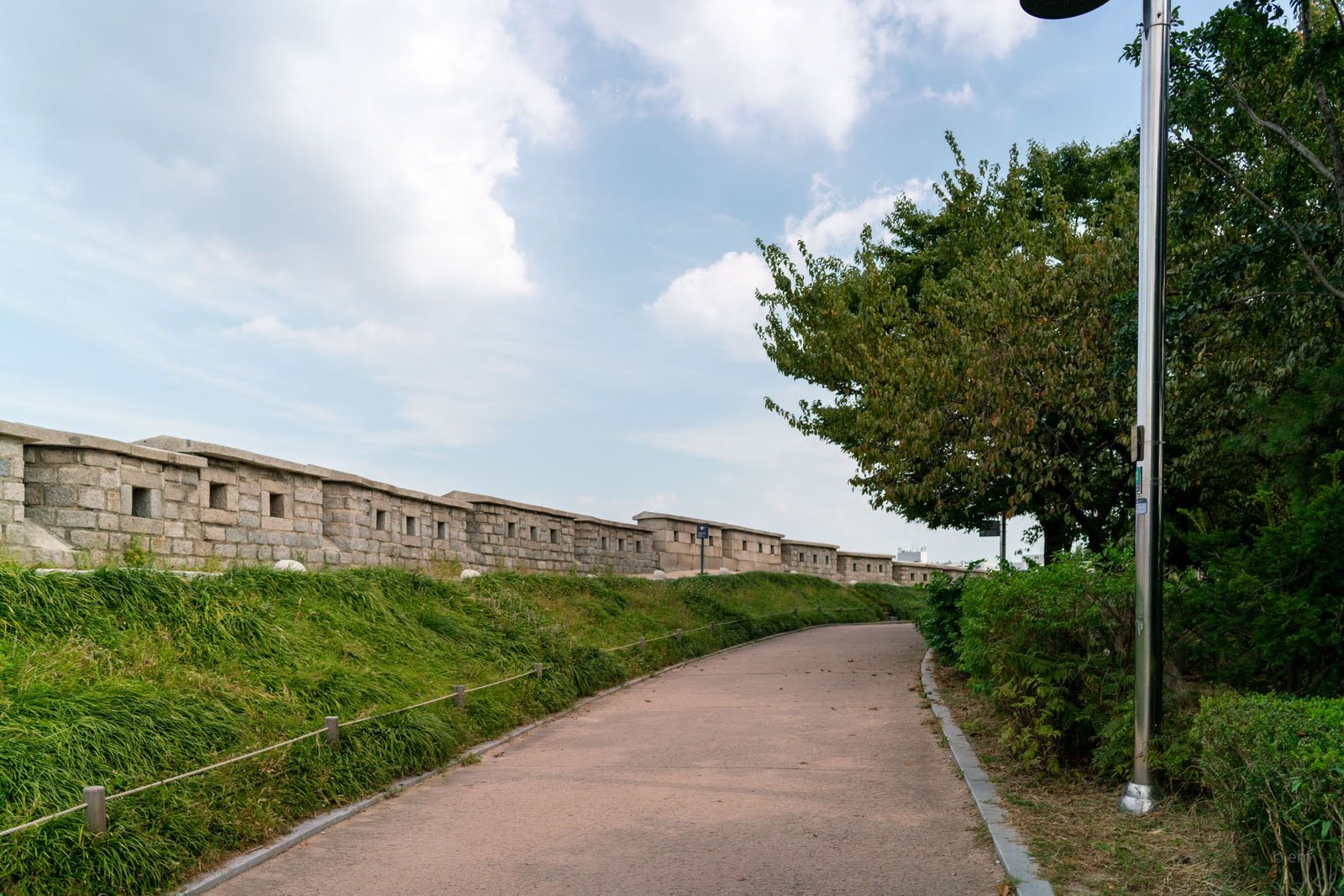
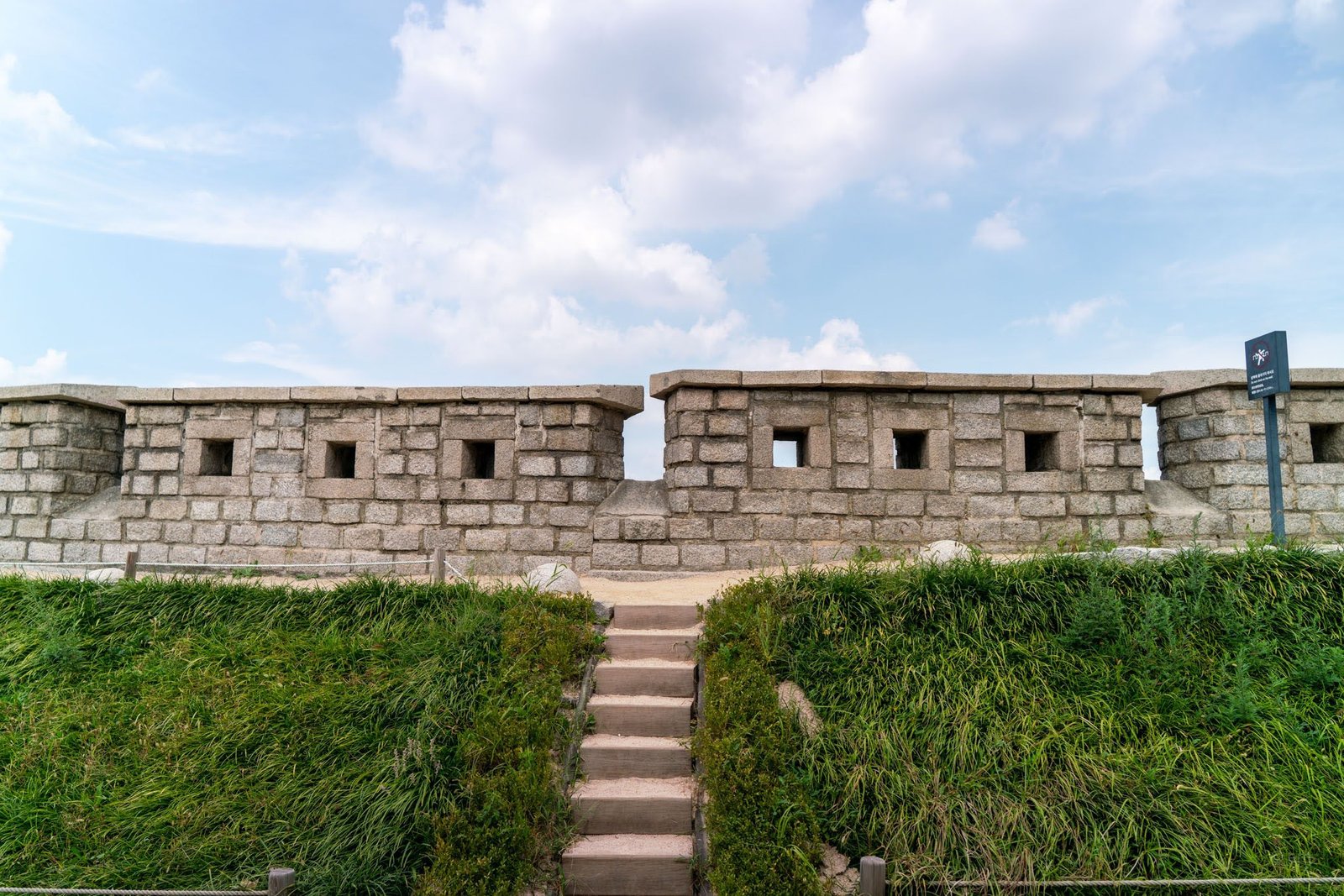
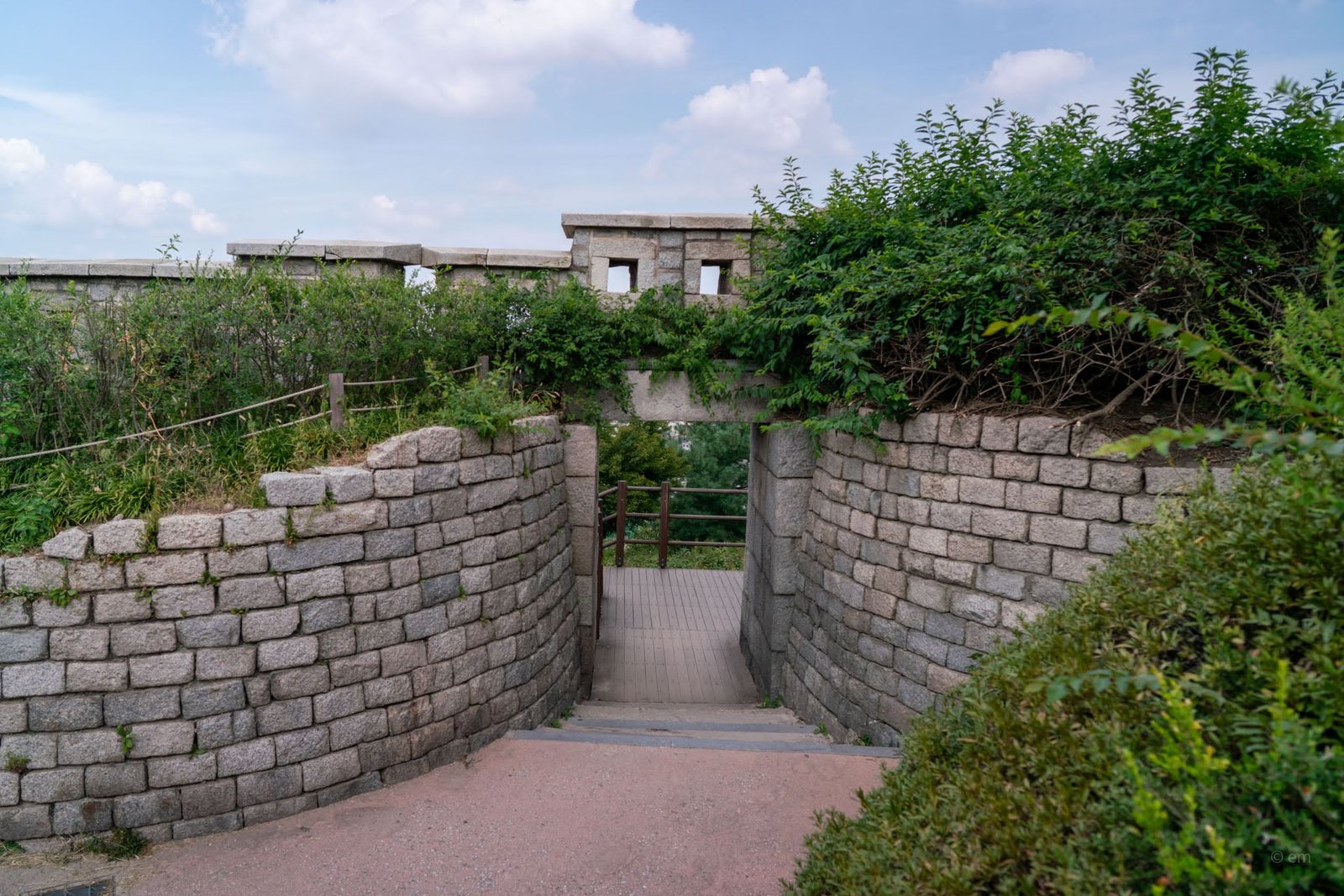
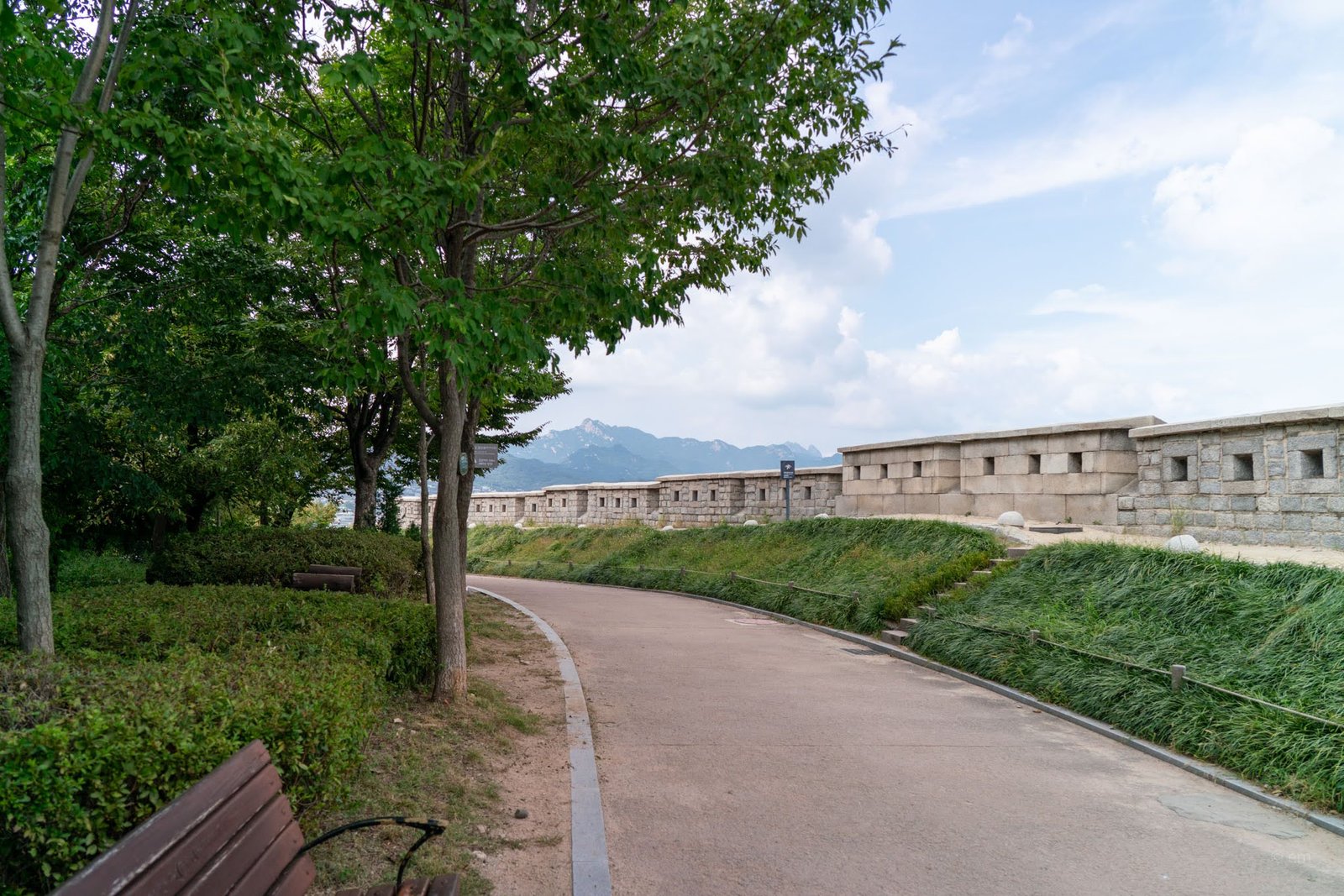
The trail(Seoul Hanyangdoseong-gil Trail Course 2: Naksan Section) runs from Hyehwamun Gate down through Naksan Park to Heunginjimun, covering about 2.1 kilometers. It is the most accessible stretch of the full wall circuit — low difficulty, almost entirely paved, well-maintained — and the views it opens onto are quietly spectacular. From the upper reaches of Naksan, the wall stretches away in both directions, its crenellated battlements stepping down the hillside in long even rows, the squared arrow-slit openings punched through at regular intervals. To the north and northwest, the jagged granite peaks of Bugaksan and Bukhansan rise above the cityline. Below, Seoul extends in every direction without interruption.
The wall here reflects three distinct building eras, readable in the stonework itself: the smaller, rounded stones of the Taejo-era original; the more uniform rectangular blocks laid during King Sejong’s mid-15th century refurbishment; and the large, dressed stone slabs of King Sukjong’s 1704 restoration. What the trail offers, then, is not a single monument but a palimpsest — the same wall, rewritten over and over, still standing.
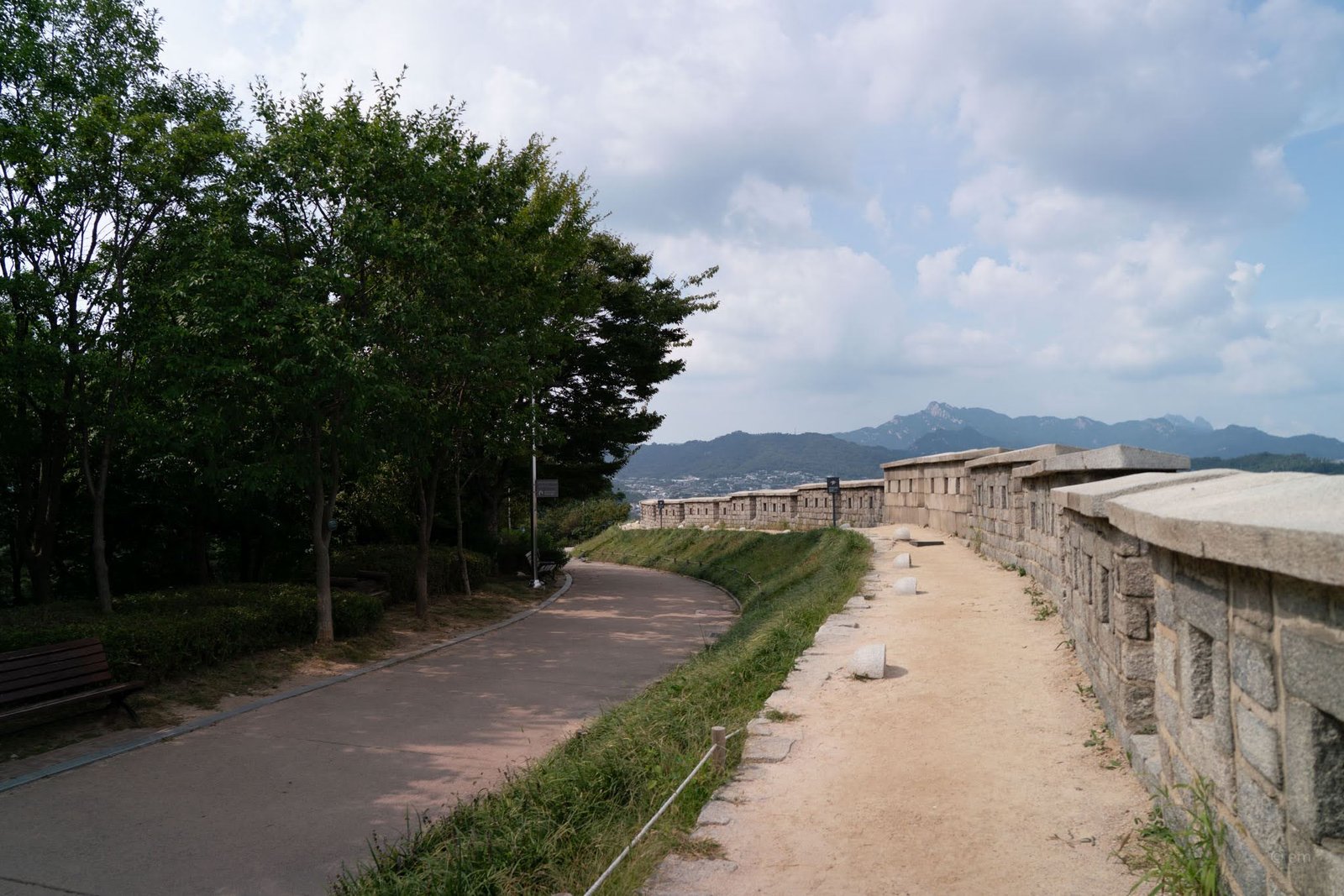
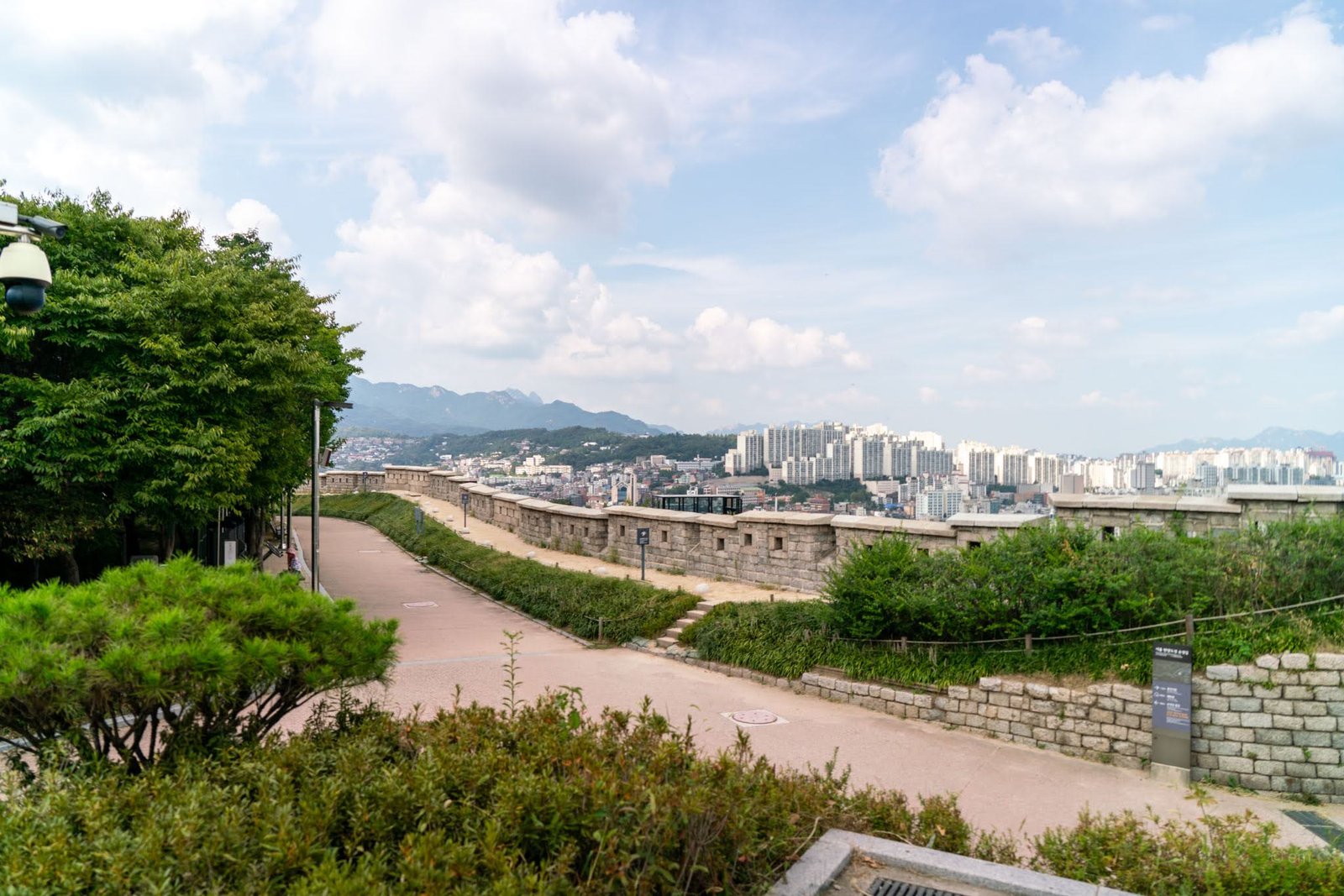
The wall’s particular quality — old stone, open sky, city below — recently drew a different kind of attention. Naksan Park and the fortress trail appear in KPop Demon Hunters (Netflix, 2025), the animated film that took two Academy Awards in early 2026 and became the most-watched Netflix original in history. The scene set here is one of the film’s quieter moments: a clandestine meeting between the protagonist Rumi and her love interest Jinu, the city spreading out beneath them. It’s easy to see why the location read as right. The wall has always had a quality of in-between — neither fully inside the city nor outside it, a threshold that has been a threshold for six centuries.
The Descent
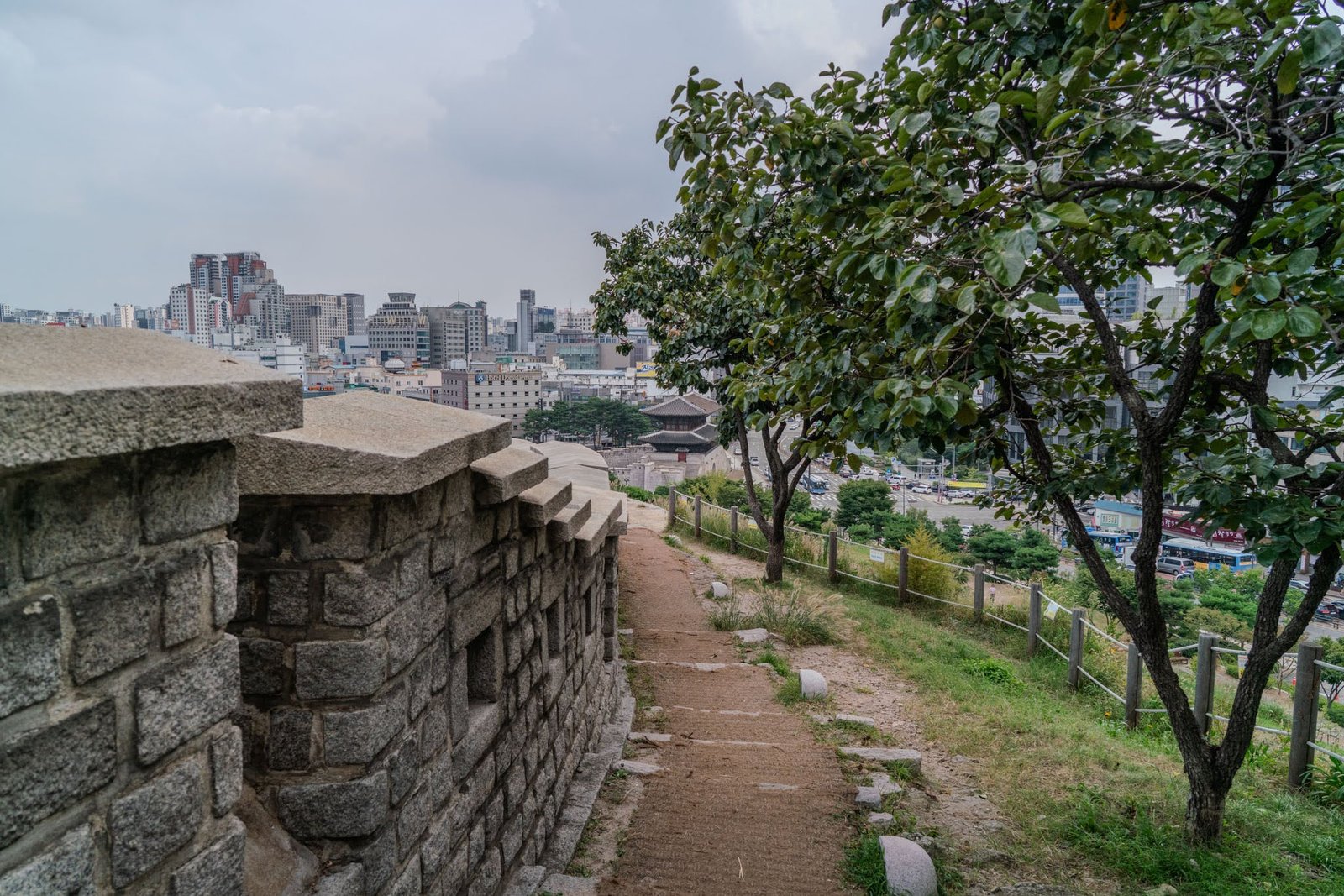
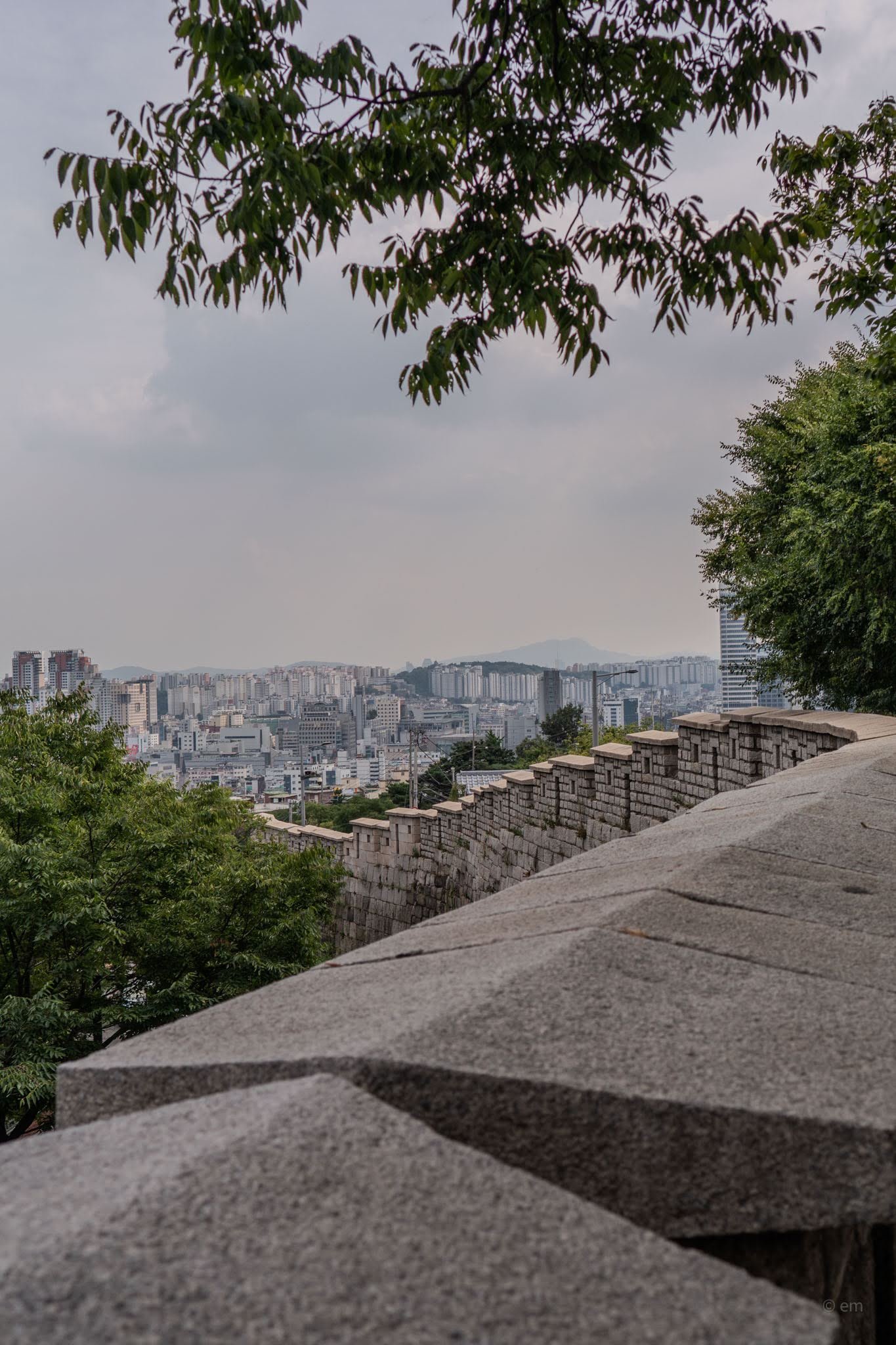
From the higher ground of Naksan the trail curves downward, the city pressing in more closely on both sides. The path runs between the wall and a ribbon of park — benches under broad-leafed trees, the occasional information marker — and the sensation shifts from hilltop to corridor. The wall’s interior face is visible from the walking path, lower and more austere than the outer face, the sandy ground between path and wall left deliberately sparse.
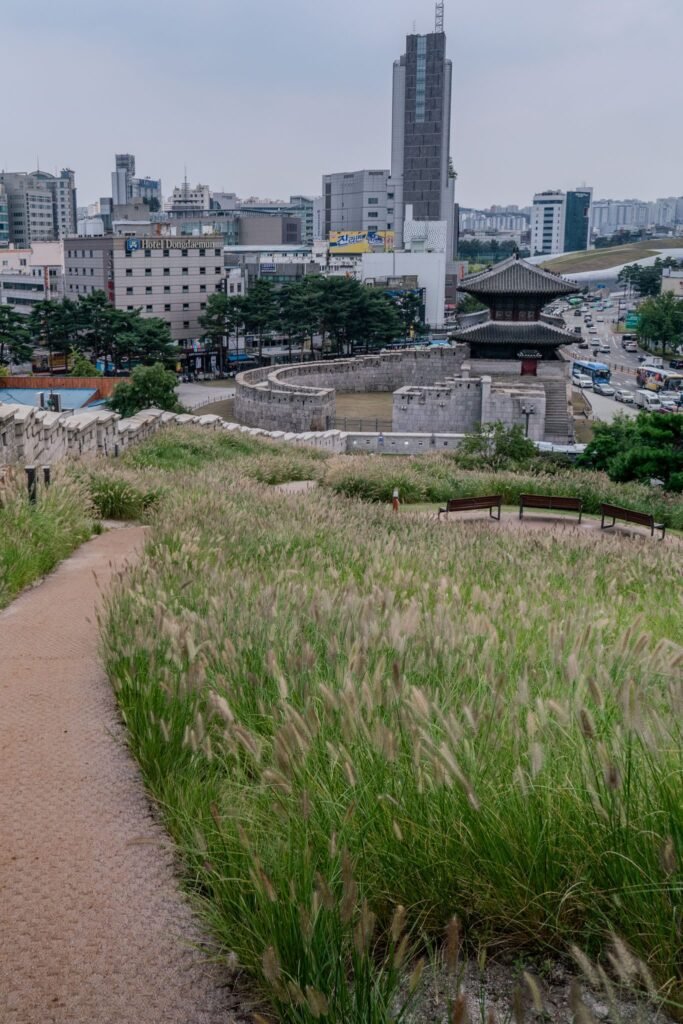
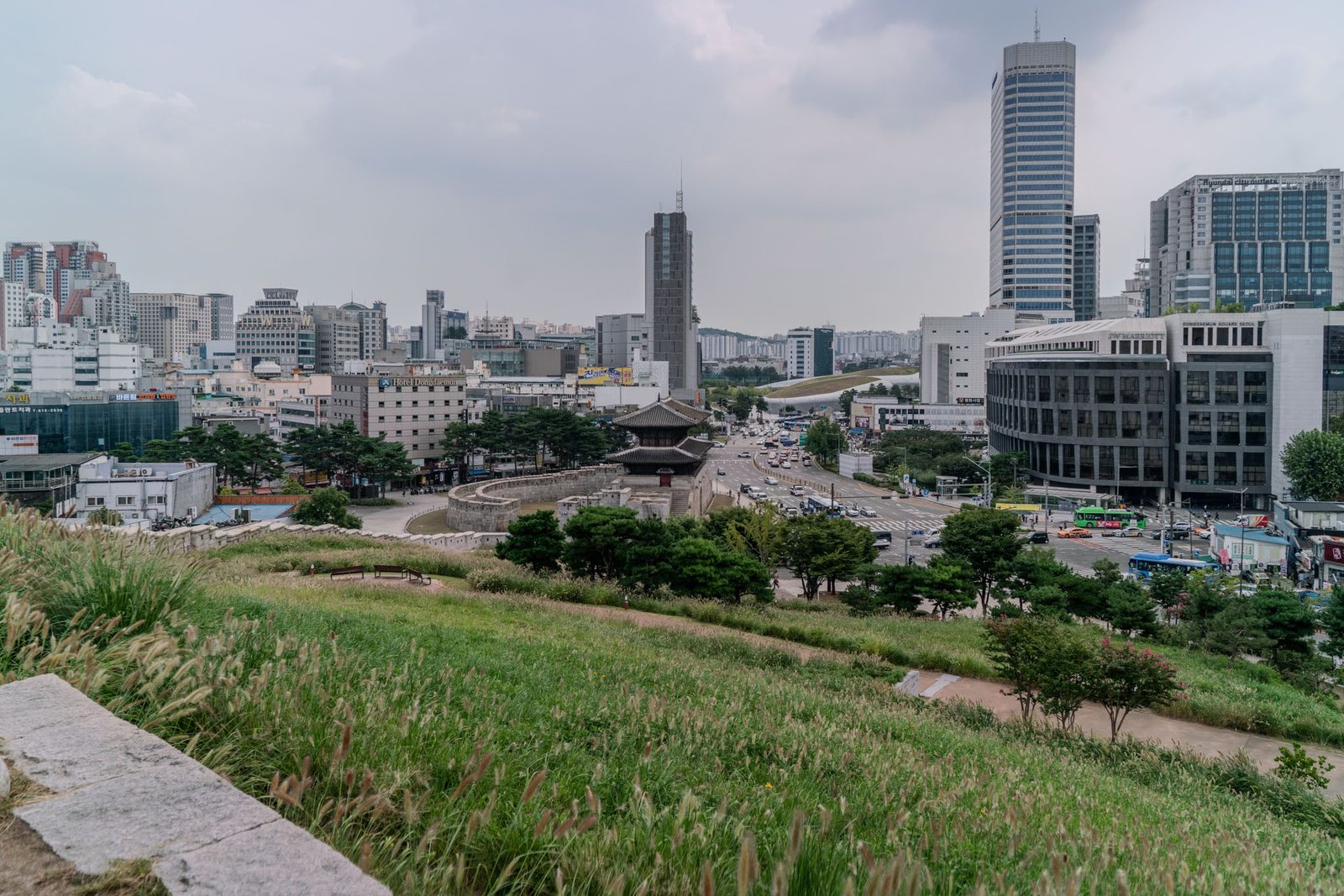
At a certain point in the descent, a turn in the wall opens a view down over the Heunginjimun gate compound, the roofline of the two-story pavilion visible below and, beyond it, the Hotel Dongdaemun sign, the DDP’s white curve, the stack of towers that constitutes the Dongdaemun skyline. The juxtaposition is particular to this city: the gate standing in its roundabout island, traffic circling it, the wall extending uphill from it toward where you’re standing.
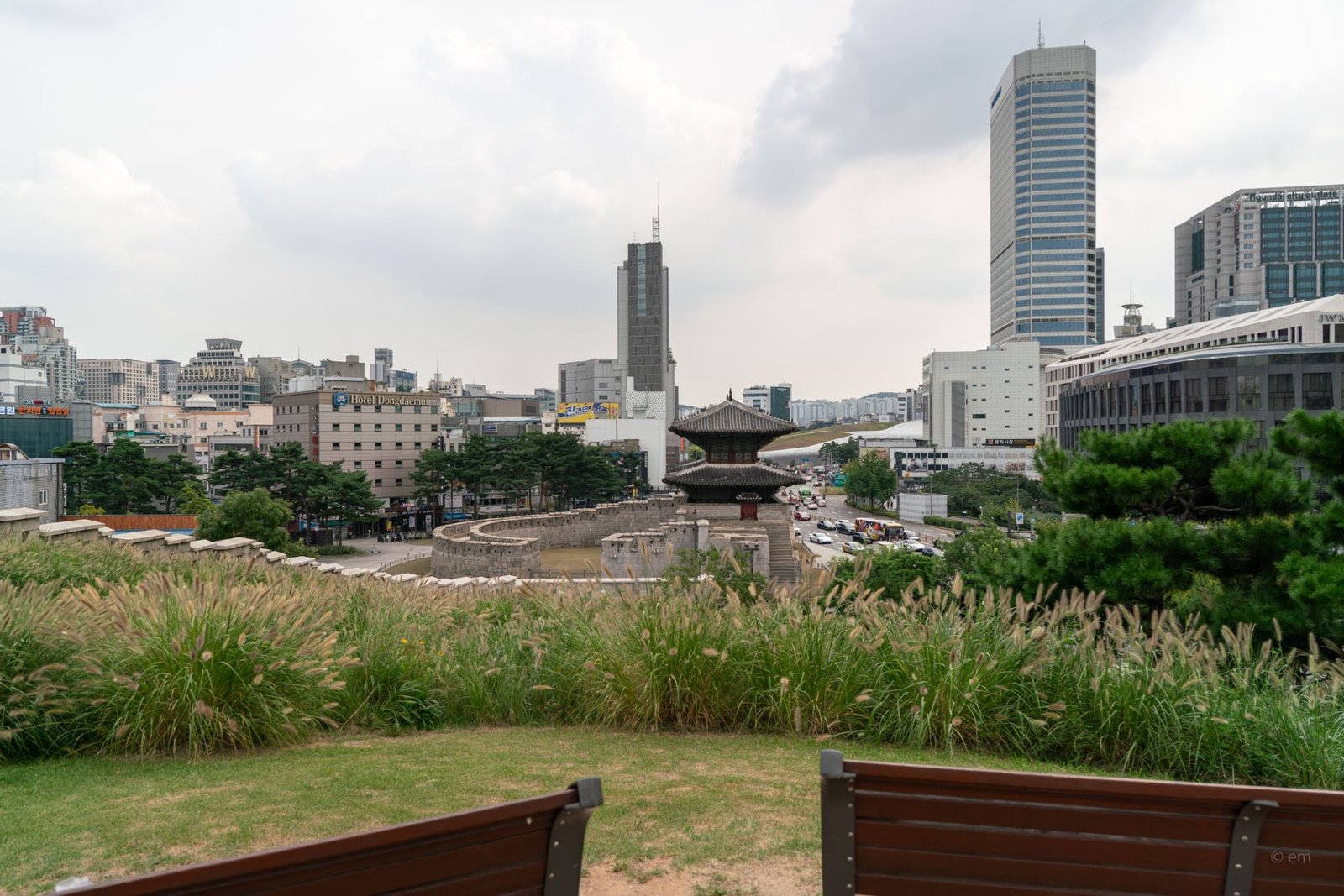
Heunginjimun and the Ongseong
The current structure of Heunginjimun was rebuilt in 1869, under King Gojong, showing the architectural style of the late Joseon period. It is designated as Treasure No. 1 by the Korean government. The gate’s formal name — Heunginjimun, meaning “Gate of Rising Benevolence” — carries a deliberate energy: the character ji was added to the name specifically to reinforce the vital energy of the land in front of the gate, a geomantic correction for what was considered a weak eastern terrain.
One of the unique factors of Heunginjimun is that it is the only gate among Seoul’s eight to have an ongseong — a half-circle-shaped outer wall built to protect the gate. This half-moon shaped stone wall forced attackers to approach in a curve, making the gate easier to defend. Seen from the hillside above, the ongseong reads clearly: a sweeping semicircular stone enclosure wrapping around the gate’s base, still intact, the geometry of a defensive calculation made in stone and still legible after 150 years. It is the only one of its kind among Seoul’s great gates.
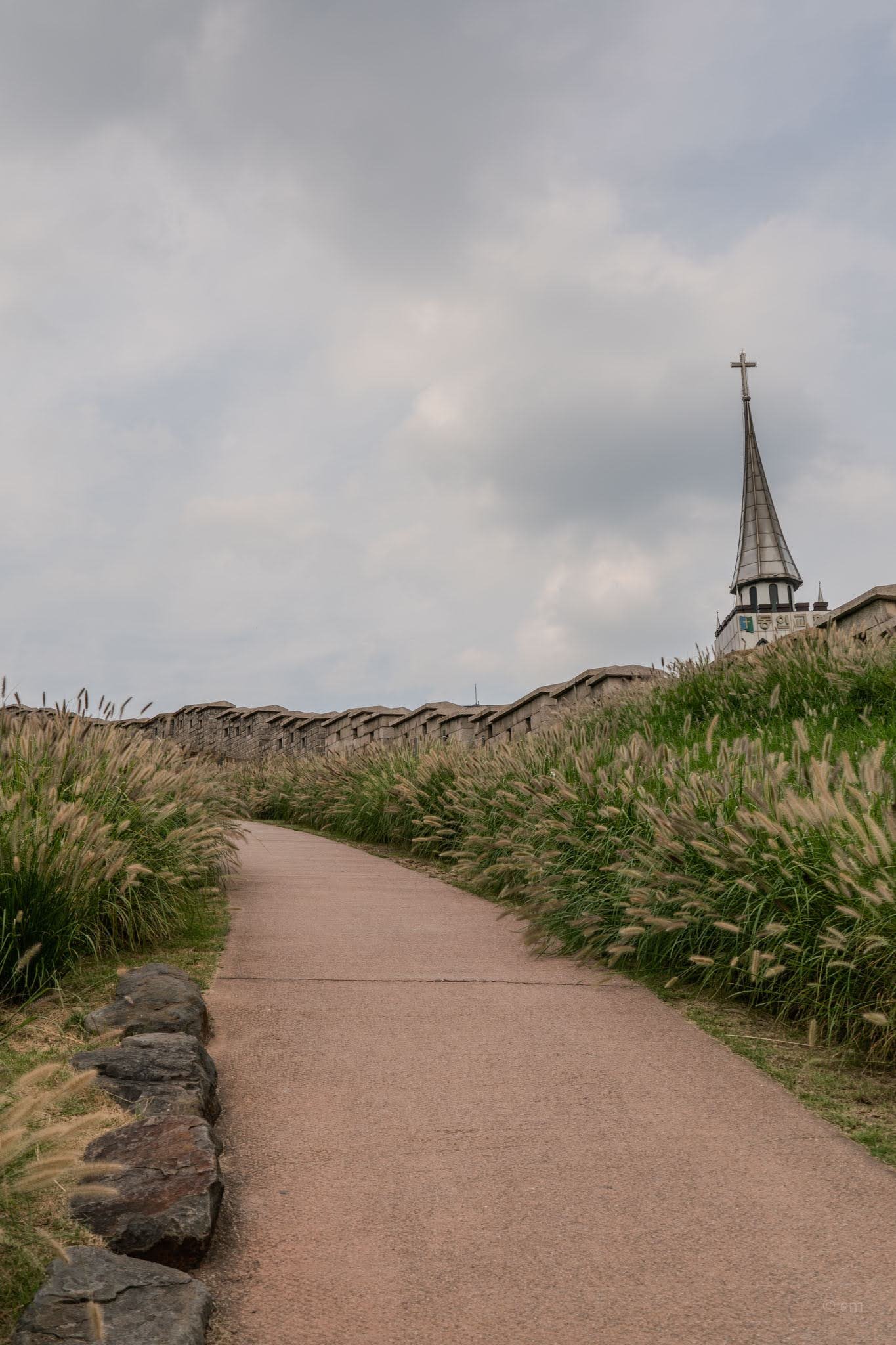
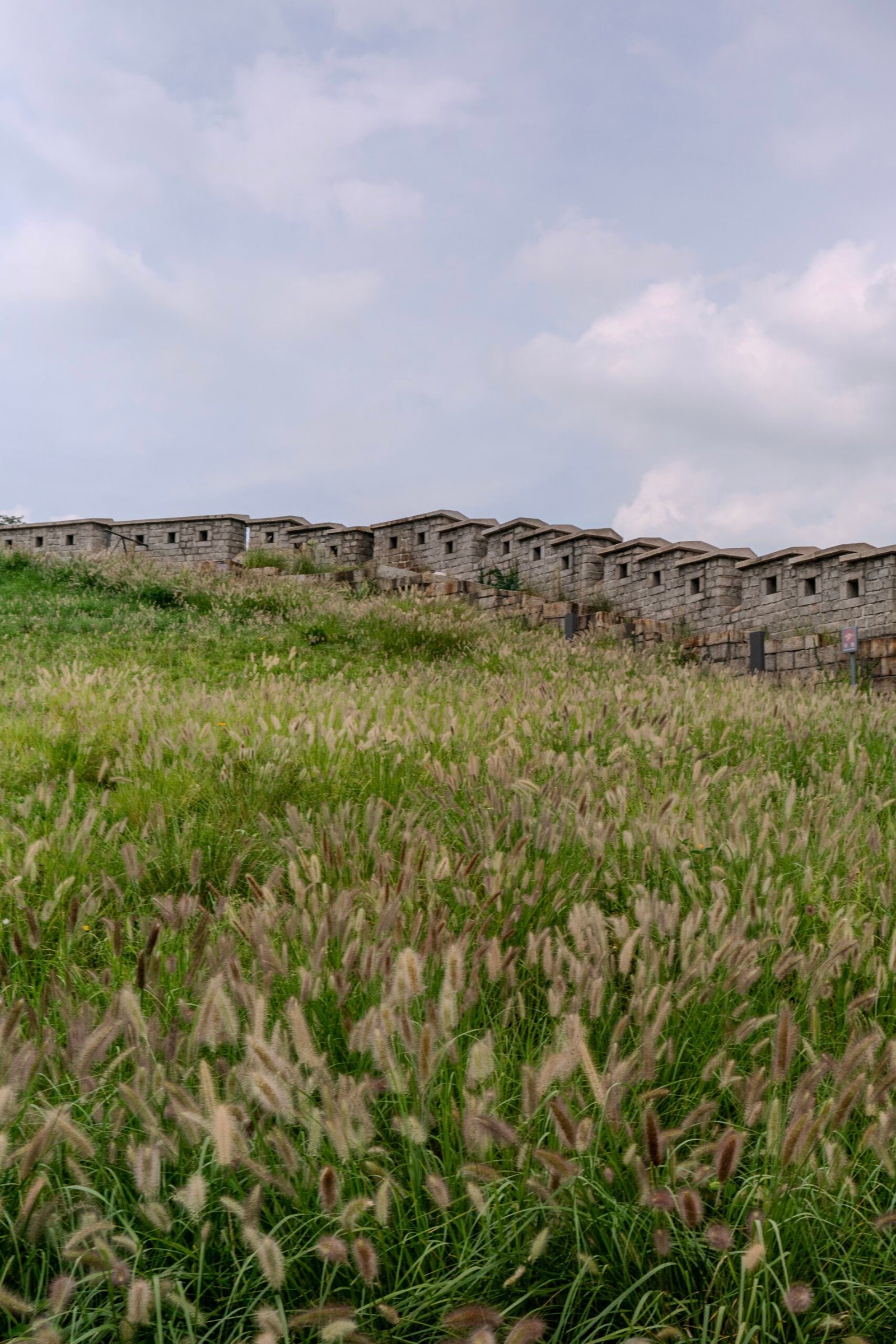
The Grass Slopes
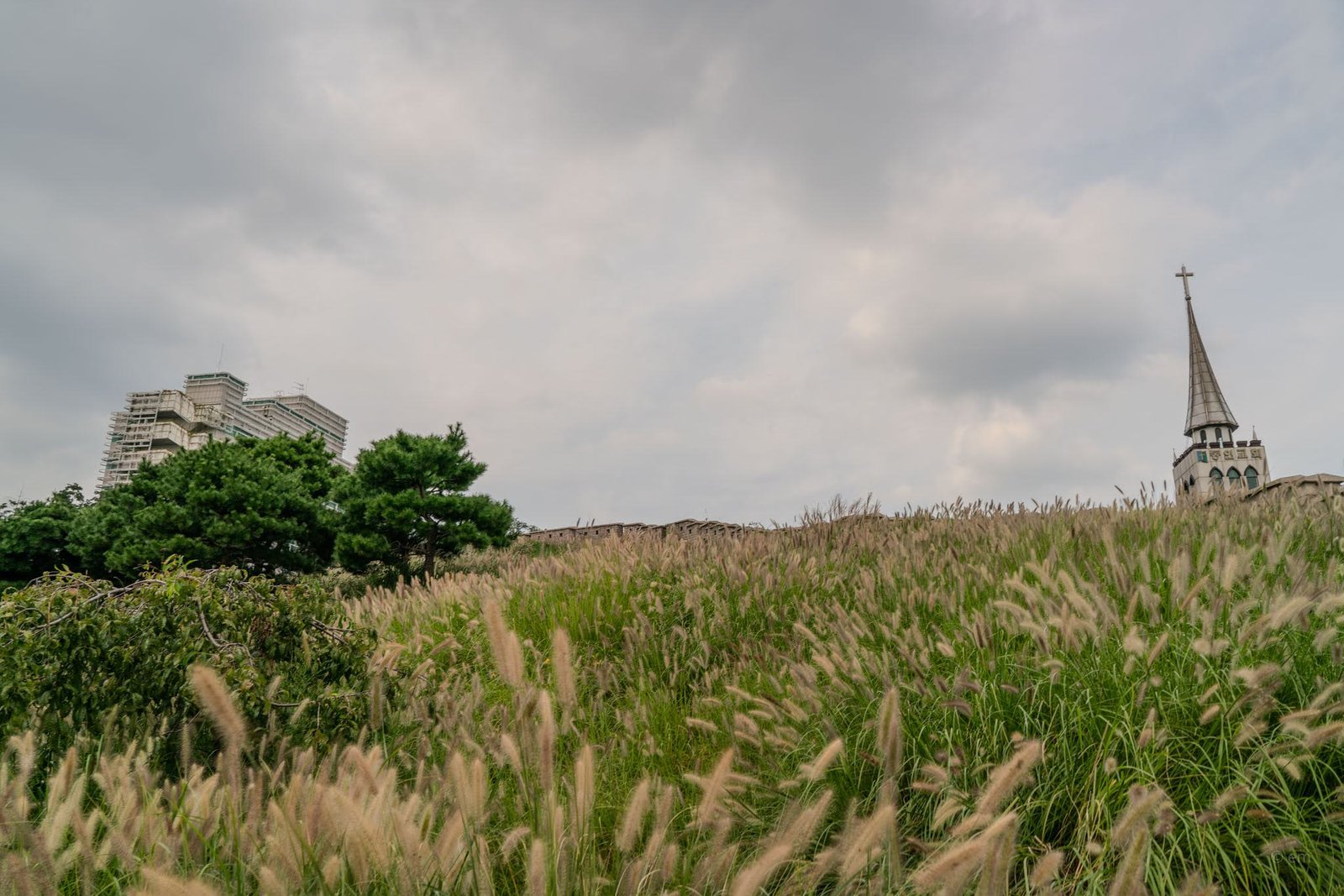
The park space surrounding the approach to Heunginjimun has its own character, separate from the wall walk itself. The inner slope between the path and the wall is planted — or left — with dense summer grass, the kind with feathery seed-heads that move constantly in any wind. Photographed from below, the wall rising behind a foreground of pale grass plumes against a grey-white sky, it looks less like a city park and less like a fortress approach than something in between: maintained wilderness, deliberate wildness. Benches at the viewing point offer a long view back toward the gate, the ongseong completing its curve in the middle distance, church steeples from the adjacent neighborhood rising over the wall’s crenellations.
The trail’s open-air quality is unusual for Seoul, not in the sense of green space — the city has parks — but in the sense of exposure. There is no interior, no café threshold, no curation beyond the path itself. The wall is simply here, and has been, and the city has grown up around it without quite absorbing it. That persistence is its own kind of presence.
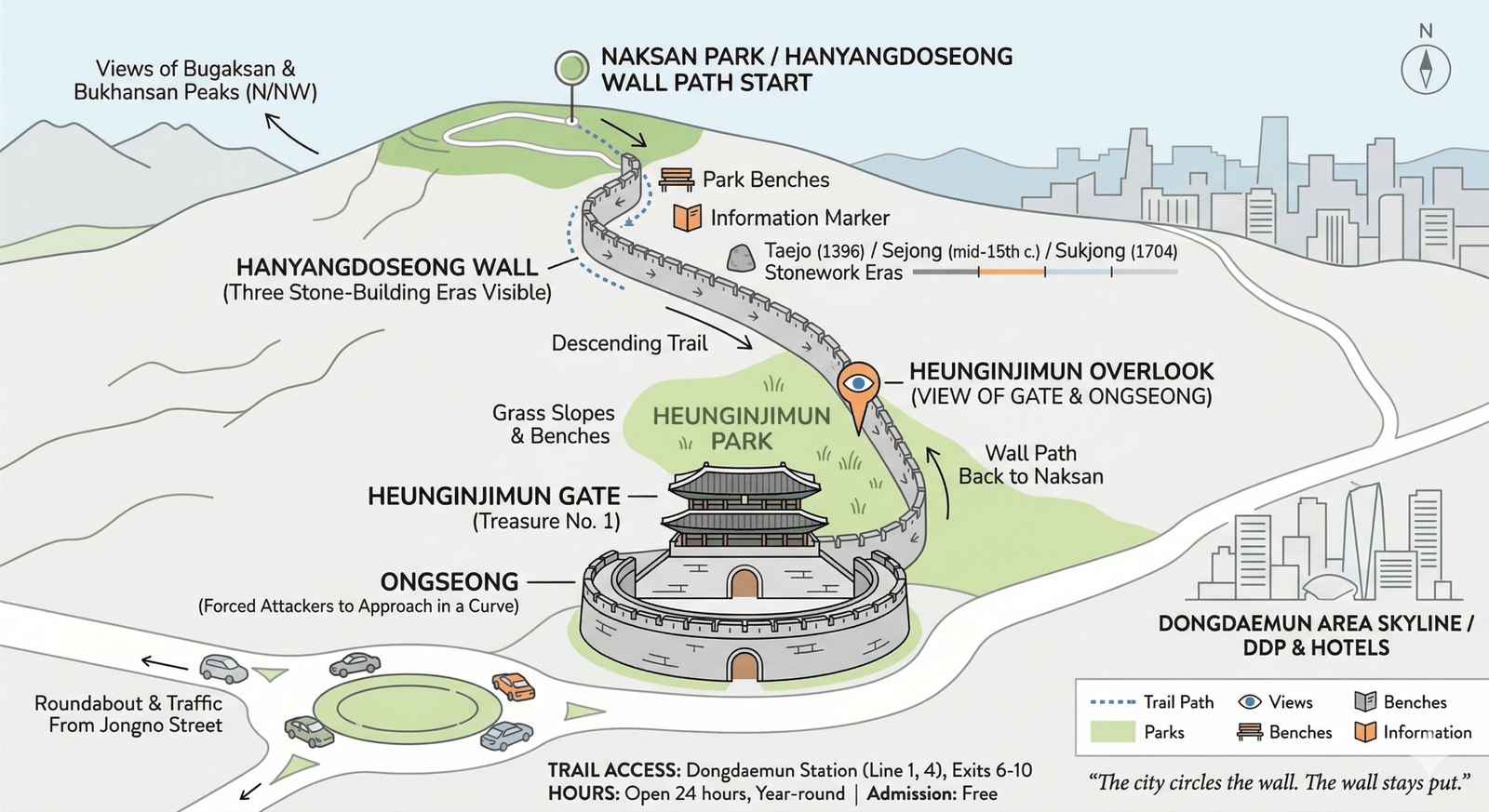
AI GENERATED IMAGE
Seoul City Wall (Hanyangdoseong) — Naksan to Heunginjimun Section Access: Dongdaemun Station, Line 1 or 4, Exits 6–10 (Heunginjimun Gate) or Hyehwamun Gate end via Exits near Naksan Park
Heunginjimun Gate address: 288 Jongno, Jongno-gu, Seoul (Jongno 6-ga intersection)
Hours: Naksan and Heunginjimun sections open 24 hours, year-round
Admission: Free
The city circles the wall. The wall stays put.