Somewhere between a Route 66 pitstop and a Suwon side street, someone decided to make coffee better.
There is a particular grammar to the American roadside. You know it the moment you see it: the low, wide building set back from the road, the oversized signage that reads from a moving car, the pole sign rising above the roofline with its stacked panels — DINER / GAS / LODGING — and some kind of sculpted shape perched at the top like a landmark you can spot a half mile out. The parking lot is generous and mostly flat. The exterior walls carry the evidence of years of accumulated signage, enamel plates for motor oil and grain companies and tire brands you half-recognize from old photographs. The door, when you finally reach it, swings open onto something warm.
This grammar exists in a specific American geography — the stretch between cities, the exits that once meant something before the interstates arrived — and it belongs, in the popular imagination, to a version of the country that runs on coffee, bagels, and early mornings. It is a visual language built from decades of roadside commerce, and it is not the kind of thing you expect to encounter in Gwonseon-dong, Suwon, behind a bus terminal, on a street where most people are just trying to park.
1059-3 Bagel & Coffee House speaks it fluently anyway.
The Name Is the Address
The name gives nothing away until it gives everything away. 1059-3 is the land address of the building on Seokwonro 166beon-gil — Gwonseon-dong 1059-3 — which means the café named itself after where it stands. Not after a feeling, not after a concept, not after a person. After a cadastral number on a government map of a mid-sized city in Gyeonggi-do.
There is something quietly radical about that. It is the kind of naming decision that refuses nostalgia even while building a space almost entirely out of it — as if the owners wanted to make sure you understood that this is a real place, not a reconstruction of somewhere else, not an approximation of an America that may or may not have existed. The address anchors it. Everything else, all the Route 66 iconography and the checkerboard tile and the diner stools, is a choice made here, in this specific spot, by people who live twenty minutes from Suwon Hwaseong Fortress.
What Stops You First
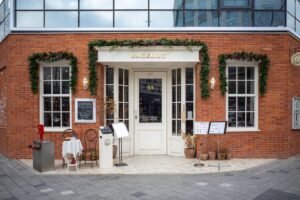
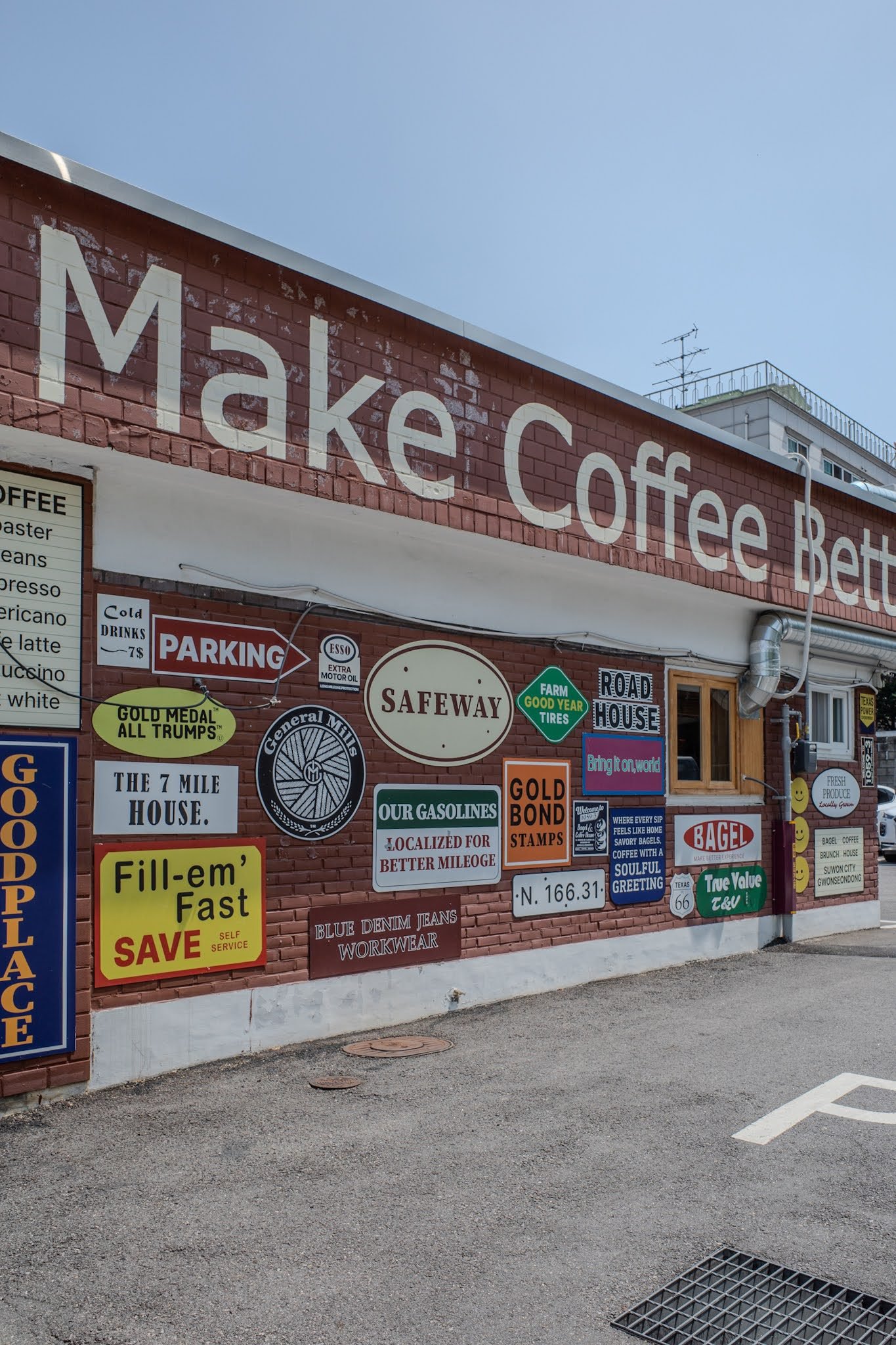
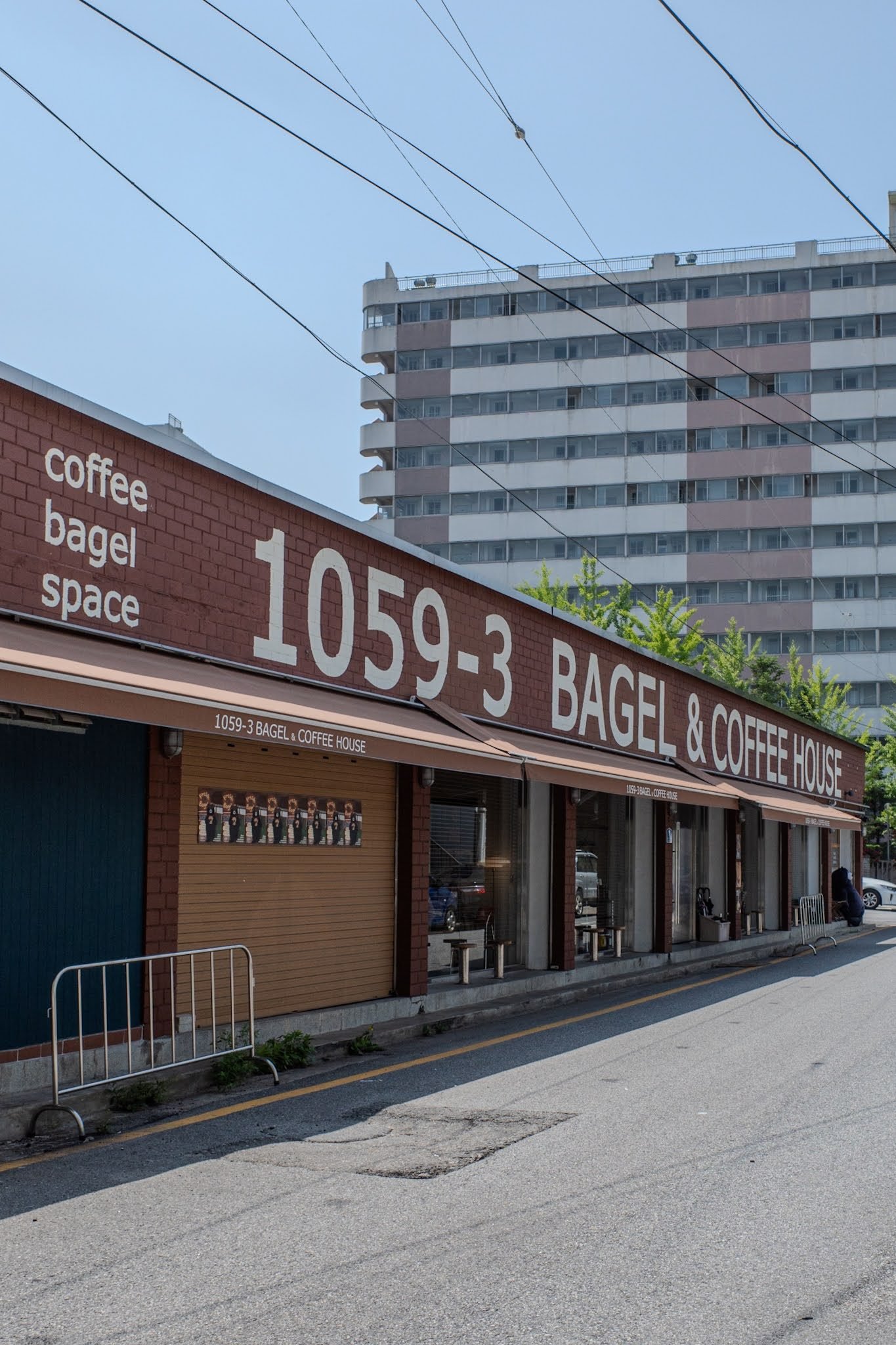
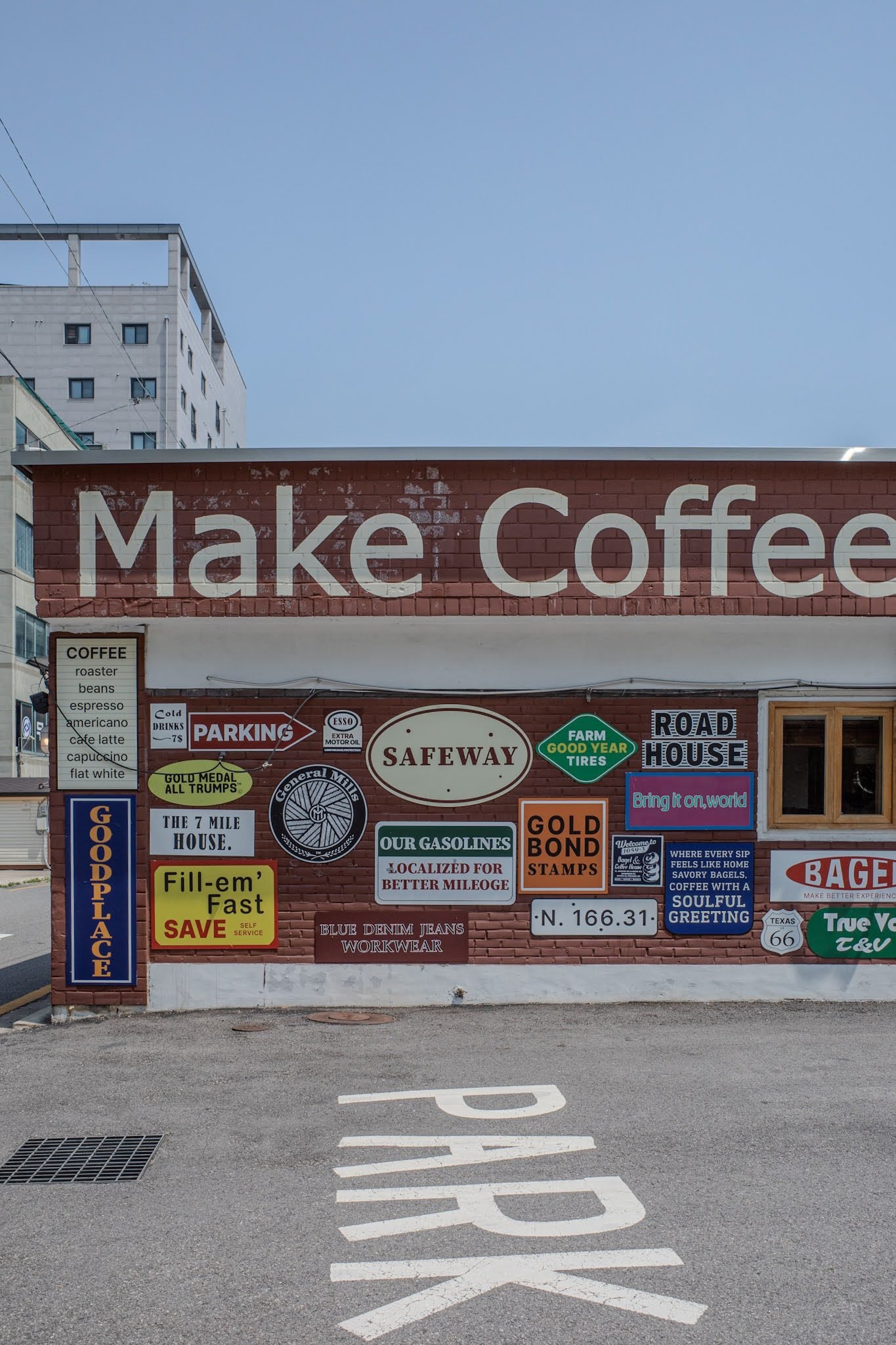
The building is long and low, its red-brick face running the width of the lot in a way that feels more like a commercial strip than a café. Painted white across the full roofline, in letters large enough to read from across the road: MAKE COFFEE BETTER. Below that, the official signage — 1059-3 BAGEL & COFFEE HOUSE — and to one side, in quieter text: coffee / bagel / space.
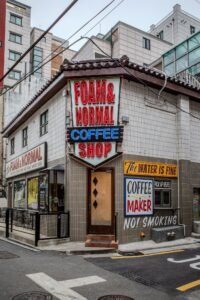
The side wall is where the Americana fully arrives. Vintage enamel signs — Safeway, Esso, Goodyear, General Mills, Route 66 Texas 66, Gold Bond Stamps, a dozen others — are mounted directly to the brick in the casual density of a roadside building that has been accumulating signage for forty years. Fill-em Fast. Our Gasolines. Road House. The signs reference a commercial landscape that has largely disappeared in the country that produced it, and here they exist as pure composition, a wall of American vernacular graphic design installed in a Suwon parking lot with complete conviction.
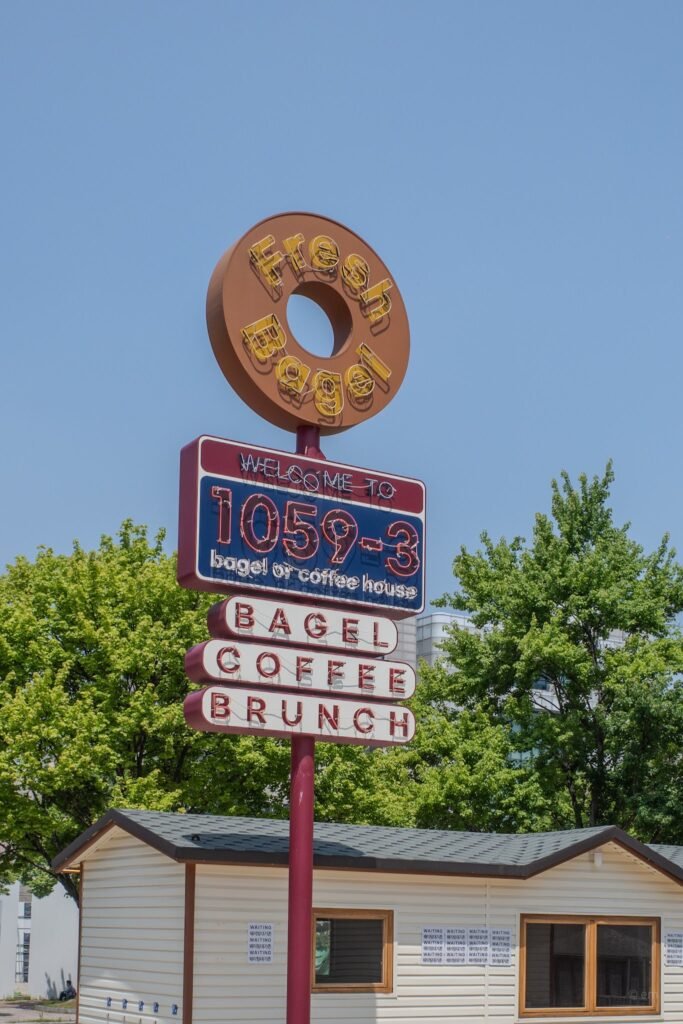
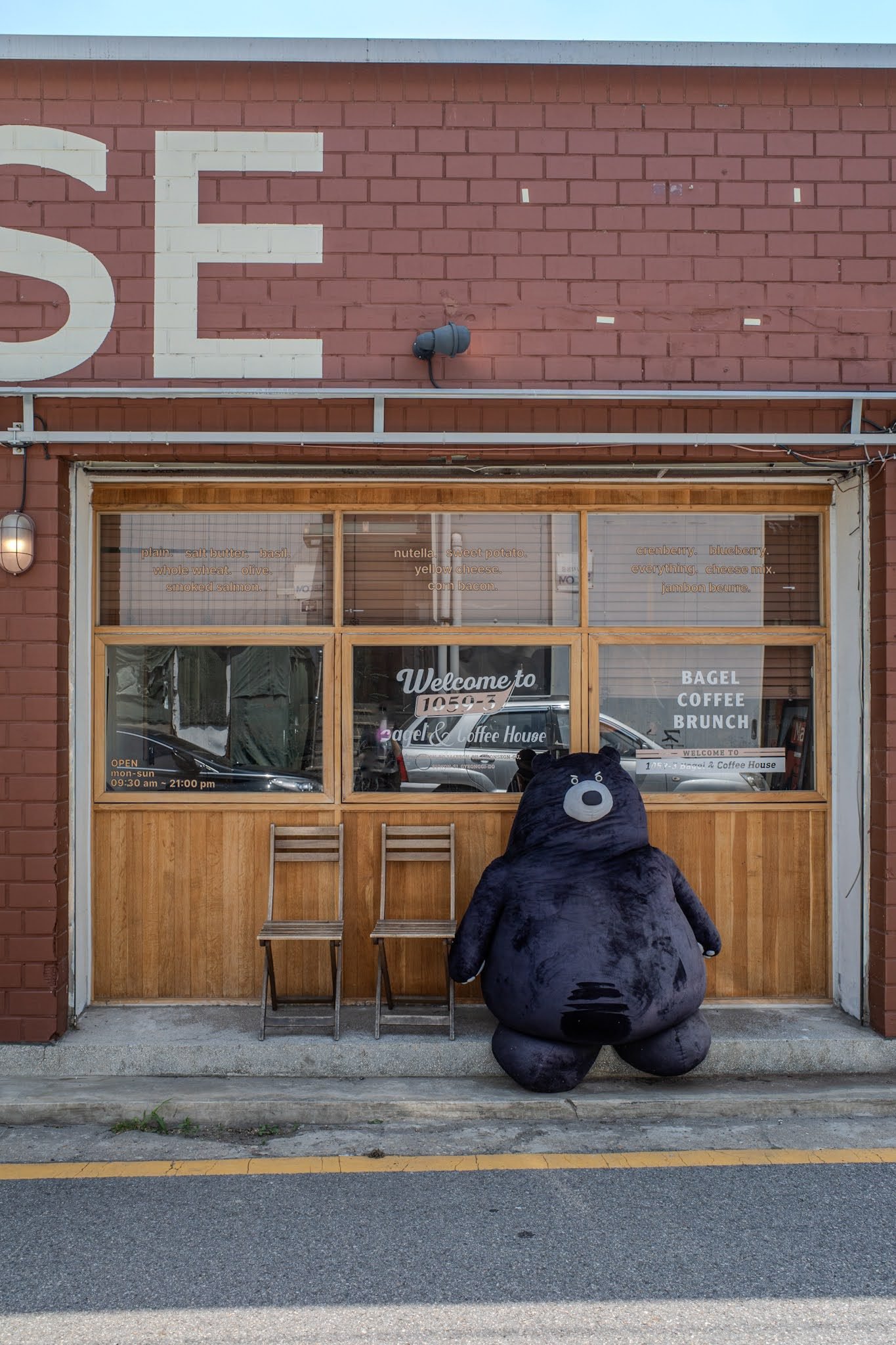
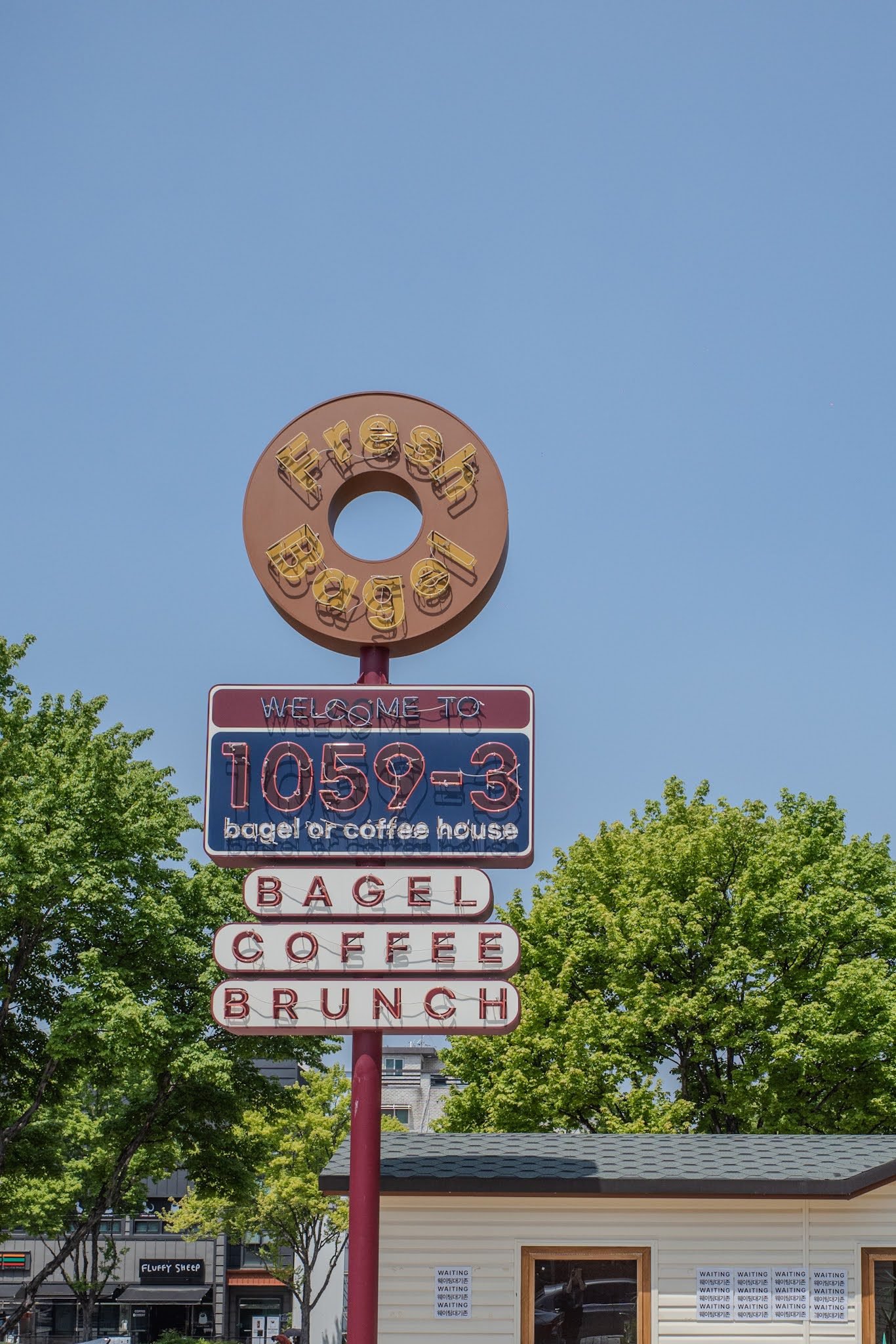
Out front, the pole sign is the centerpiece. A large sculpted bagel in neon sits at the top, “Fresh Bagel” rendered in yellow script around the ring. Beneath it, panels in red-bordered roadside type: BAGEL / COFFEE / BRUNCH. Below the building name, smaller panels: Welcome to 1059-3 / bagel & coffee house. Waiting huts — low, white, wood-framed structures — flank the entrance, their windows stickered with opening hours and notices. An oversized black bear sits propped at the door as if it arrived early and decided to wait.
The Main Hall
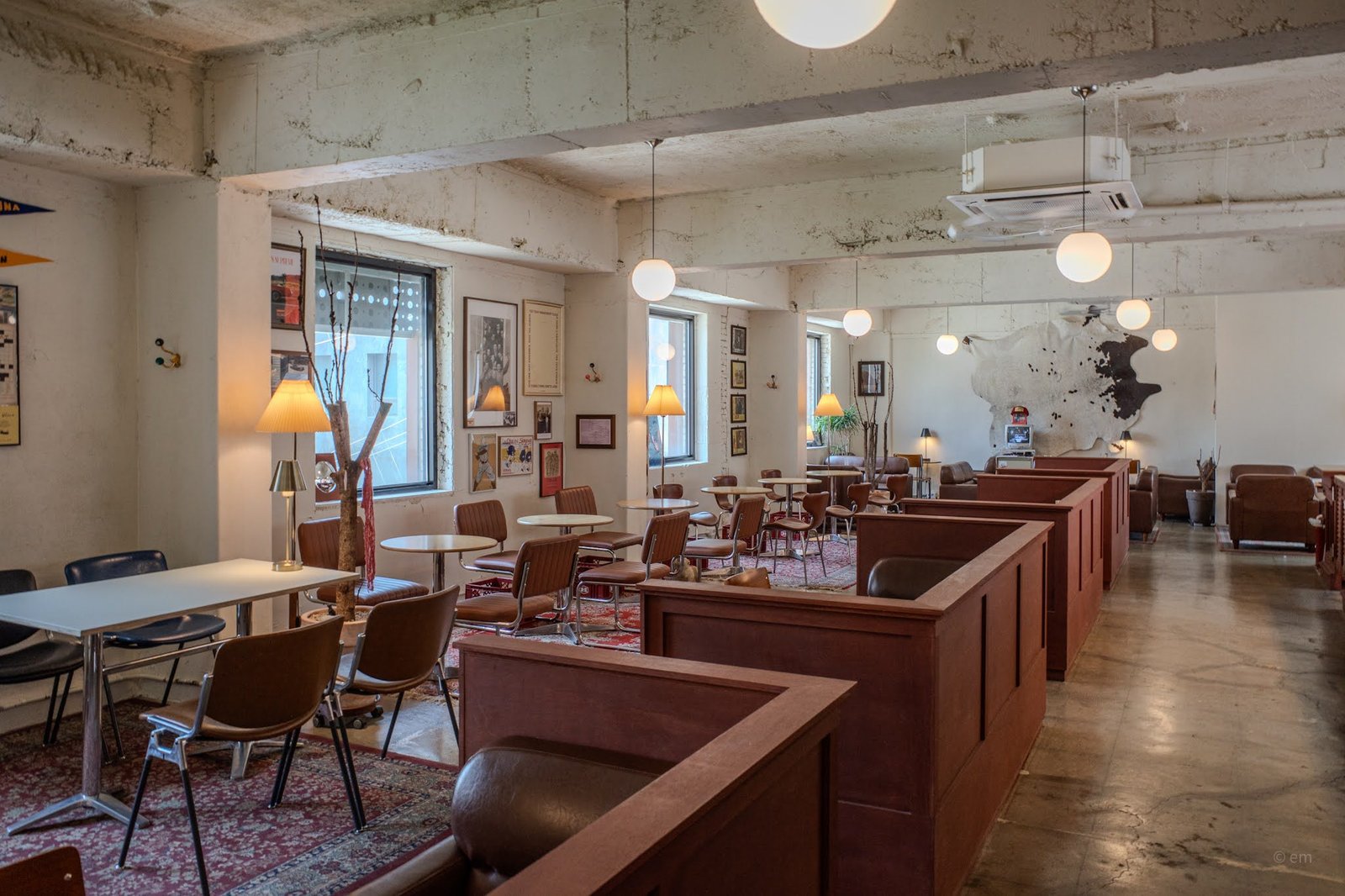
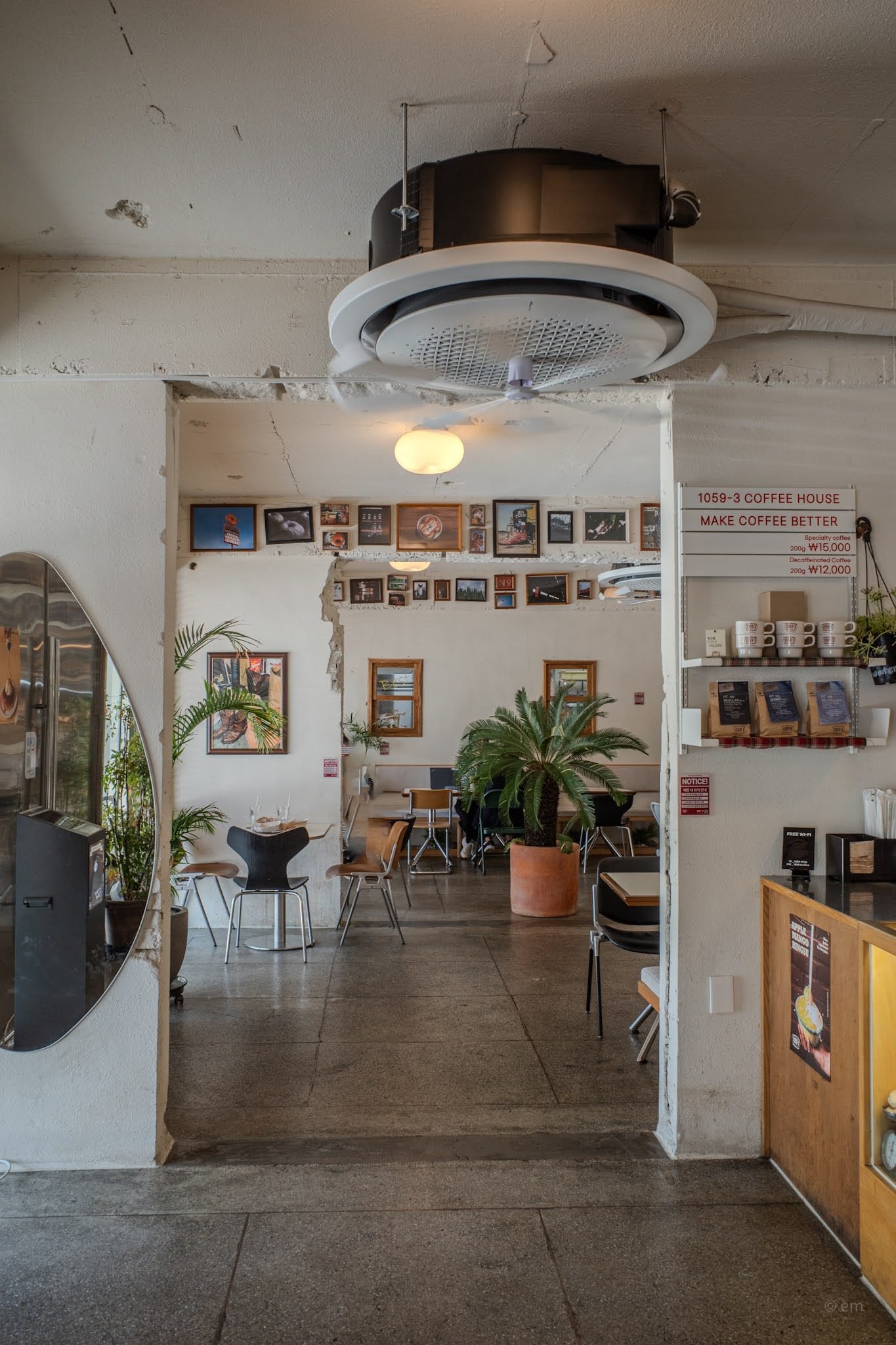
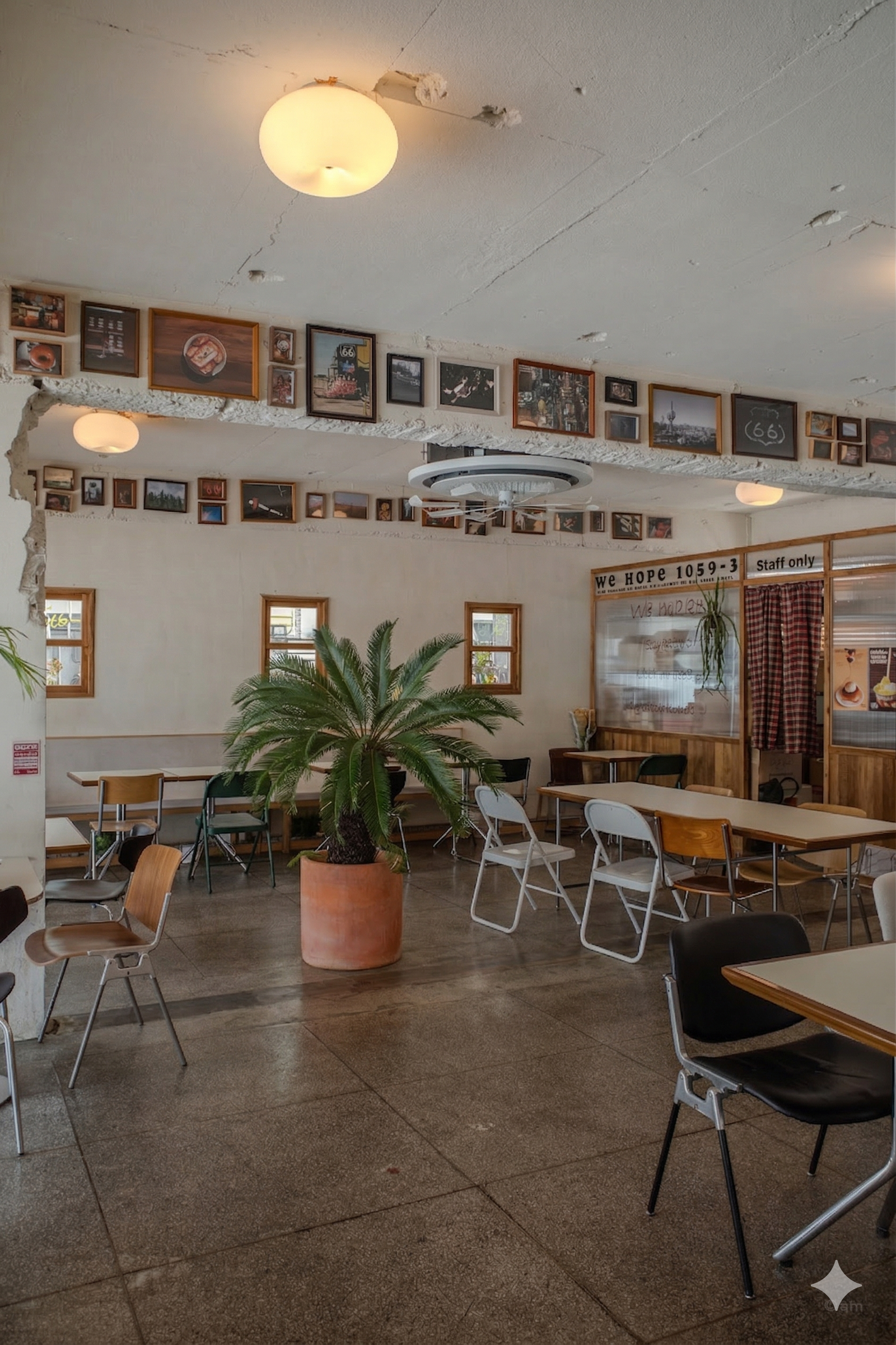
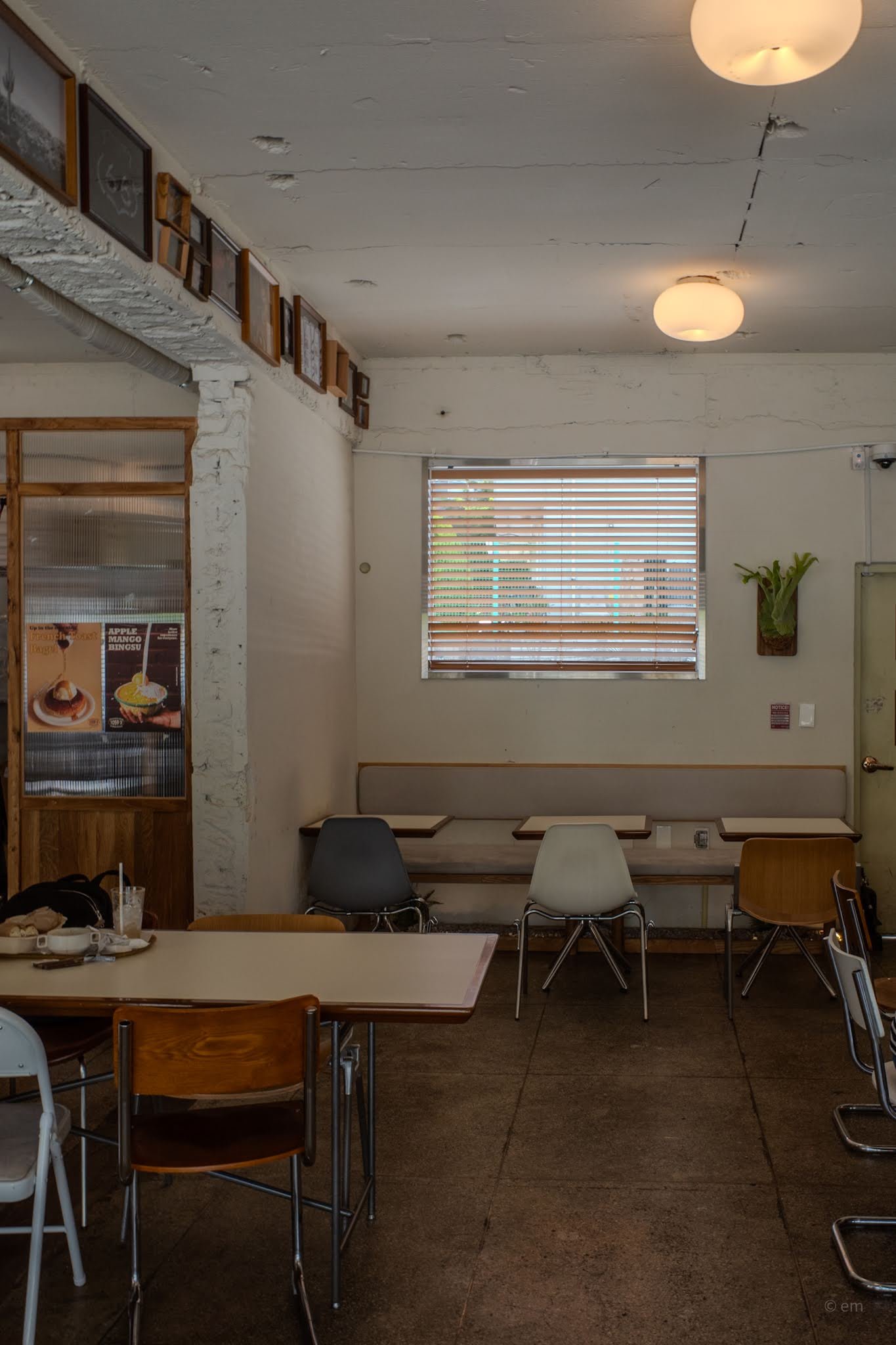
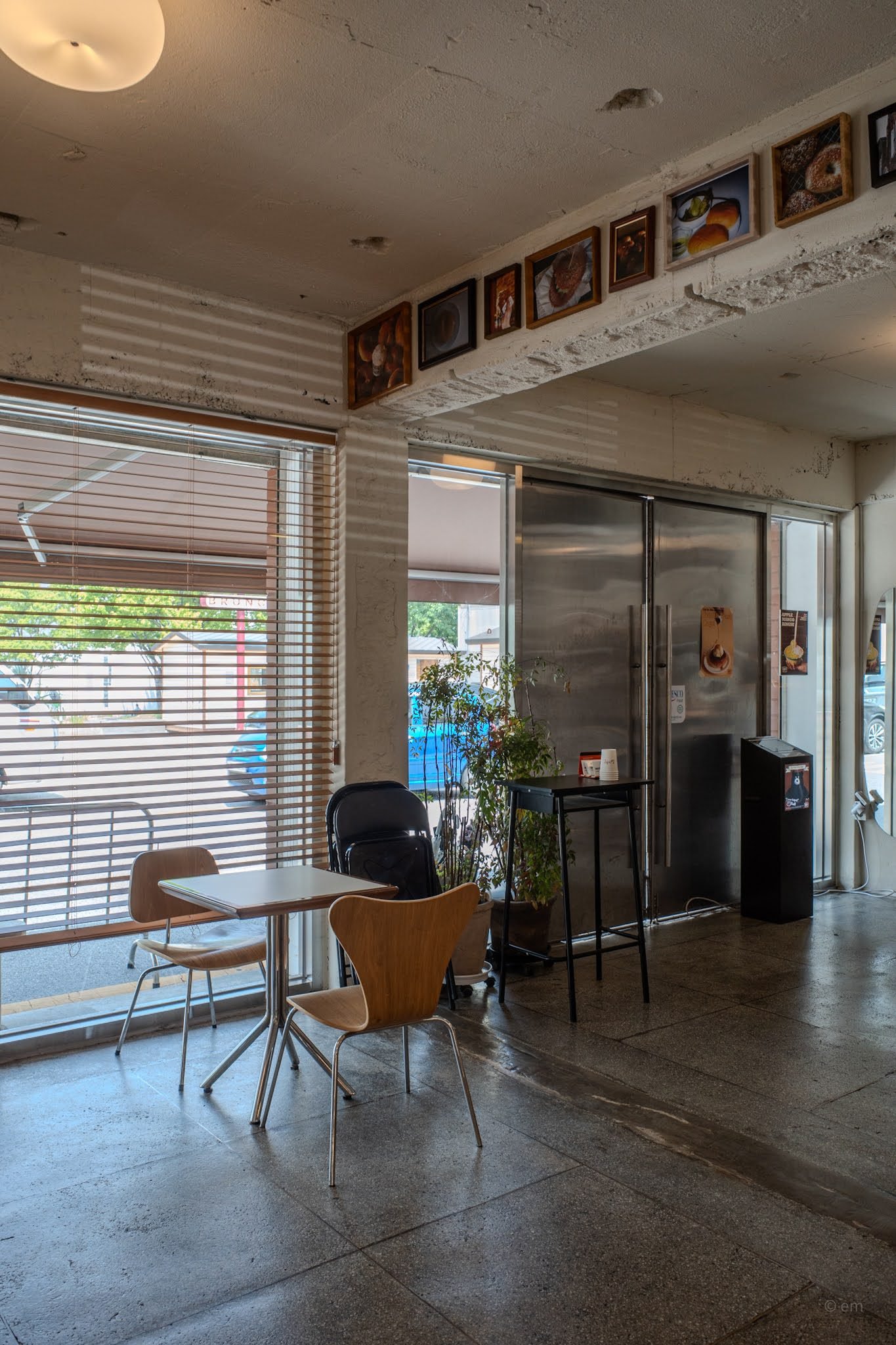
Inside, the space opens wide and high. The floors are laid in large grey terrazzo tiles. The ceiling is cracked plaster, its imperfections left exactly as found, lit by round globe pendants that glow warm without trying to be atmospheric about it. The chairs are mismatched in the specific way that suggests accumulation rather than curation — folding metal chairs, bentwood café chairs, black office chairs, a few pieces that look lifted from a school canteen — arranged around plain rectangular tables in the unhurried configuration of a room that has been rearranged many times and settled into whatever worked.
Along every beam, in continuous running rows, framed photographs document a world of American diner culture, road trips, coffee, and bagels. The frames vary in size and finish — some raw wood, some darker wood, some ornate — which gives the installation the feeling of an ongoing project rather than a finished one. A large potted cycad palm presides near the center of the hall, its spiky crown at eye level, its terracotta pot on the bare floor. On the back wall, stenciled in simple block type: We Hope 1059-3 / Bagel & Coffee House.
This room is the café’s public face — the wide space where groups eat and strangers share tables — and it carries the casualness of an old diner that stopped caring about interior design sometime in the late eighties and never looked back. The cracked ceiling and the mismatched chairs are not studied imperfection. They are just the building, and the building is fine.
The Diner Room
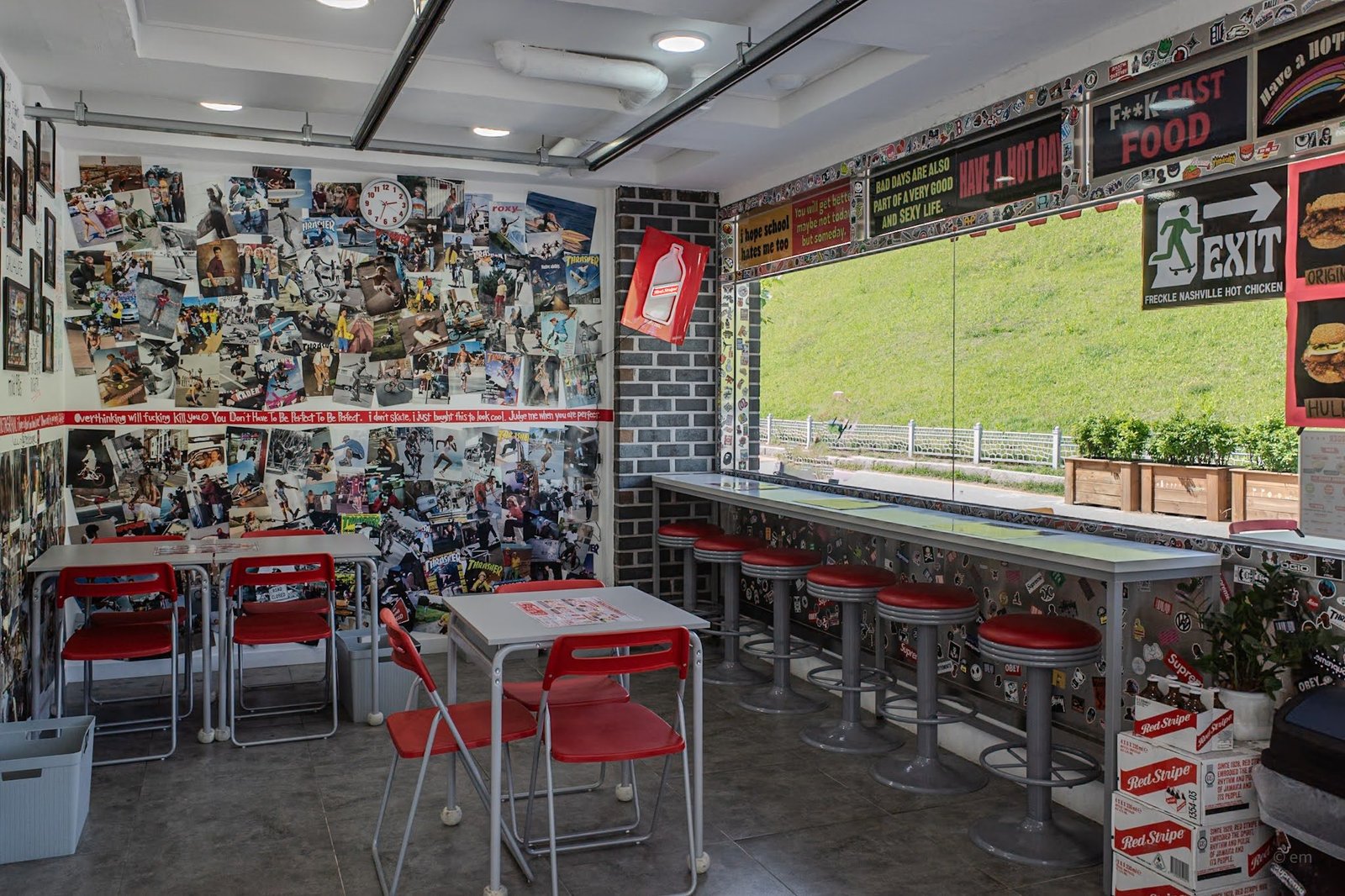
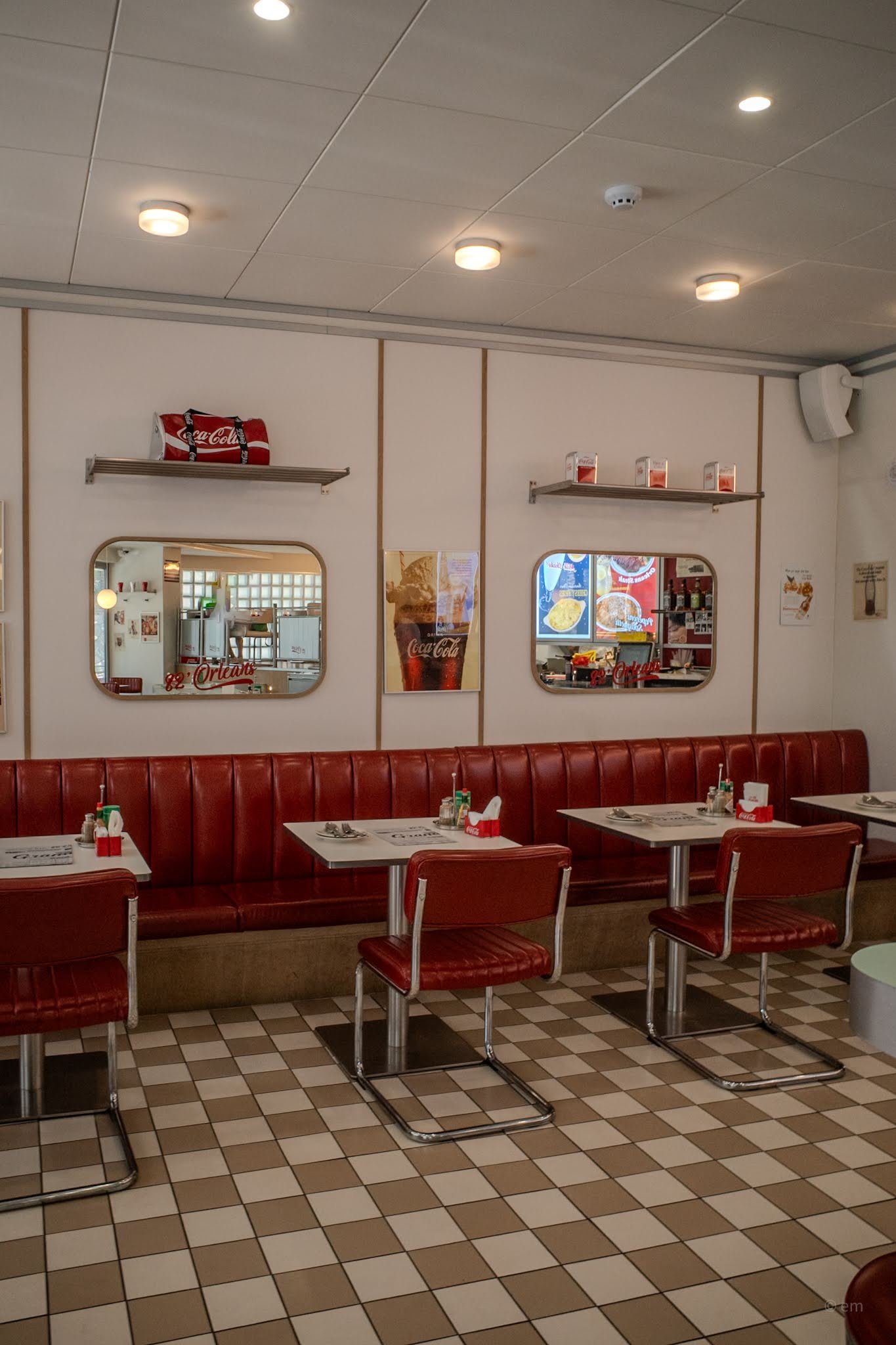
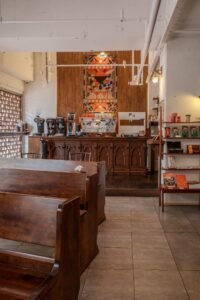
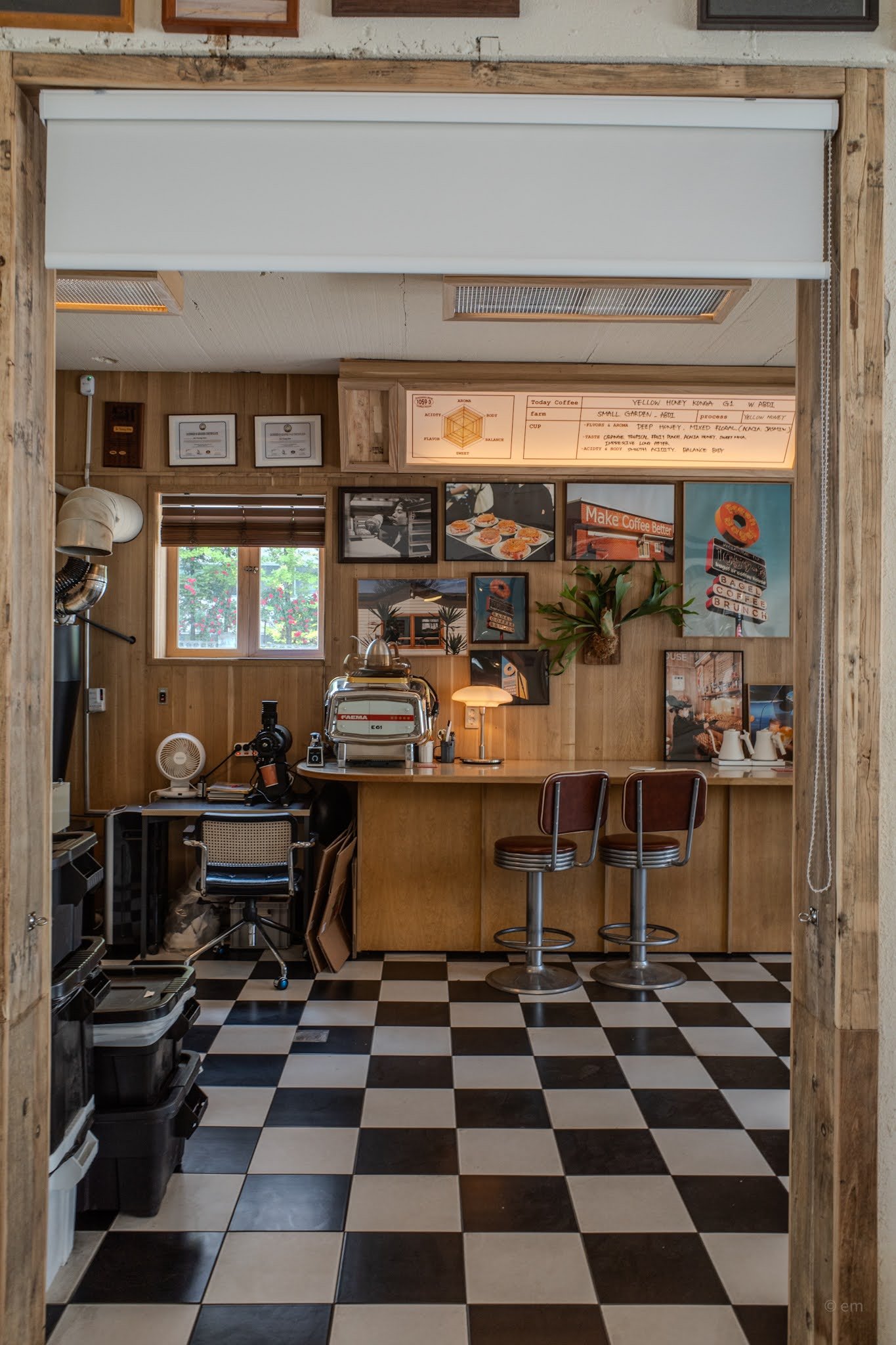
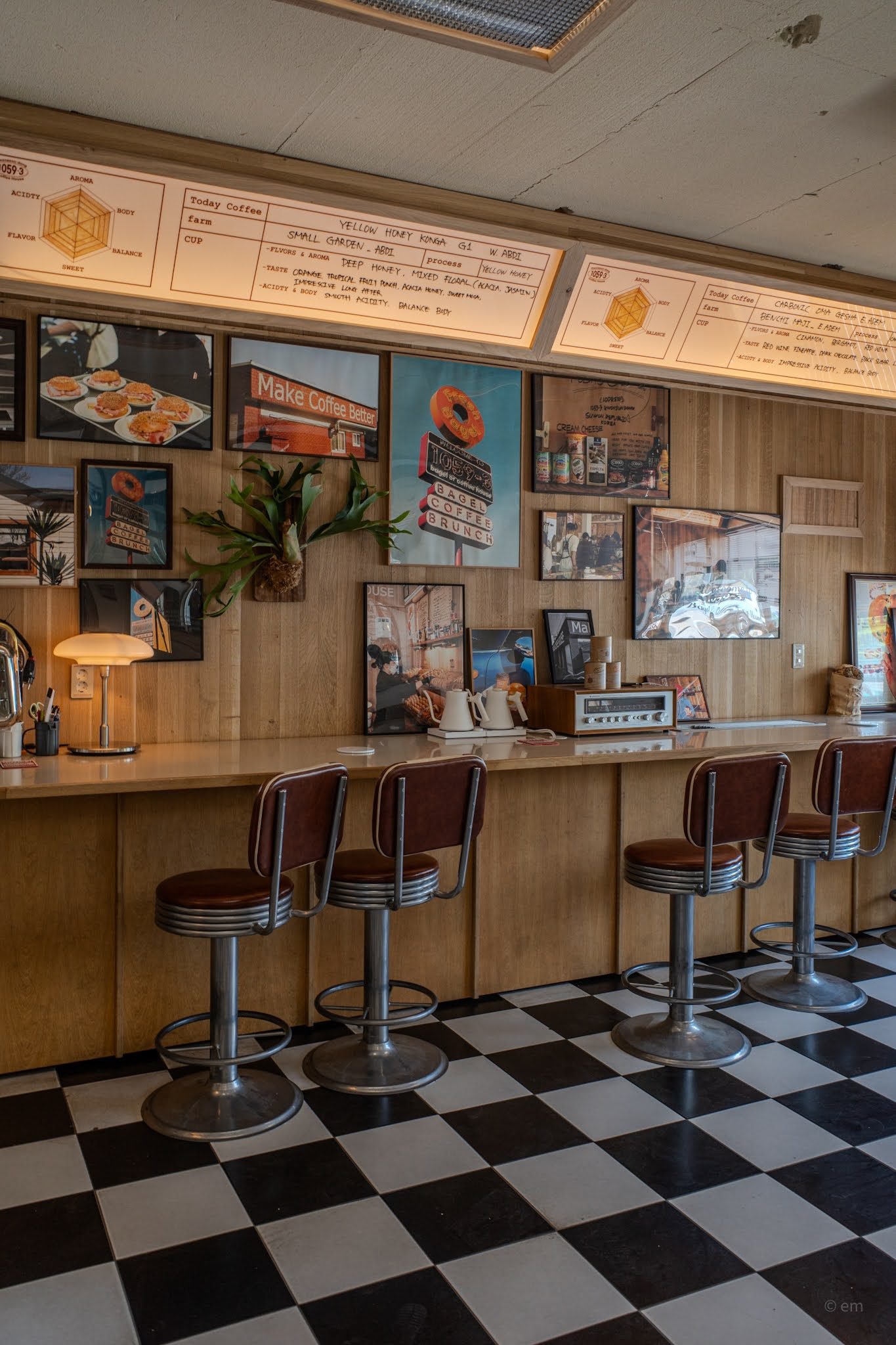
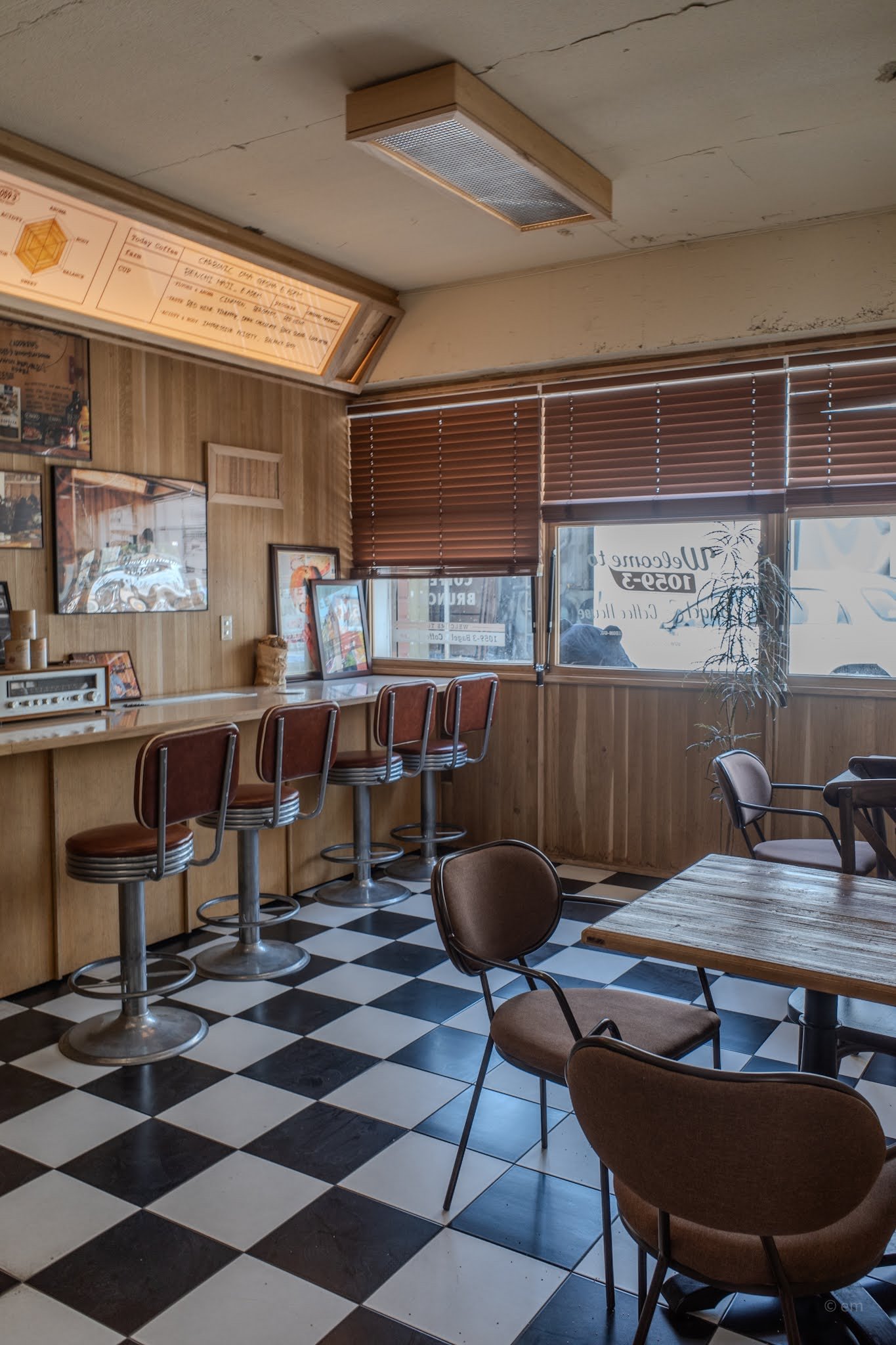
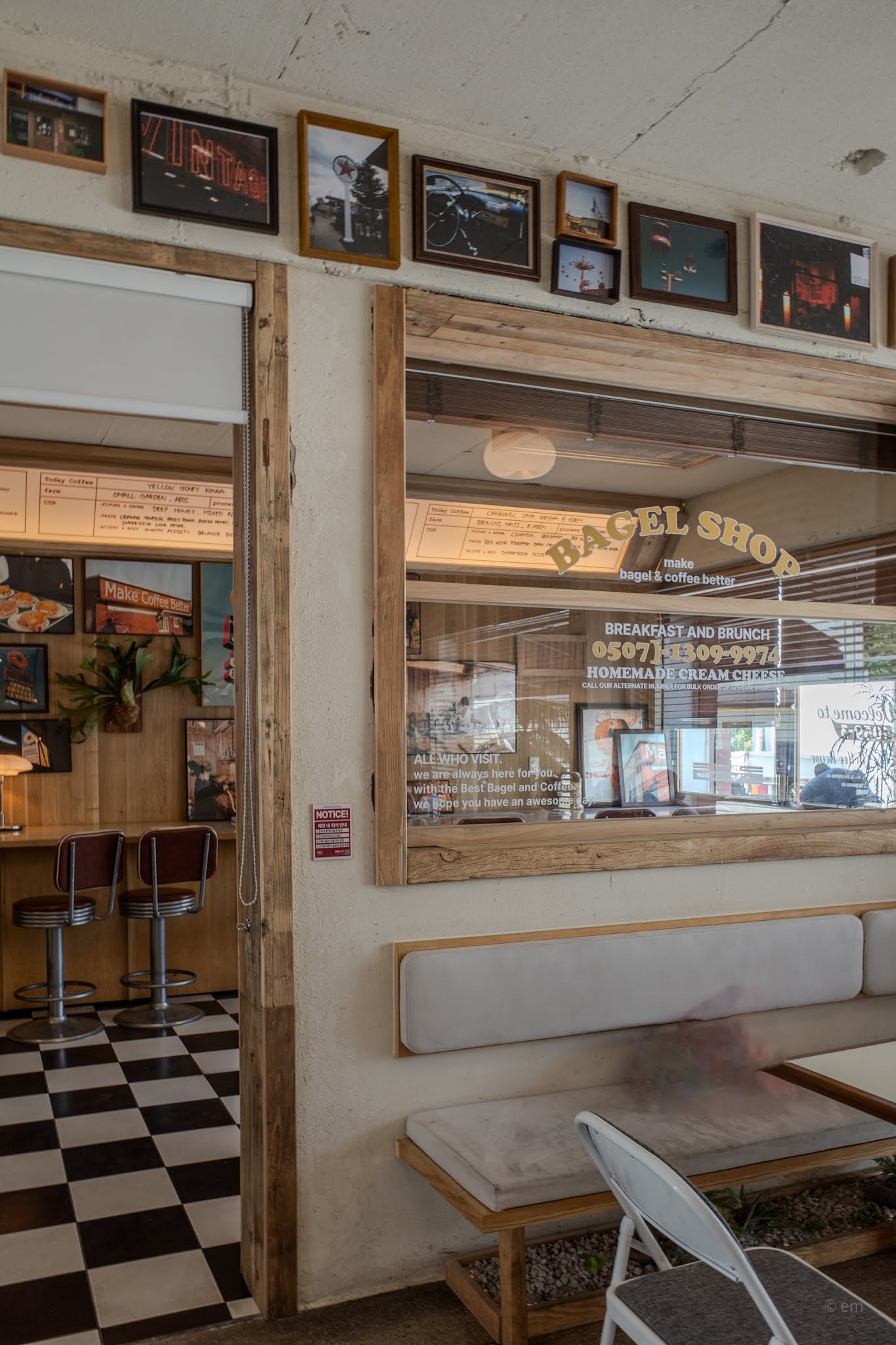
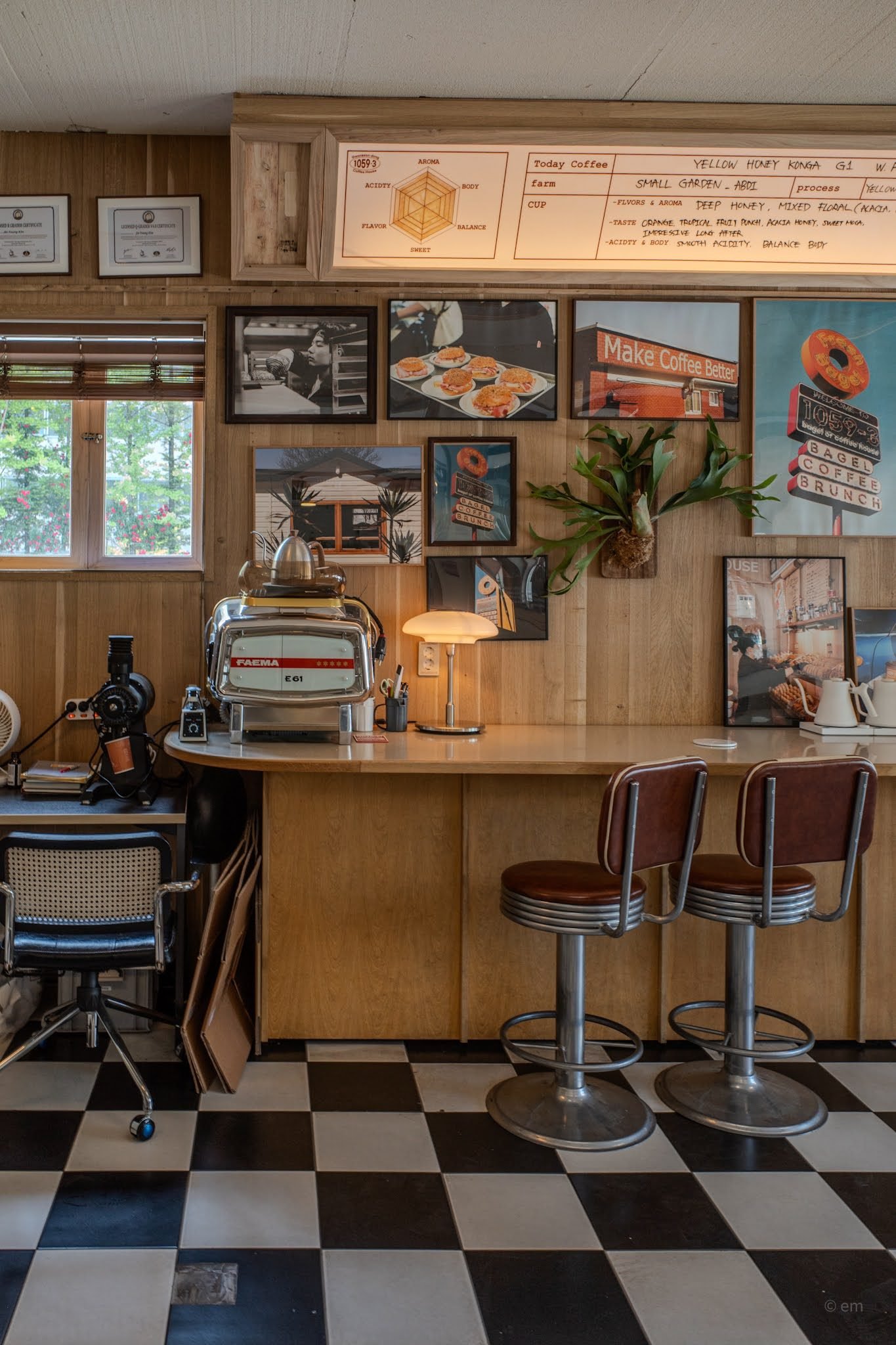
Through a doorframe built from rough, unfinished timber — the kind of wood that looks like it came off a barn or a demolished warehouse — the space shifts entirely. The floor here is black-and-white checkerboard tile, the walls are lined in warm wood paneling, and the light drops a register. The counter runs the length of one wall: a long formica surface behind which a Faema E61 espresso machine sits like a silver anchor, its chrome catching the warmth of the room.
Chrome-and-leather diner stools line the counter. The kind with stacked chrome rings around the base, upholstered in brown-red vinyl, designed to swivel and hold someone sitting through two cups of coffee and a long conversation. Above the counter, the coffee program is explained on illuminated boards in handwritten text: “Today Coffee” with origin, farm name, process, flavor notes, and a hand-drawn flavor-profile spider chart. The detail is serious — the kind of notation you’d find at a specialty roastery in Seoul’s Seongsu-dong or Mapo — transplanted here into the visual language of a 1970s American diner without any apparent sense of contradiction.
On the counter: a vintage stereo receiver, a small table lamp, white carafes, ceramic cups. Behind it, the gallery wall fills in around the machine — photographs of the café’s own exterior signage, food shots, a black-and-white portrait, a poster of the bagel sign catching golden-hour light. It is a room that has been building toward itself for years, adding and adjusting, until the weight of it feels settled.
The Bagel Counter
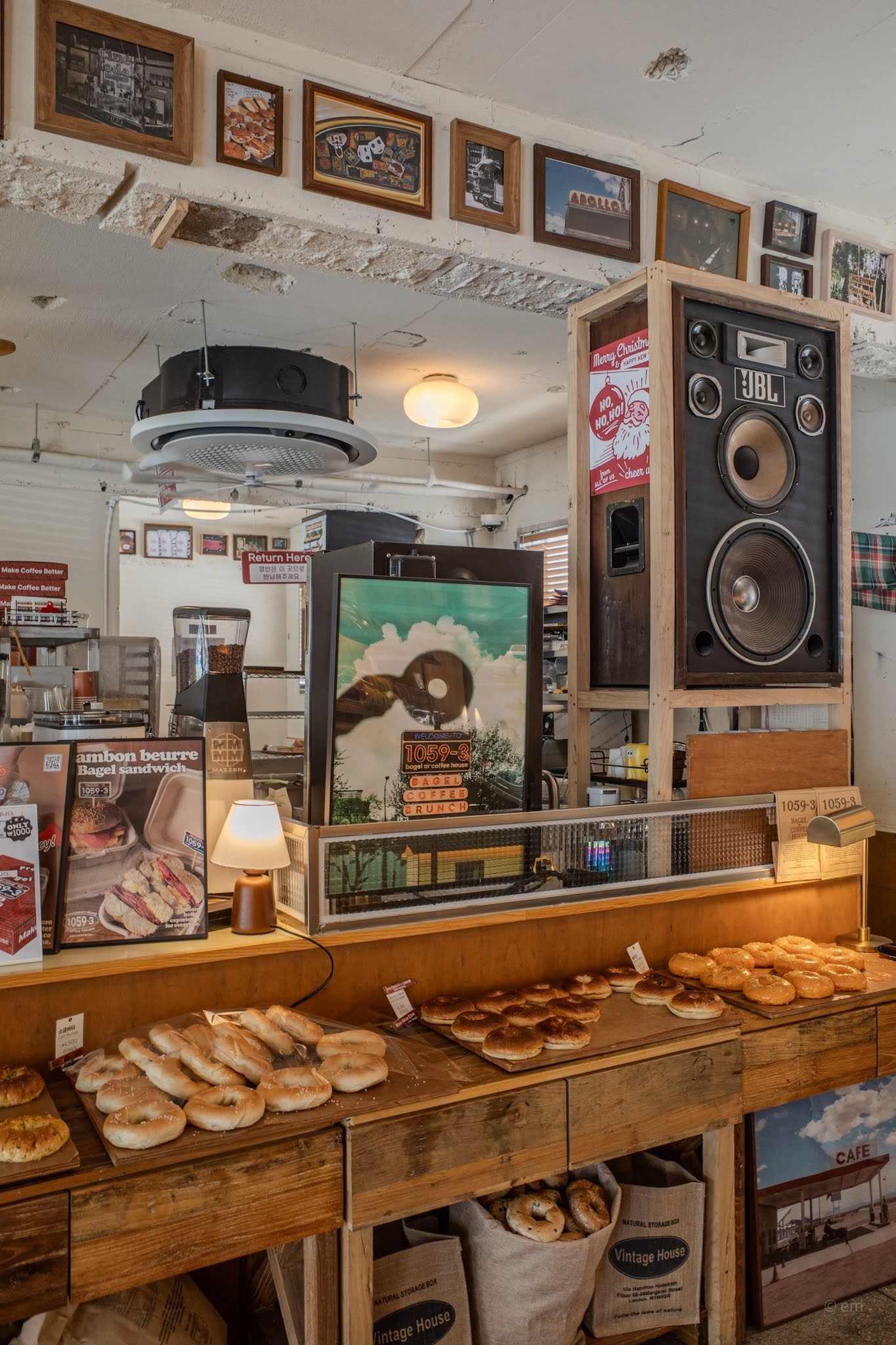
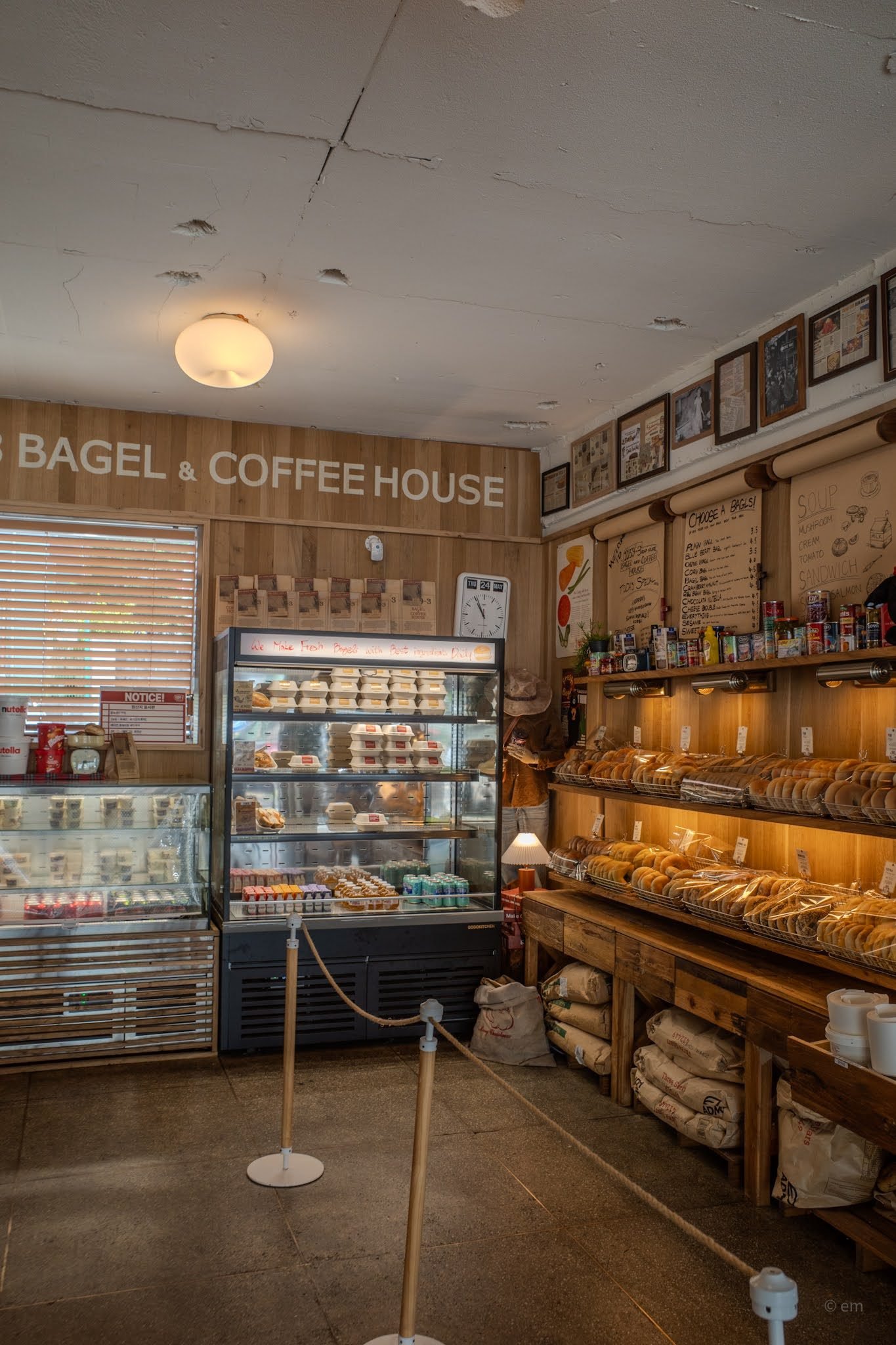
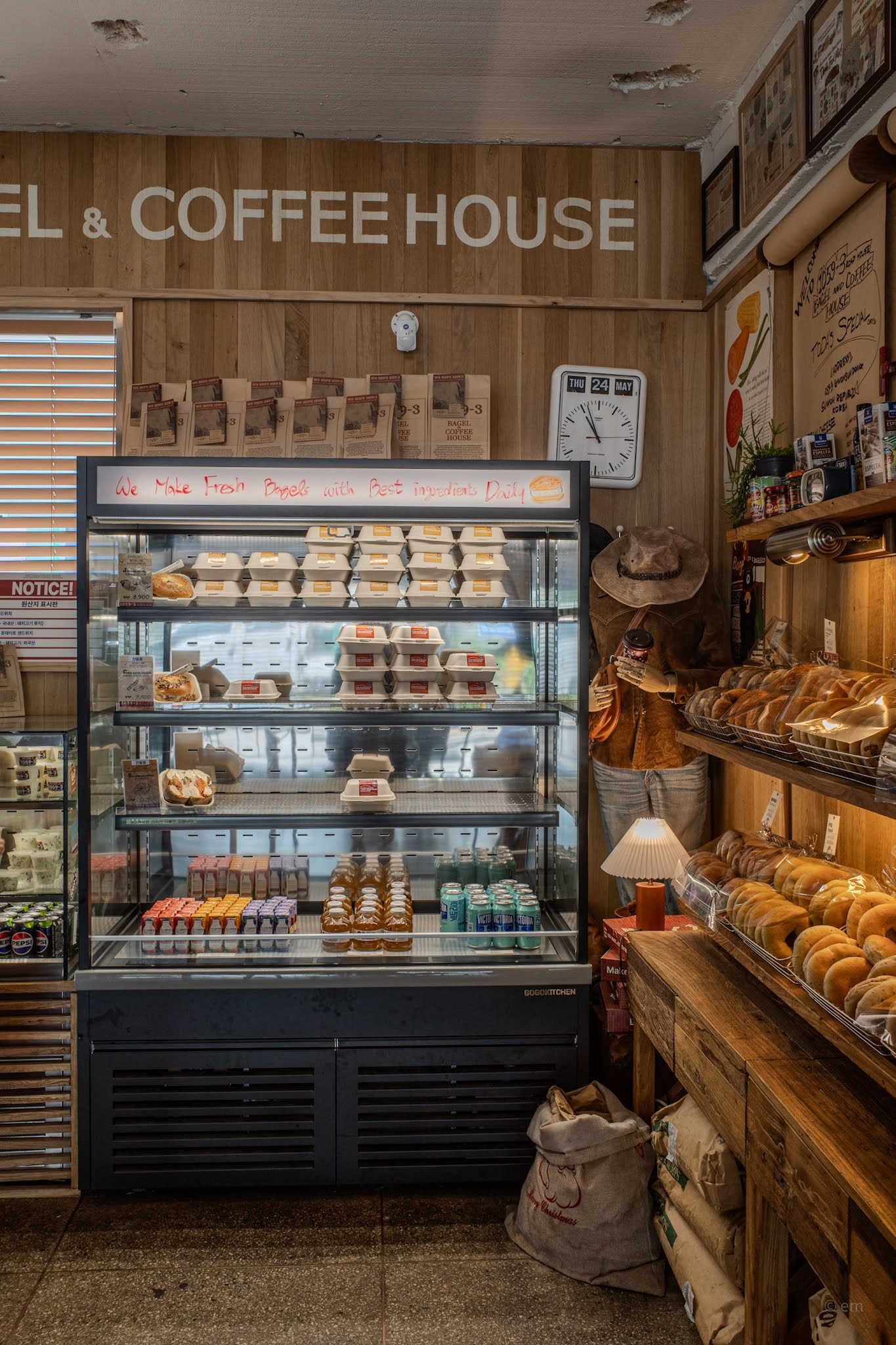
The third zone is closest to the entrance and operates on the logic of a New York deli that got lost in the American heartland. Wooden display shelves hold bagels in rows, sorted by variety: plain, sesame, everything, olive, whole wheat, cranberry walnut, garlic butter, smoked salmon, corn bacon, nutella, jambon beurre. They are baked daily on the premises — the refrigerated case carries the sandwich boxes, stacked in neat rows, each labeled with its filling. The handwritten message across the case reads: We Make Fresh Bagels with Best Ingredients Daily.
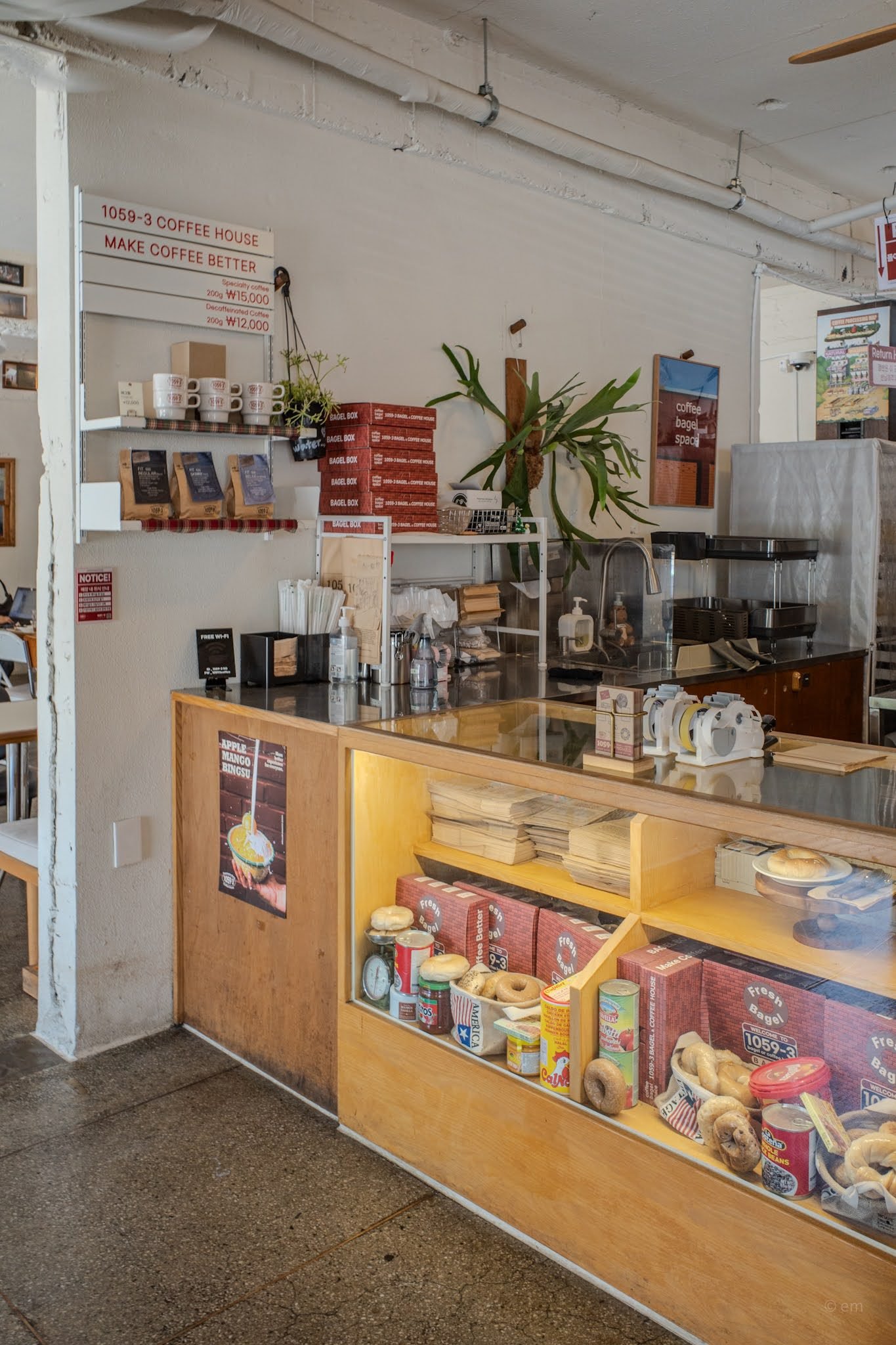
The cream cheese is made in-house, in several varieties. A selection of packaged goods and branded merchandise — 1059-3 gift boxes, coffee beans sold by the 200g bag, branded tote bags — occupies the shelves alongside the food. A large JBL floor speaker stands at the corner of the counter, its wooden cabinet and visible cones belonging somewhere between a recording studio and a record shop. The overall effect is a market counter that takes itself seriously without taking itself solemnly: the food is real, the sourcing is careful, and the packaging is good-looking, but none of it performs scarcity or exclusivity.
Mushroom soup rounds out the brunch menu and has quietly become one of the most talked-about items — a small detail that fits the space perfectly, the kind of thing you order without expecting much and remember afterward.
The Coffee Program
The specialty coffee program at 1059-3 runs with more precision than the building’s worn edges might suggest. The day’s offering is chalked onto the illuminated board above the counter in full detail — origin country, farm name, producer, processing method, and a flavor-profile breakdown across aroma, body, flavor, acidity, sweetness, and balance, mapped onto the spider chart that has become shorthand for serious Korean specialty coffee culture. On the day of this visit: Yellow Honey Konga G1 from Small Garden farm, Abdi, Ethiopia, processed as yellow honey, with tasting notes running to deep honey, mixed floral, acacia jasmine, tropical fruit peach, and a smooth, long finish.
Coffee beans are available for purchase in 200g bags — specialty and decaf both stocked — alongside the café’s branded cups. The espresso machine is not decorative. The foam on the milk is not an afterthought. In a building that signals America at every exterior surface, the coffee program signals something else entirely: a Korean specialty coffee sensibility that arrived here from a different direction and decided the diner counter was a perfectly good place to land.
Practical Info
The original Gwonseon-dong location is a seven-minute walk from Suwon Bus Terminal, with ample parking at the front and rear of the building. Weekends draw queues, and popular bagel varieties sell out by early afternoon. The jambon beurre sandwich bagel consistently runs out first.
Address: 경기도 수원시 권선구 세권로166번길 31 1층 (권선동 1059-3) 31
Seokwonro 166beon-gil, Gwonseon-gu, Suwon, Gyeonggi-do (1F)
Hours: Daily 09:30–21:00
Phone: 0507-1309-9974
Instagram: @10593_bagel_coffee_house
The highway diner that never needed a highway.