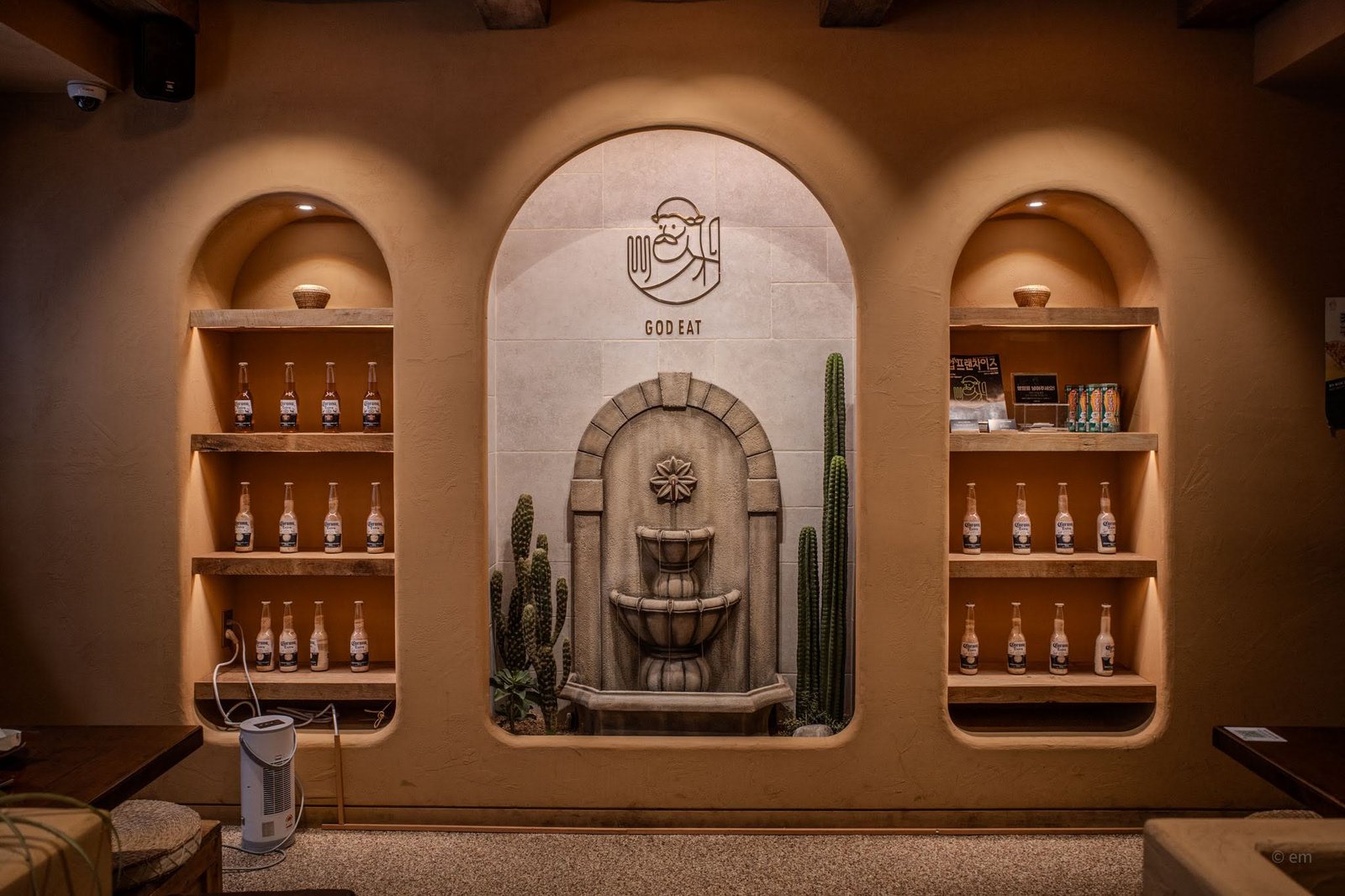
In Korean, holy water is 성수( Seongsu) — 聖水. This neighborhood is Seongsu. This restaurant is Holy Water. The shelves are full of Corona.
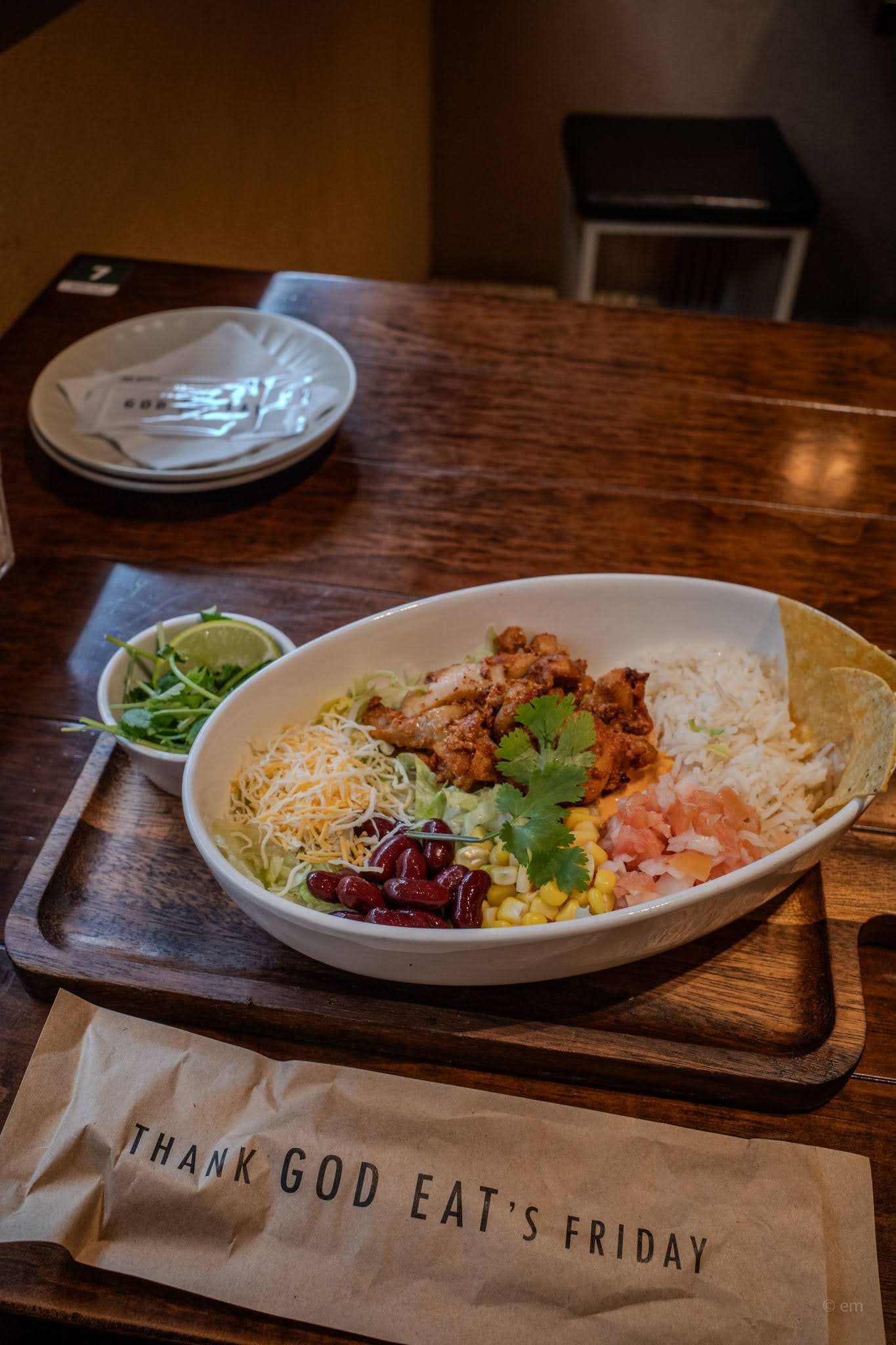
There’s a phrase tucked onto the napkins at God Eat: Thank God Eat’s Friday. It’s the kind of pun that tells you exactly what kind of place this is — irreverent, a little theatrical, and fully committed to its own bit. The Seongsu Holy Water branch, tucked into a side street off Yeonmujang-gil a few minutes from the station, takes that energy and builds an entire world around it.
The Desert, Reconstructed
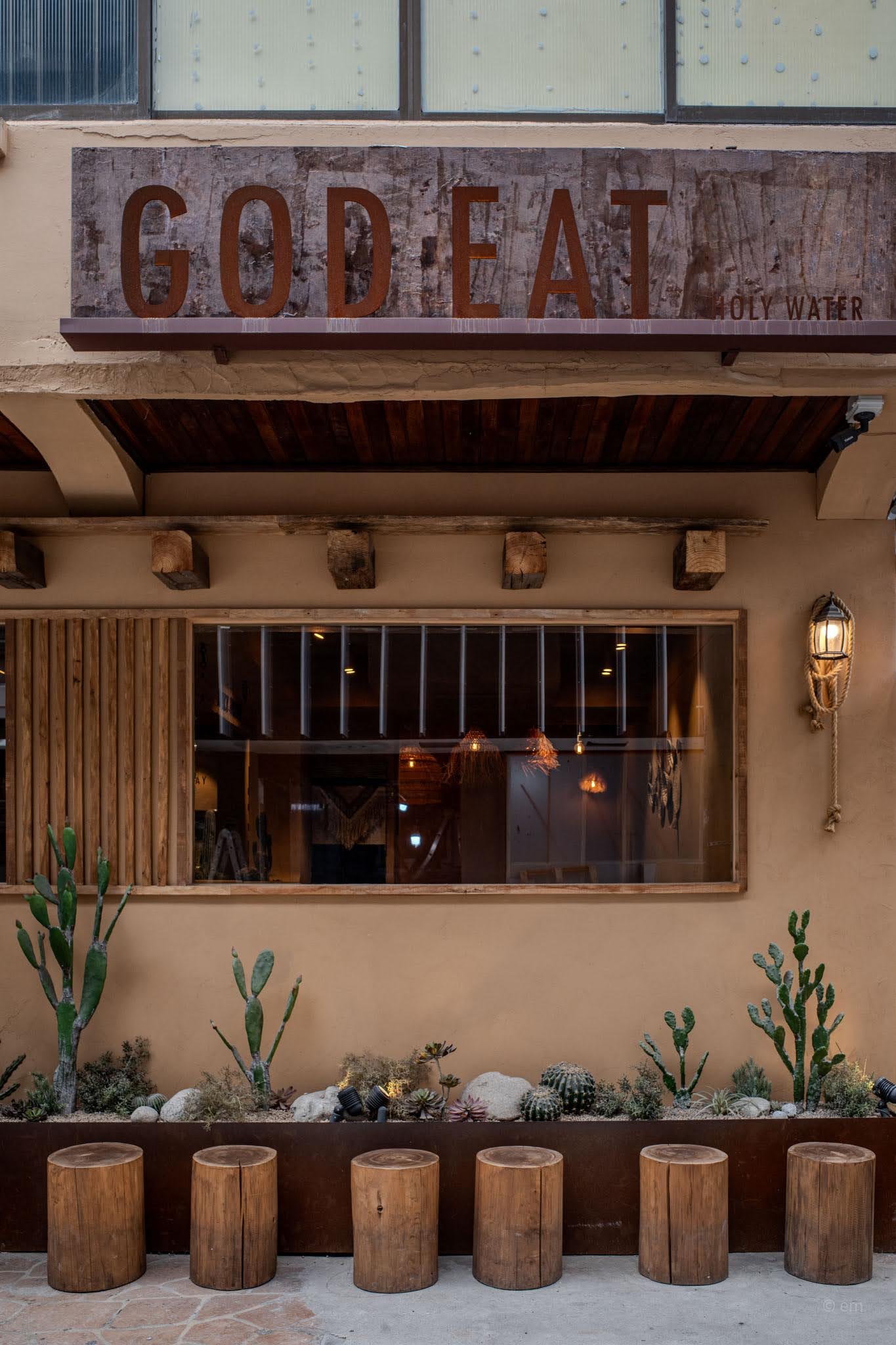
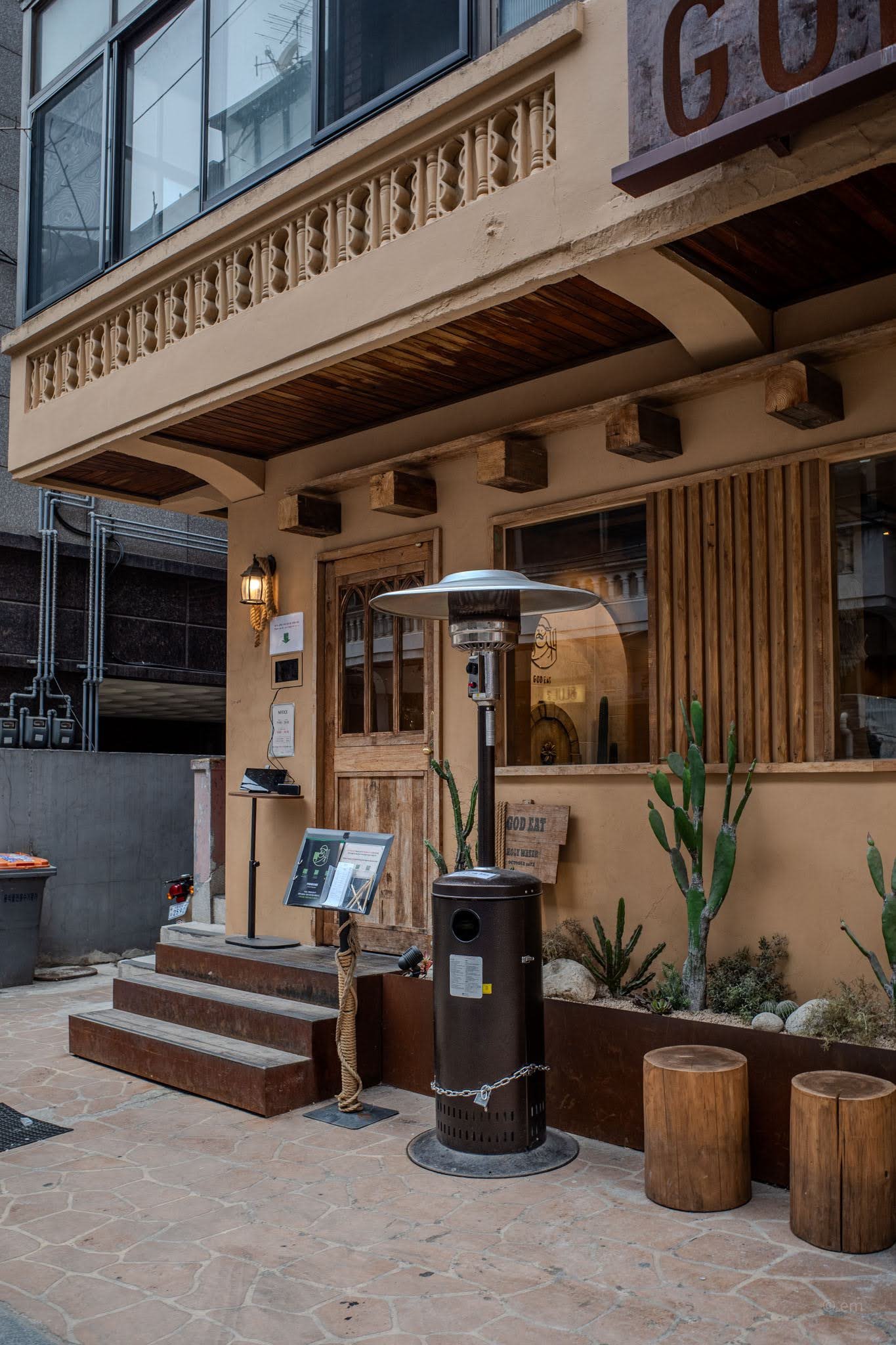
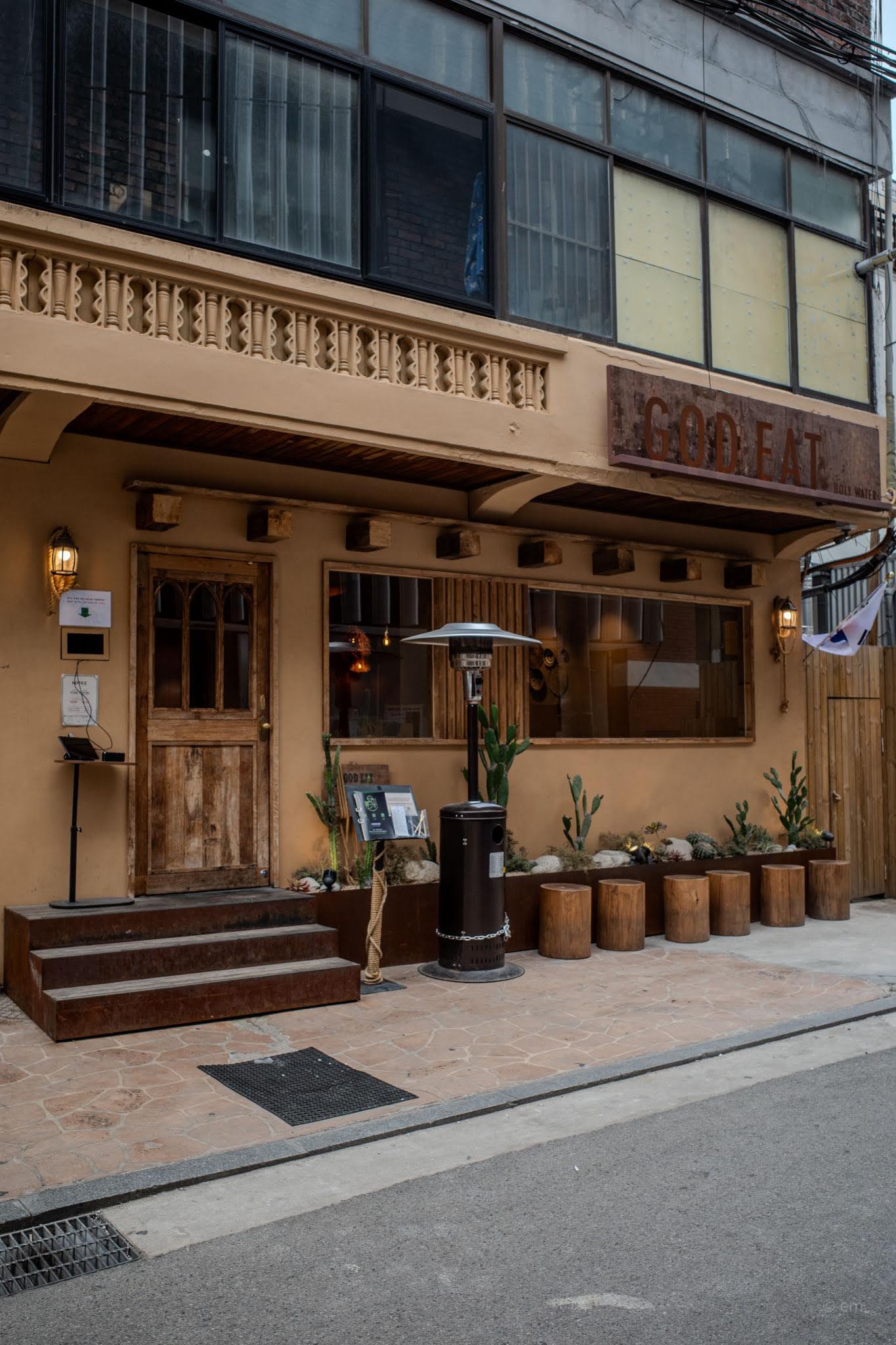
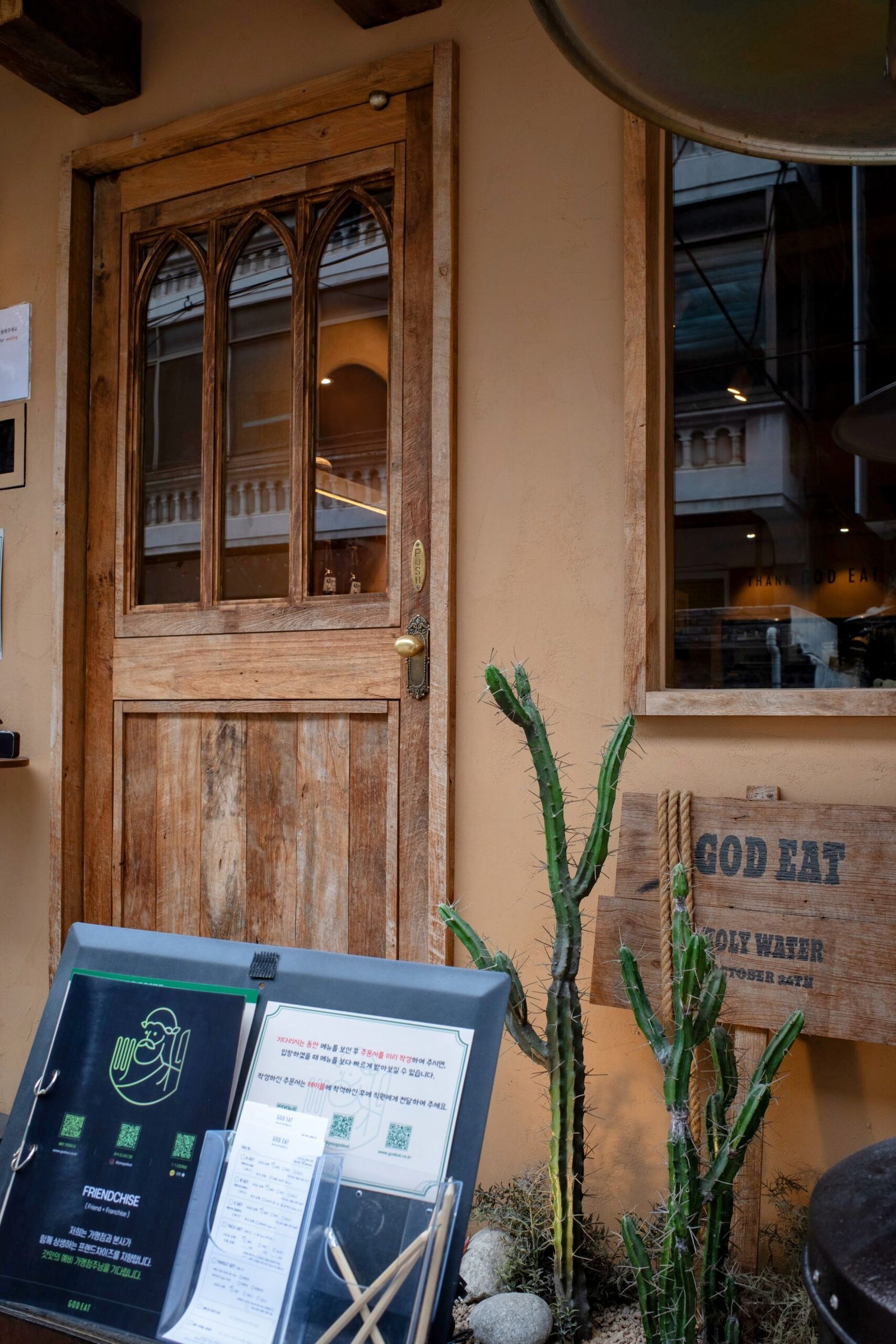
Finding the entrance is half the experience. The building stops pedestrians in their tracks before anyone even steps inside: a sand-colored adobe facade with an ornate carved balustrade running along the upper level, exposed timber beams jutting from the eaves, and a raised planter bed running along the front wall where prickly pear cacti and columnar succulents grow thick. Log stumps lined up along the curb serve as waiting stools. A heat lamp stands sentry by the door. The signage — rust-brown letters on a weathered wooden board, reading GOD EAT / HOLY WATER — looks like something salvaged from a desert town.
The door itself is worth pausing at: a Gothic-arched Dutch door in raw timber, brass-handled, with thin tracery panes at the top half. Through it, the sandy tones continue unbroken — the outside and inside feel like a single continuous space, which is exactly the point.
Holy Architecture
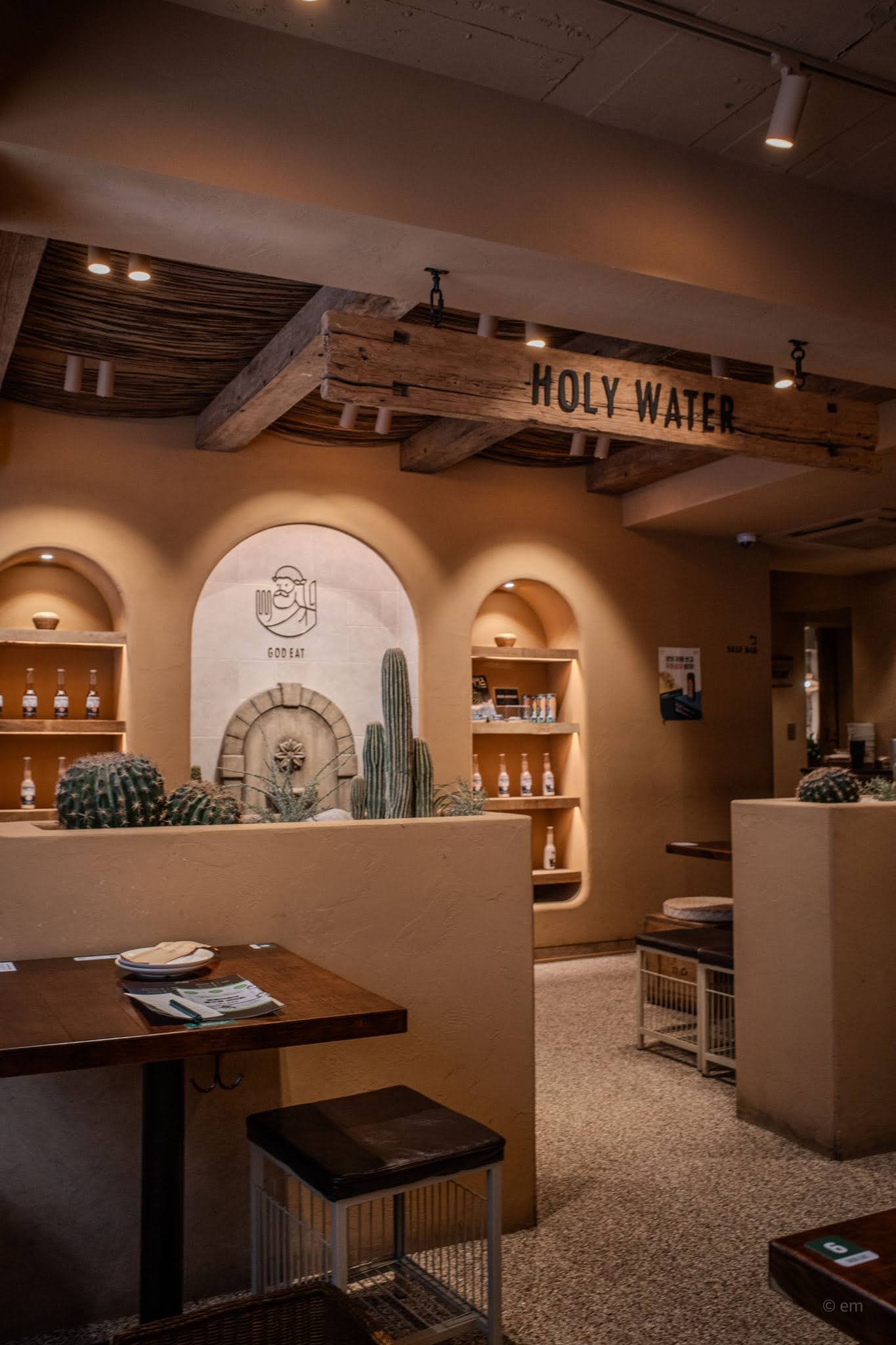
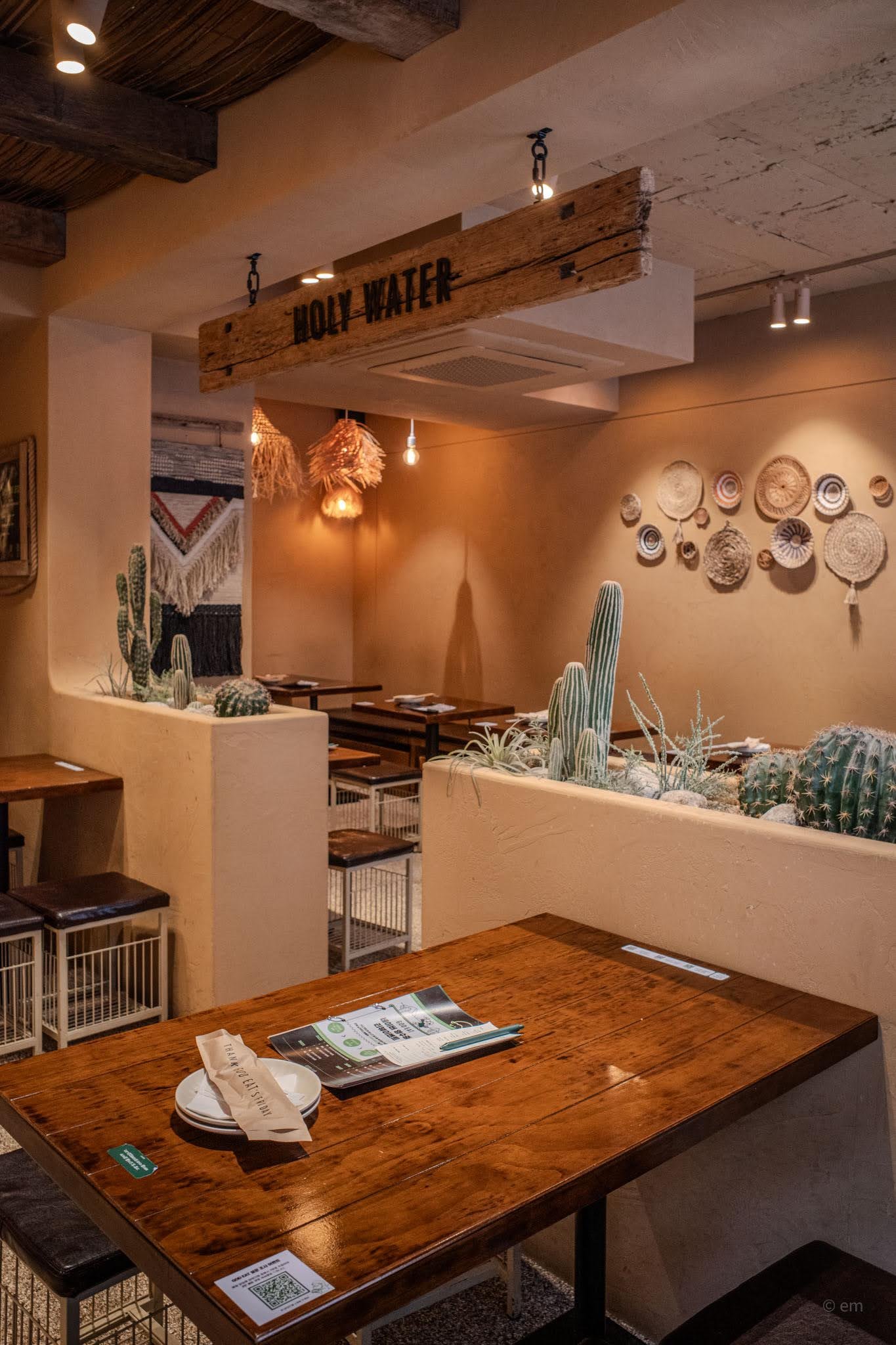
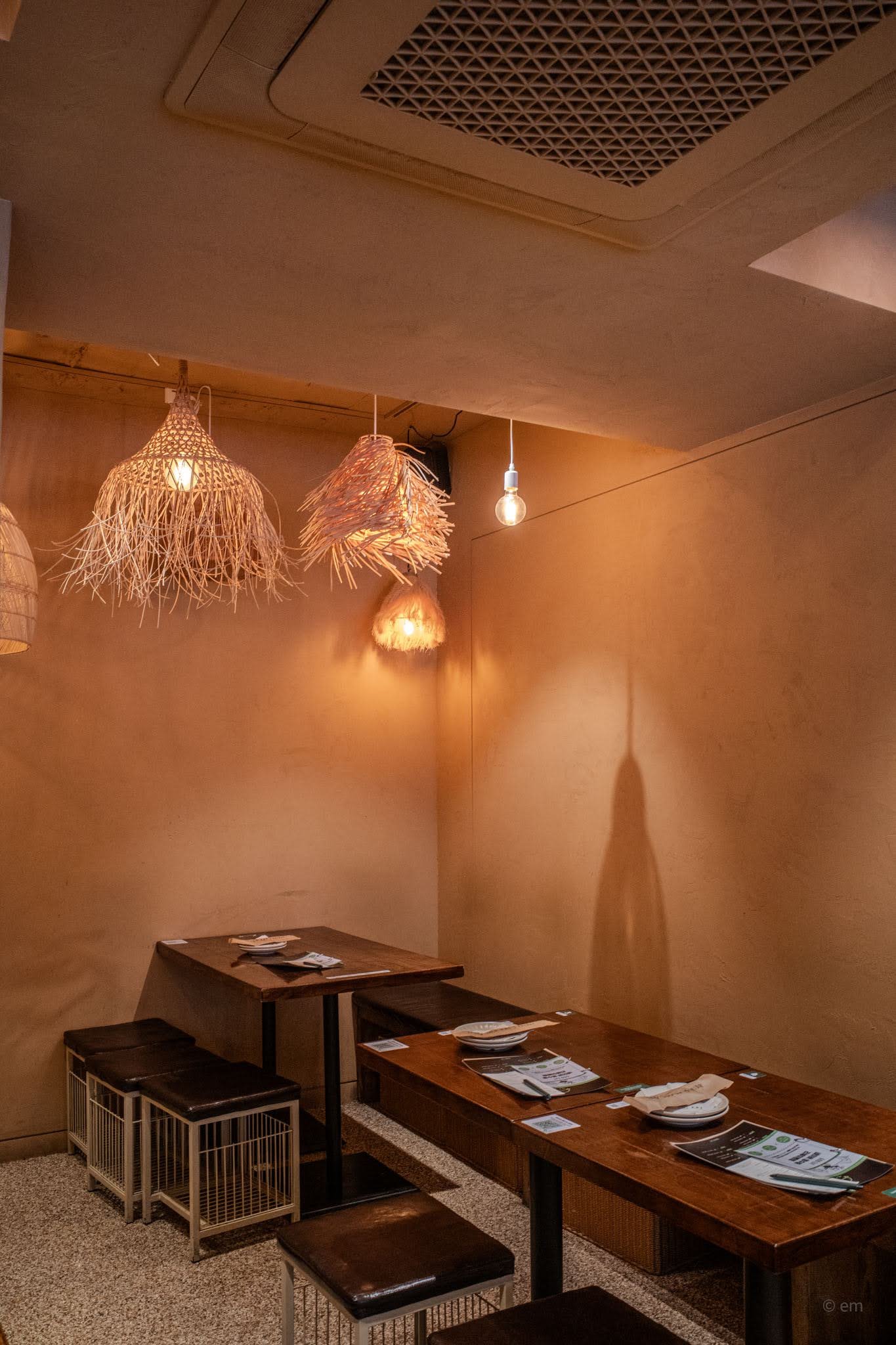
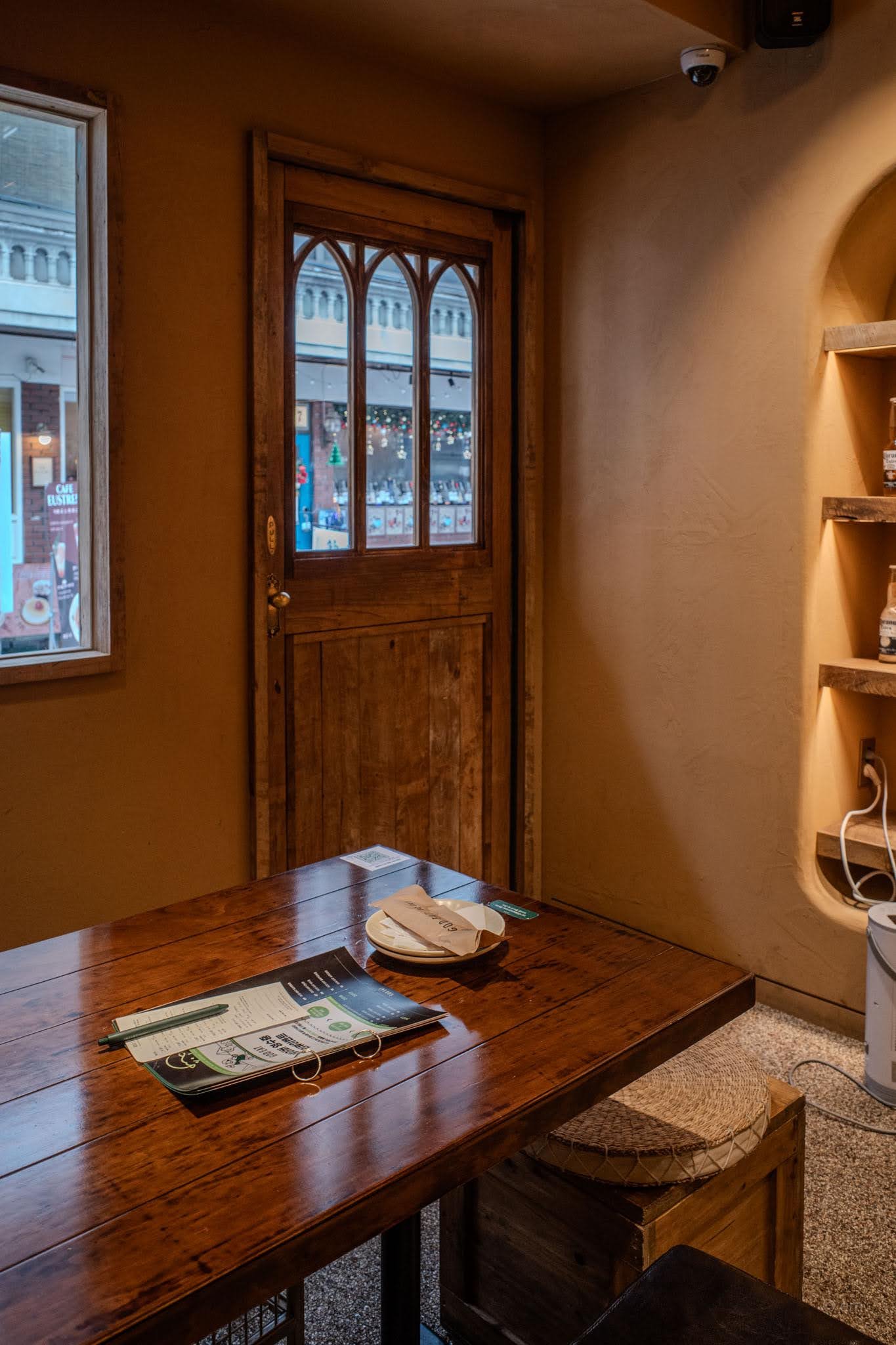
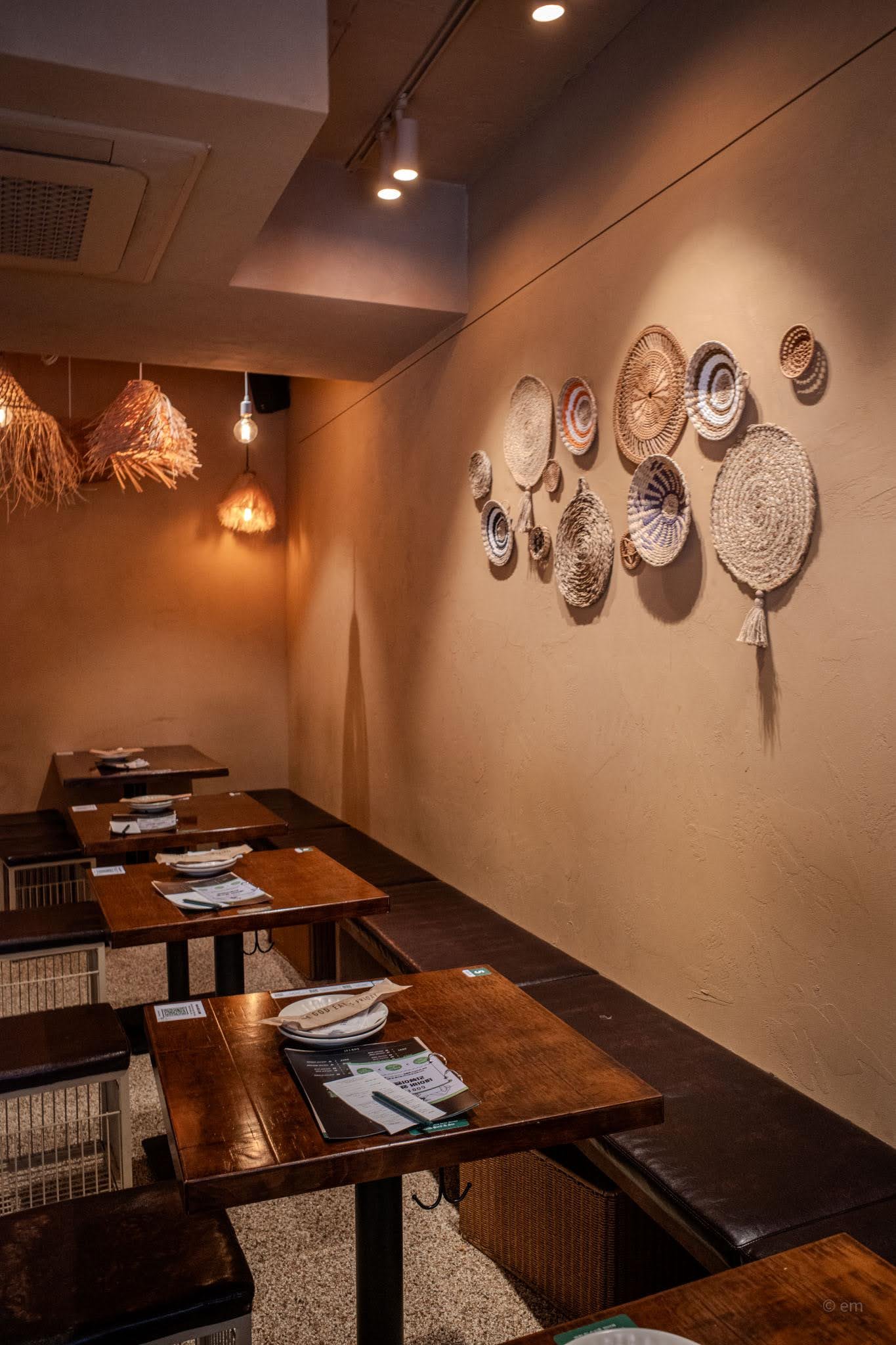
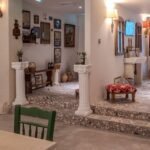
Inside, the walls are the warm ochre of sun-bleached clay. Reed matting lines portions of the ceiling between rough-hewn wooden beams, and pendant lamps made from woven straw and rattan hang at intervals, throwing amber light across the dining room. The low-slung seating, dark plank tables, and straw-accented stools complete the picture.
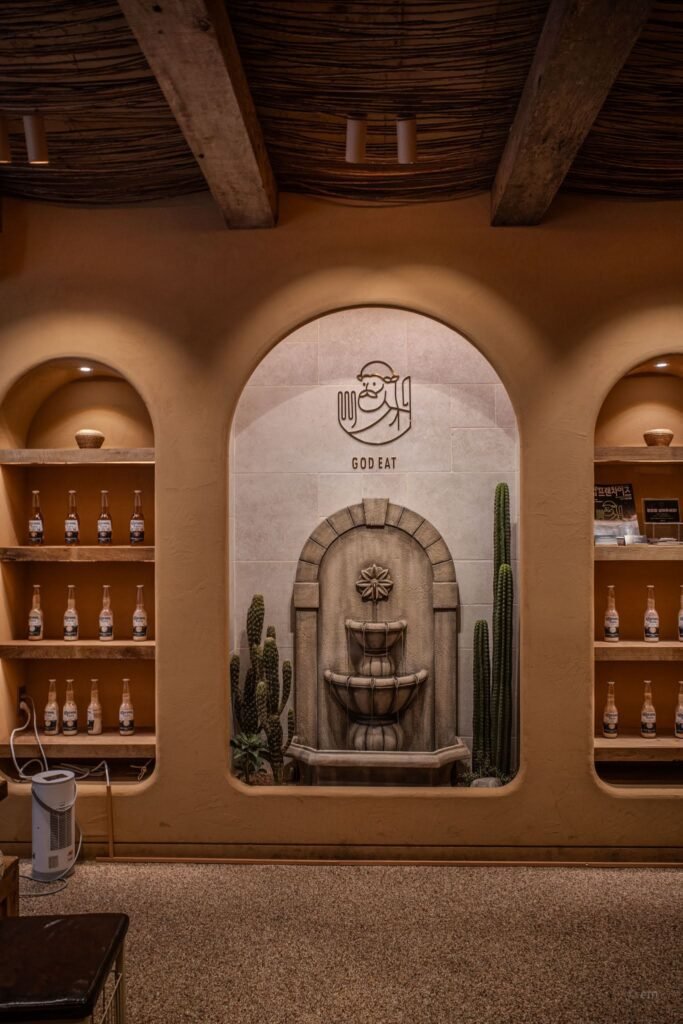
The focal point of the room is a wall of three arched niches near the back — a structure that reads more Southwestern mission than restaurant. The center arch contains a carved stone fountain, dry but fully realized, with the God Eat mascot rendered in line work above it: a bearded figure holding a fork and knife, some unlikely patron saint of the meal.
The flanking niches hold wooden shelving stacked with rows of Corona bottles — this is the “Holy Water” in question, though the name earns its keep twice over: seongsu (성수, 聖水) is the Korean word for holy water, and the branch sits squarely in Seongsu-dong. The joke lands every time someone clocks it.
A rough beam suspended from the ceiling spells out HOLY WATER in stenciled letters, anchoring the space’s central theme. Woven baskets hang in an arrangement along one wall; macramé panels fill another corner. Cactus planters divide the seating areas into sections, bringing the exterior planting logic inside.
The Menu
God Eat’s menu centers on a few core formats, each designed for sharing and assembling at the table. The God Fajita arrives on a hot iron plate — the meat, vegetables, and rice cooked separately and brought out sizzling, to be folded into tortillas with an array of salsas and toppings at the table. The God Enchilada wraps chicken, vegetables, and cheese in tortilla before pouring a rosé cream sauce over the whole thing. The God Bowl, the most straightforward of the three, arranges rice with a choice of protein — chicken, pork, or beef — alongside beans, corn, shredded cheese, salsa, and cilantro in a wide bowl, with tortilla chips for scooping. Tortillas are free-refill throughout.
Set menus run around 39,000 won for two and come loaded with extras: tacos, guacamole, potato chips, and the tortillas needed to eat everything. Individual bowls and tacos are available for lighter or solo visits. On the drinks side, the “Holy Water” — that is, Corona — occupies its own category.
The brand now counts around 47 branches nationwide, from Songridangil and Euljiro to Busan’s Seomyeon and Gyeongju’s Haeridangil, making it one of the more successful Mexican concepts to establish a foothold in Korea. The Seongsu Holy Water branch stands out within the chain for its spatial ambition — most other locations are simpler in execution, without the fountain or the full adobe treatment.
Getting There
The Holy Water branch sits just off the main Seongsu strip, a few minutes’ walk from exit 3 of Seongsu Station. It’s a neighborhood well-practiced at this kind of concept dining — the surrounding streets run thick with cafés and restaurants, each trying to carve out its own aesthetic territory. God Eat’s territory happens to be a convincing corner of the Sonoran Desert.
God Eat Holy Water | 10 Yeonmujang 7-ga-gil, Seongdong-gu, Seoul |
Hours: 11:00–21:30, last order 20:30 (weekday break 15:00–16:30) |
Instagram: @yougodeat
The food is good. The fountain is dry. The holy water is cold.

![[Lost] Hey, Laura!](https://hiddencollector.thesensitiveways.com/wp-content/uploads/2025/03/HEY-LAURA-200x300.png)