Some places arrive too fully formed for the world they land in.
Maison de BaBa opened on Jeju in 2024 under a tagline that declared its ambitions plainly: Be One with Jeju. It didn’t last the year. What remains is a set of photographs, a fountain still running in the memory of it, and the particular ache of a space that should have had more time.
What It Was
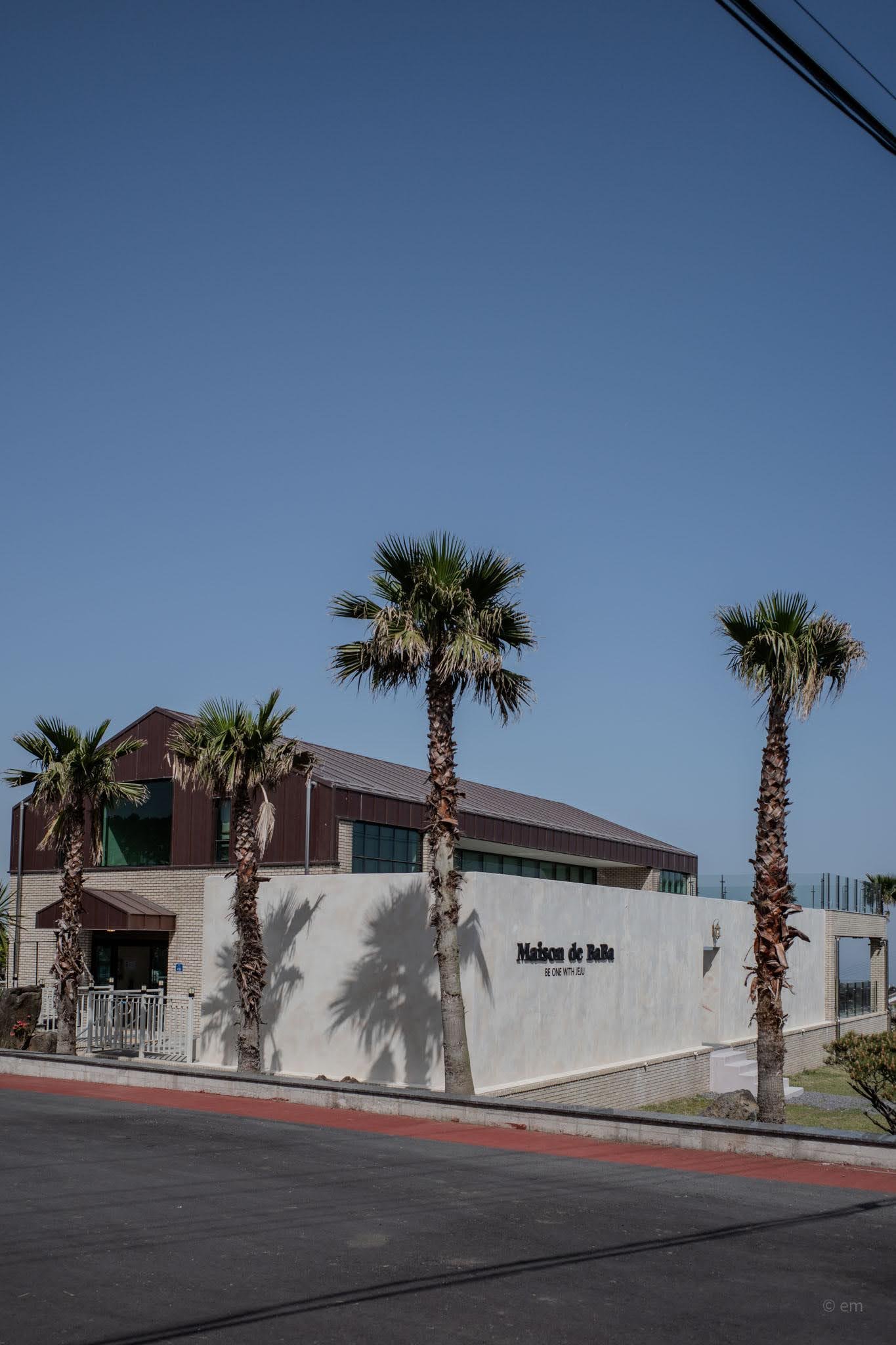
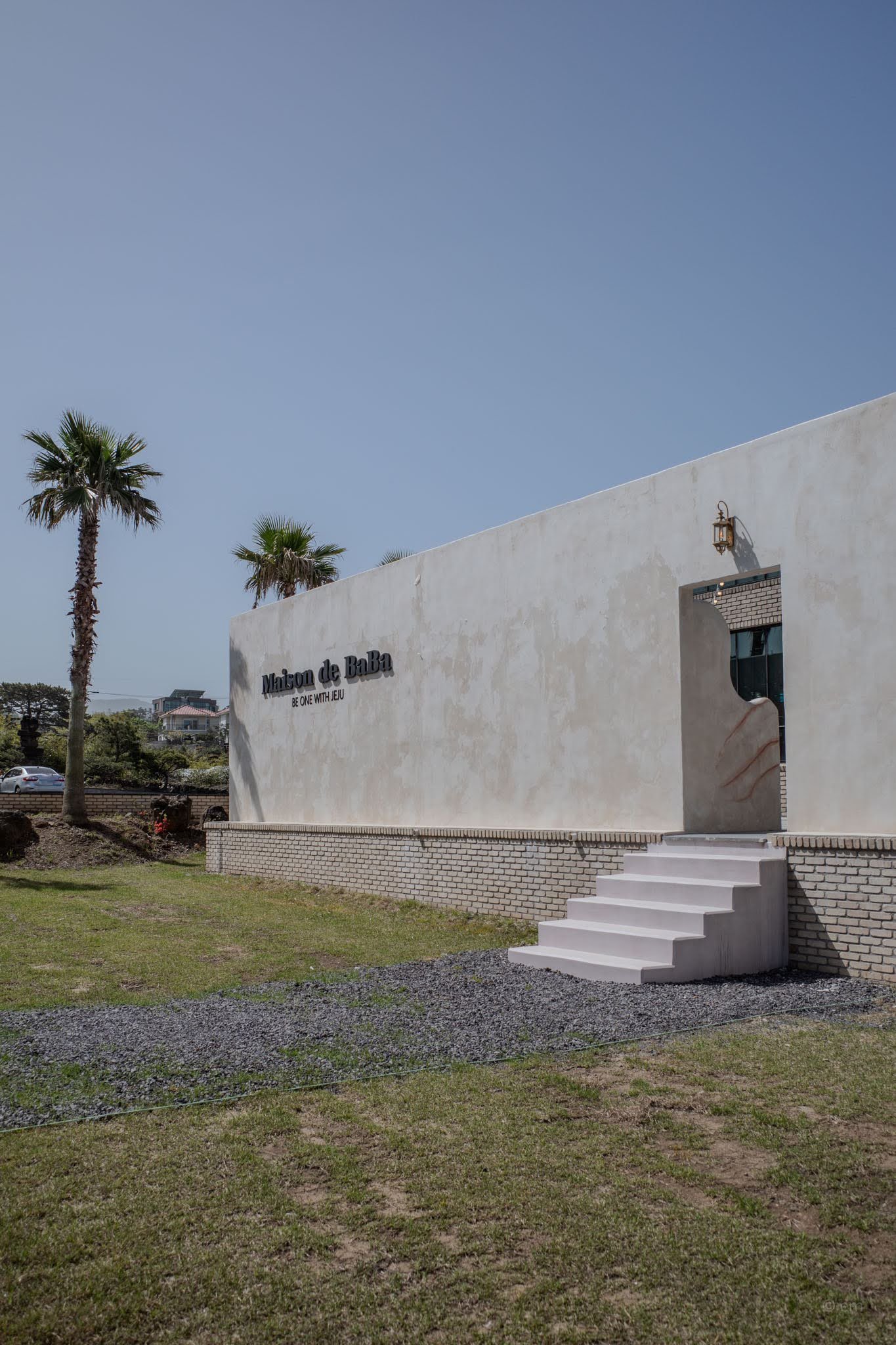
From the road, you saw the wall first — a long, low expanse of white stucco with the name lettered in serif black and several fan palms casting their ragged shadows across it. The building behind was split into two registers: a lower brick-clad body, and above it, a barn-pitched roof sheathed in dark maroon metal that caught the Jeju sun like weathered iron. Between them, a glass upper level opened the interior to sky on all sides. Nothing about the exterior announced itself as modest.
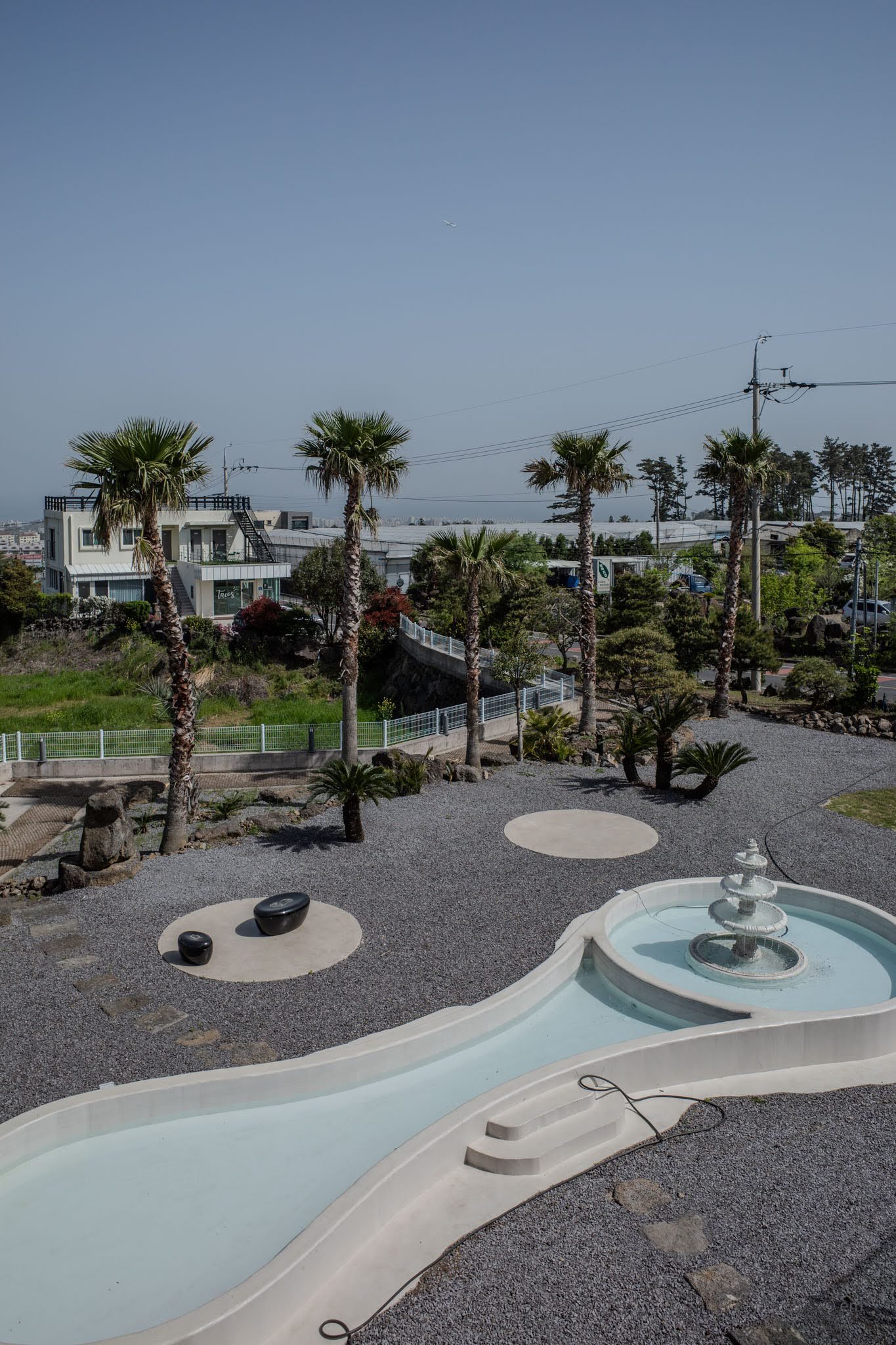
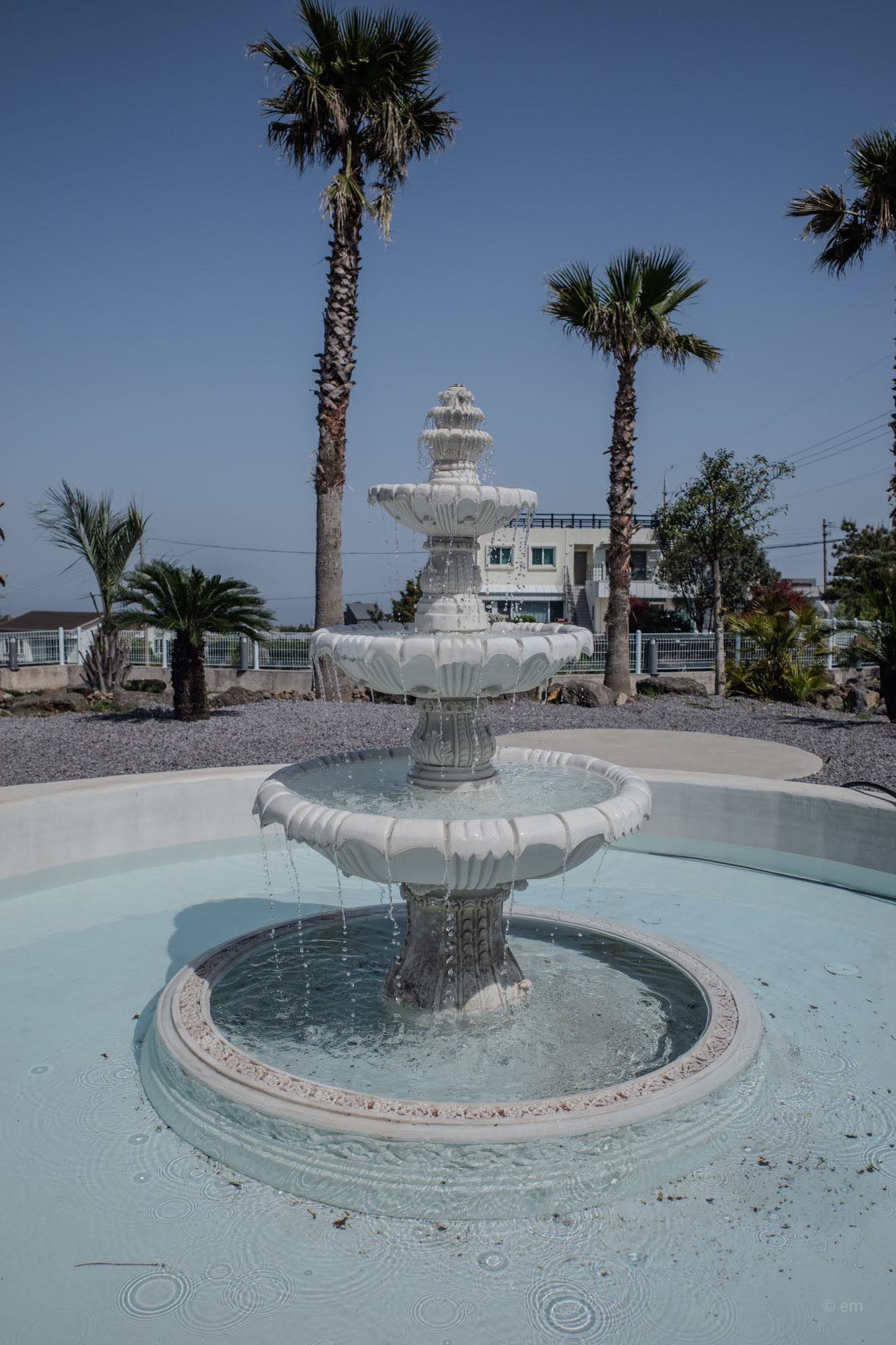
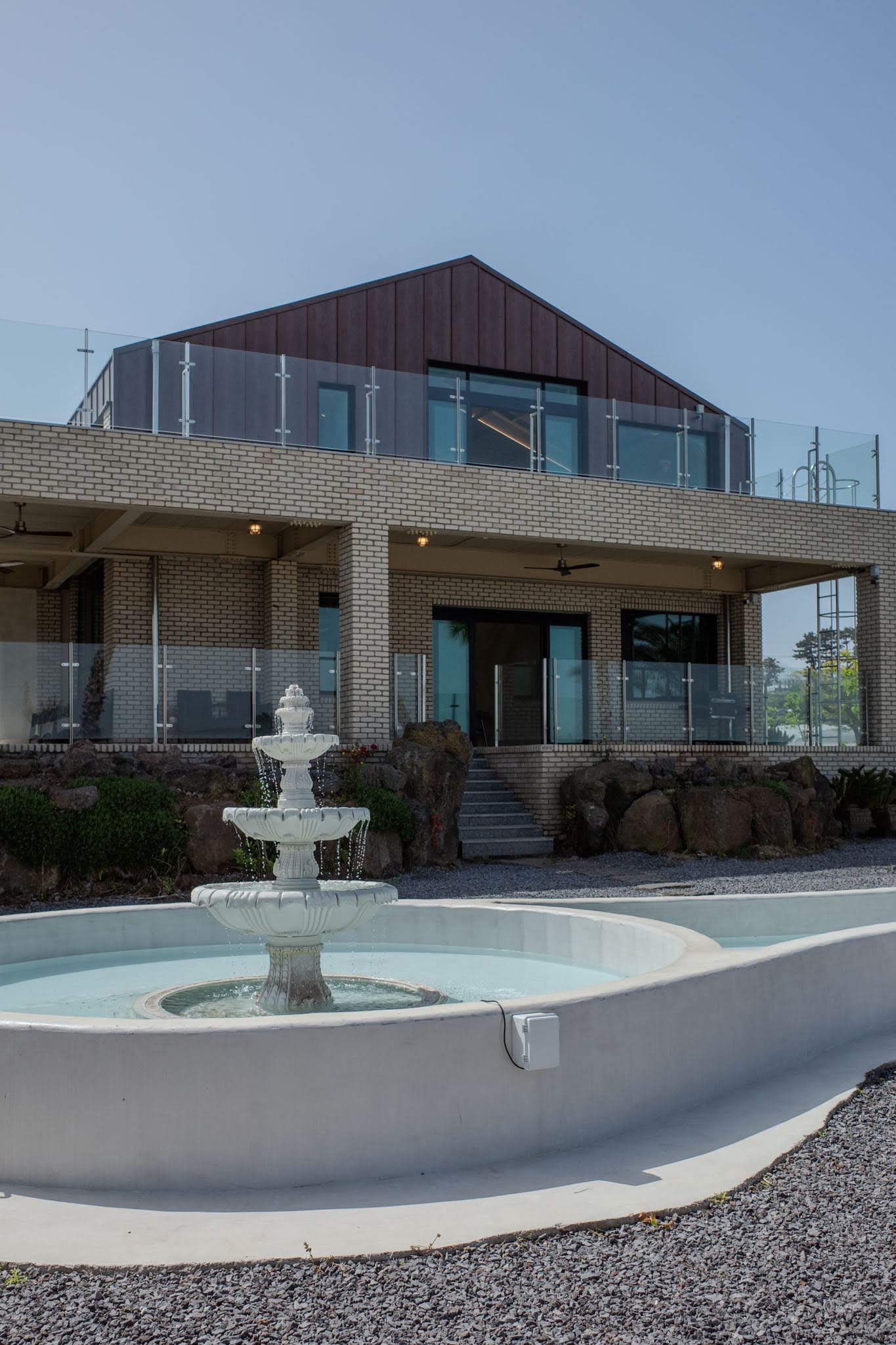
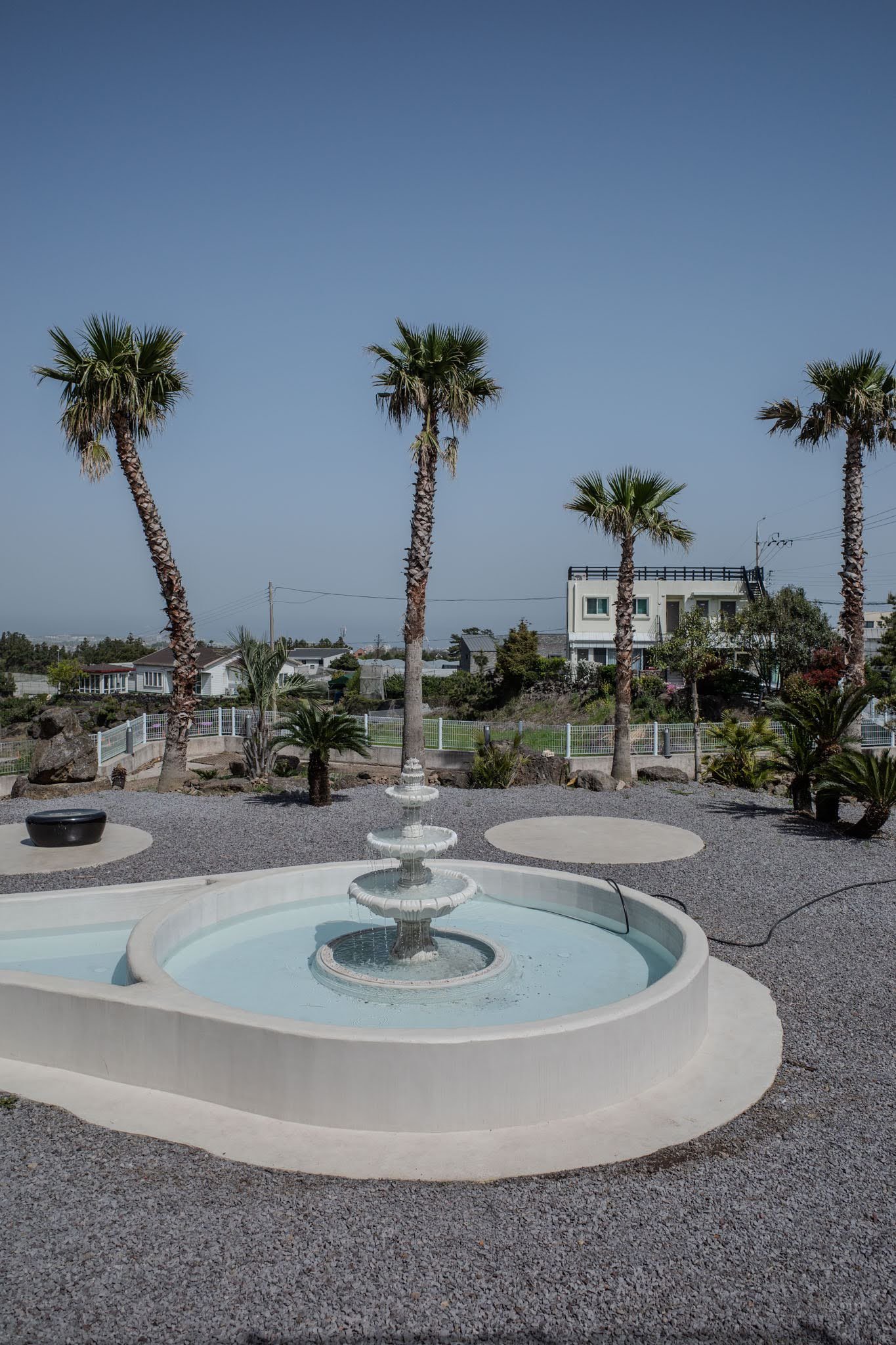
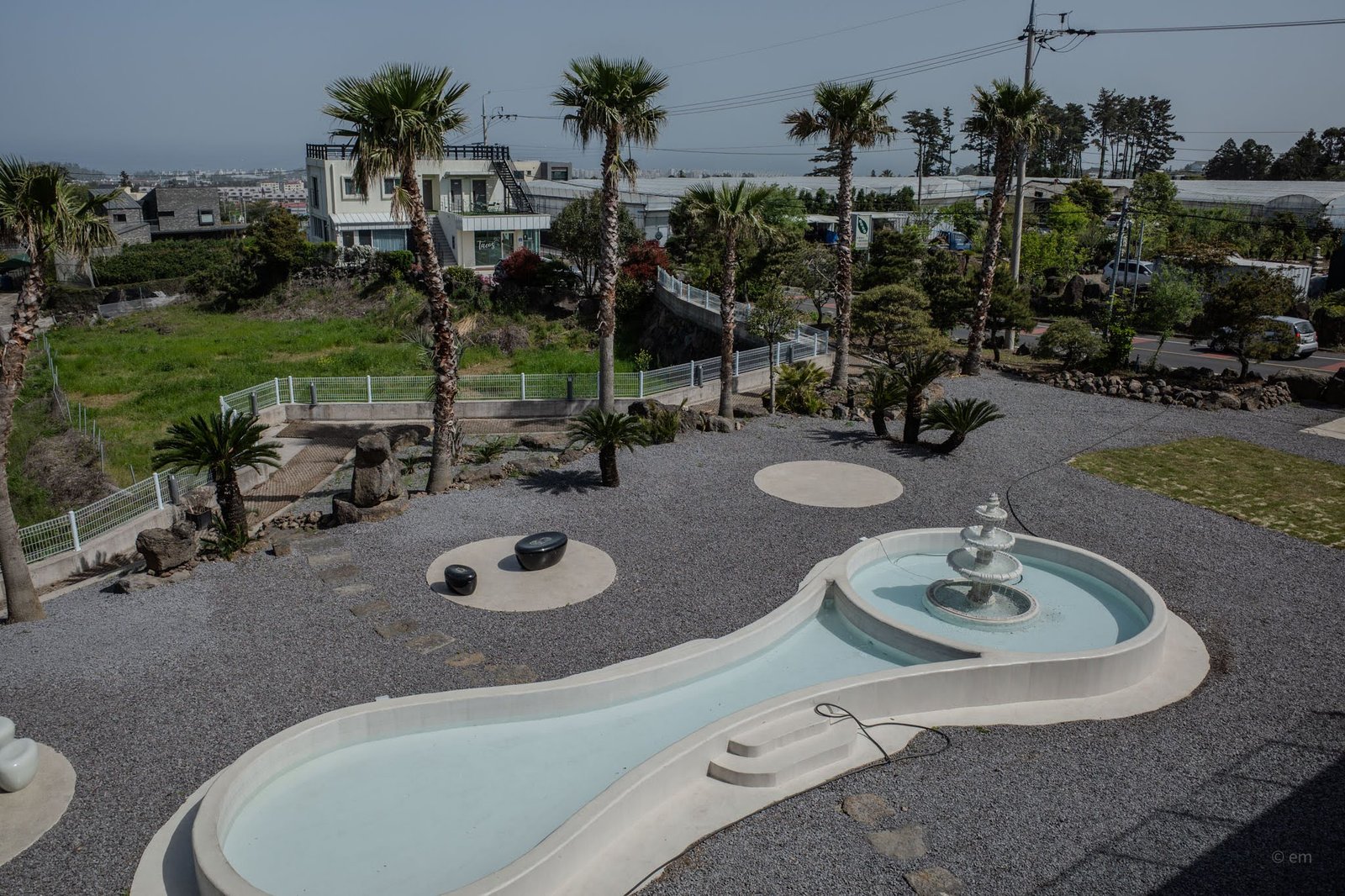
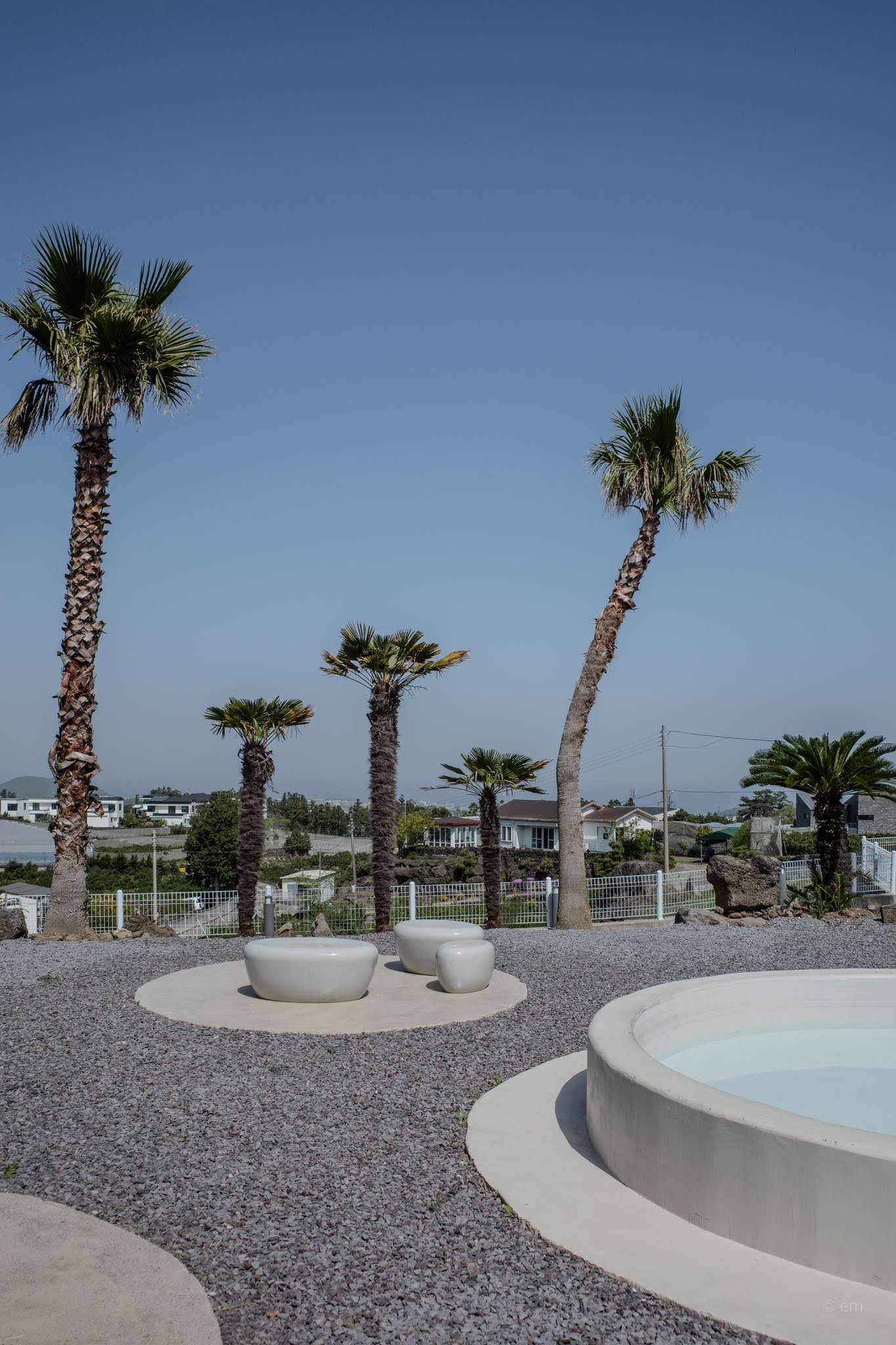
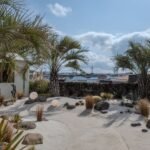
The garden forecourt at ground level set the register immediately. Black basalt gravel, the same volcanic material that runs through every corner of Jeju, was offset here by something entirely unexpected: a biomorphic fountain pool rendered in smooth white concrete, shaped like an amoeba or an opening hand, with a tiered marble fountain at its center dropping water in cascading rings. Palm trees — fan palms, Washingtonia-variety, tall and angular — stood at intervals across the gravel, their fronds catching and releasing the wind. Small circular concrete plinths held ceramic sculptural seats in white glaze. It was not Jeju. It was not anywhere specific. It was the dream of an oasis.
The Courtyard
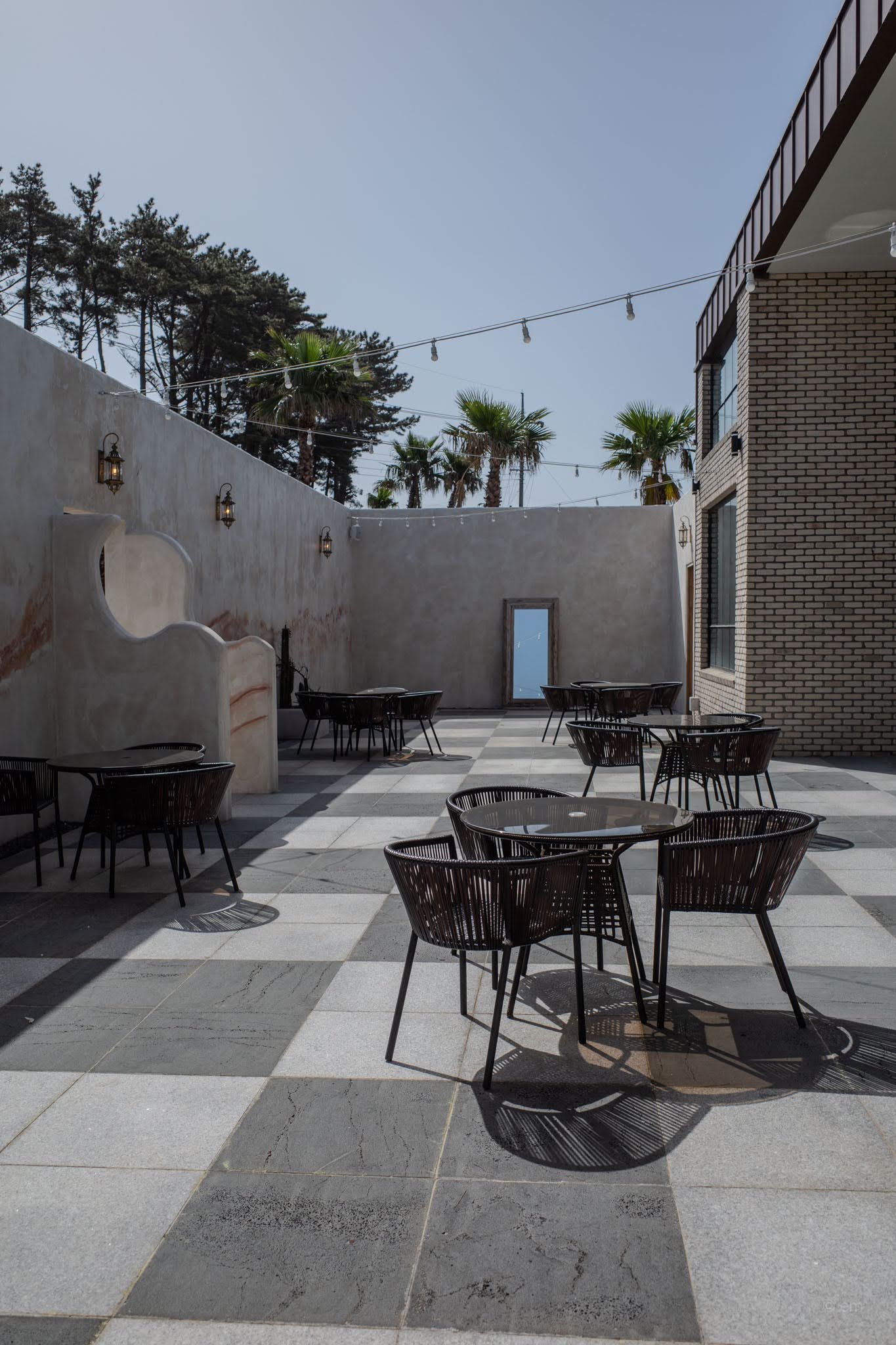
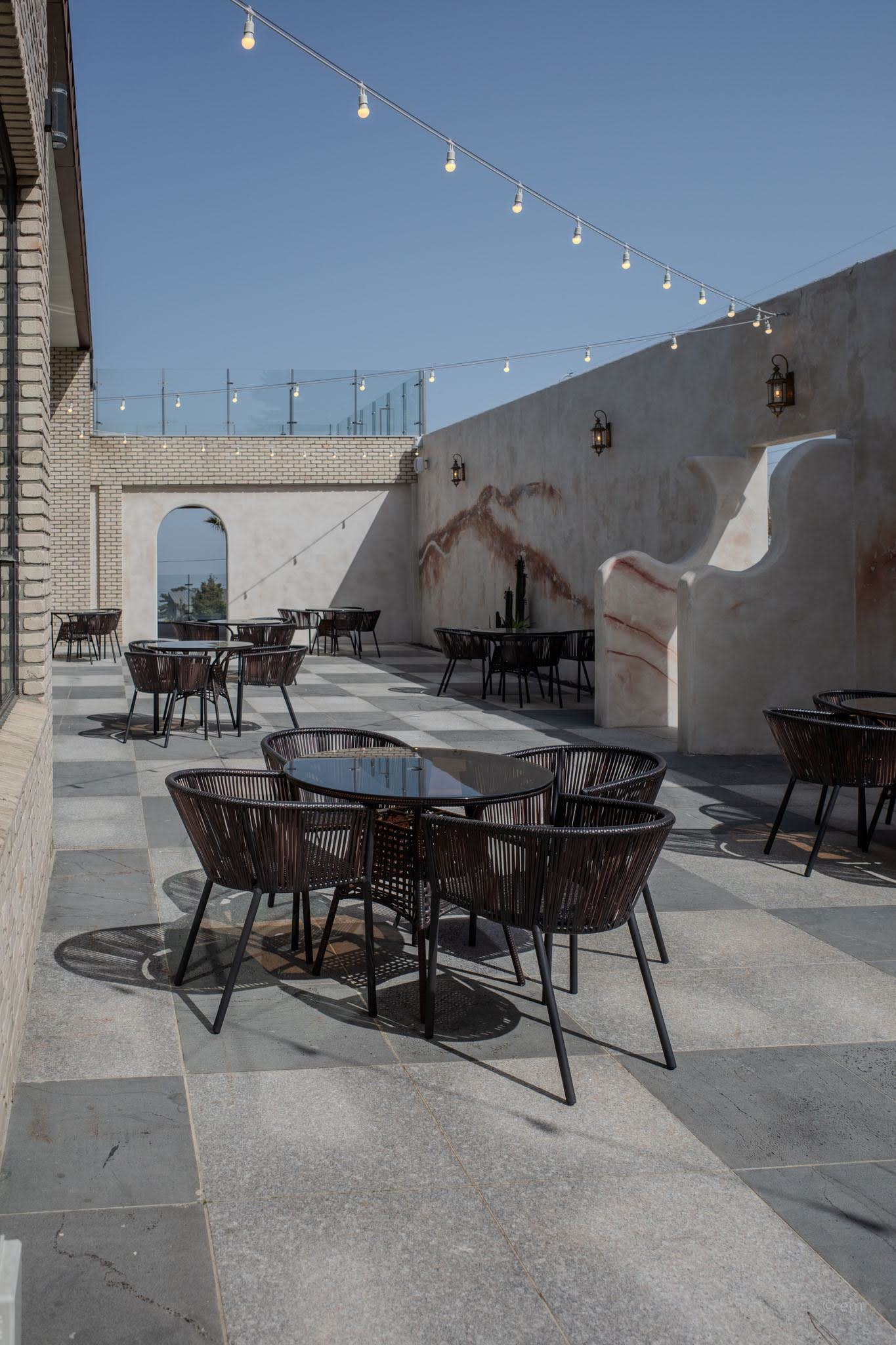
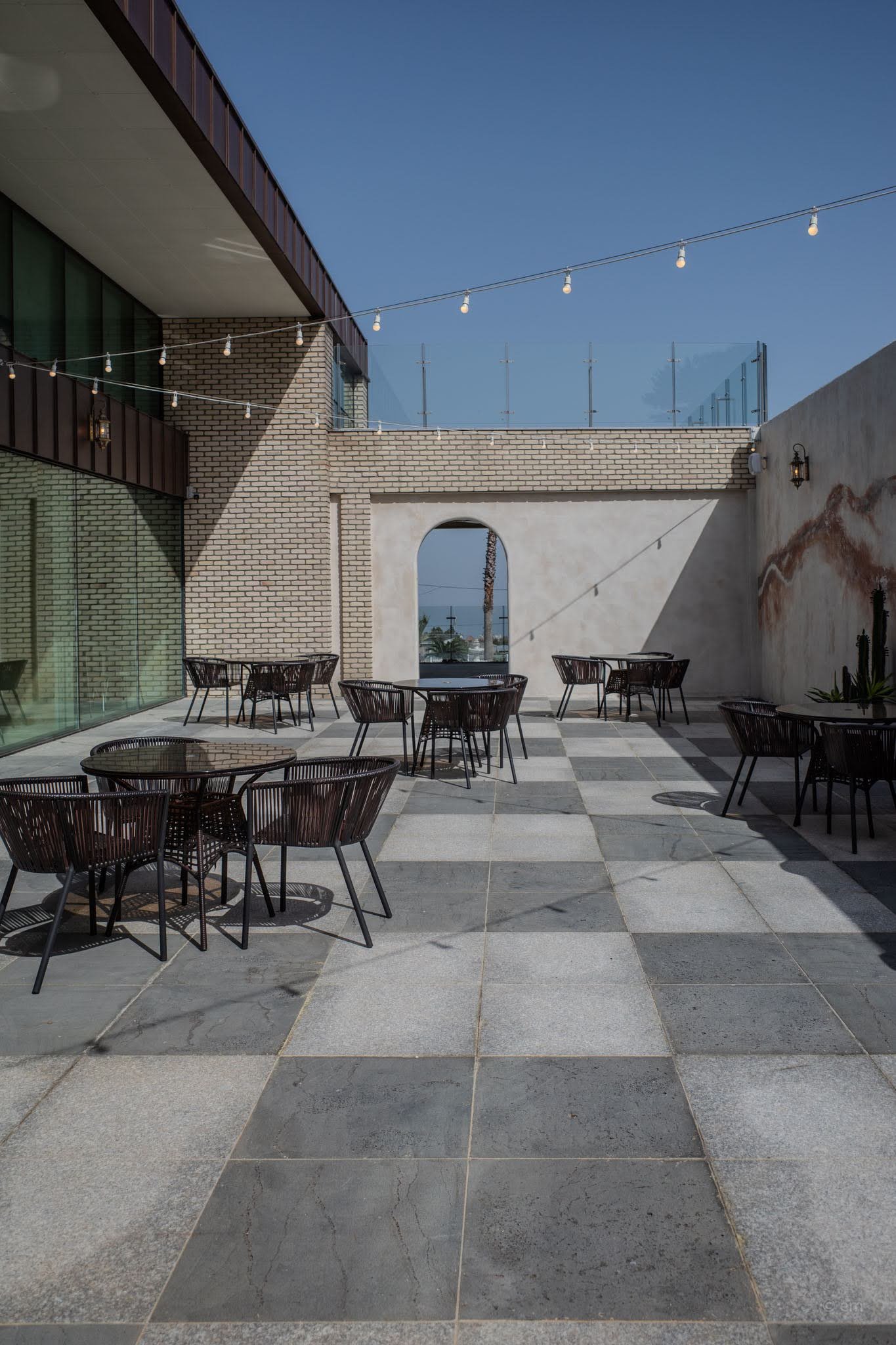
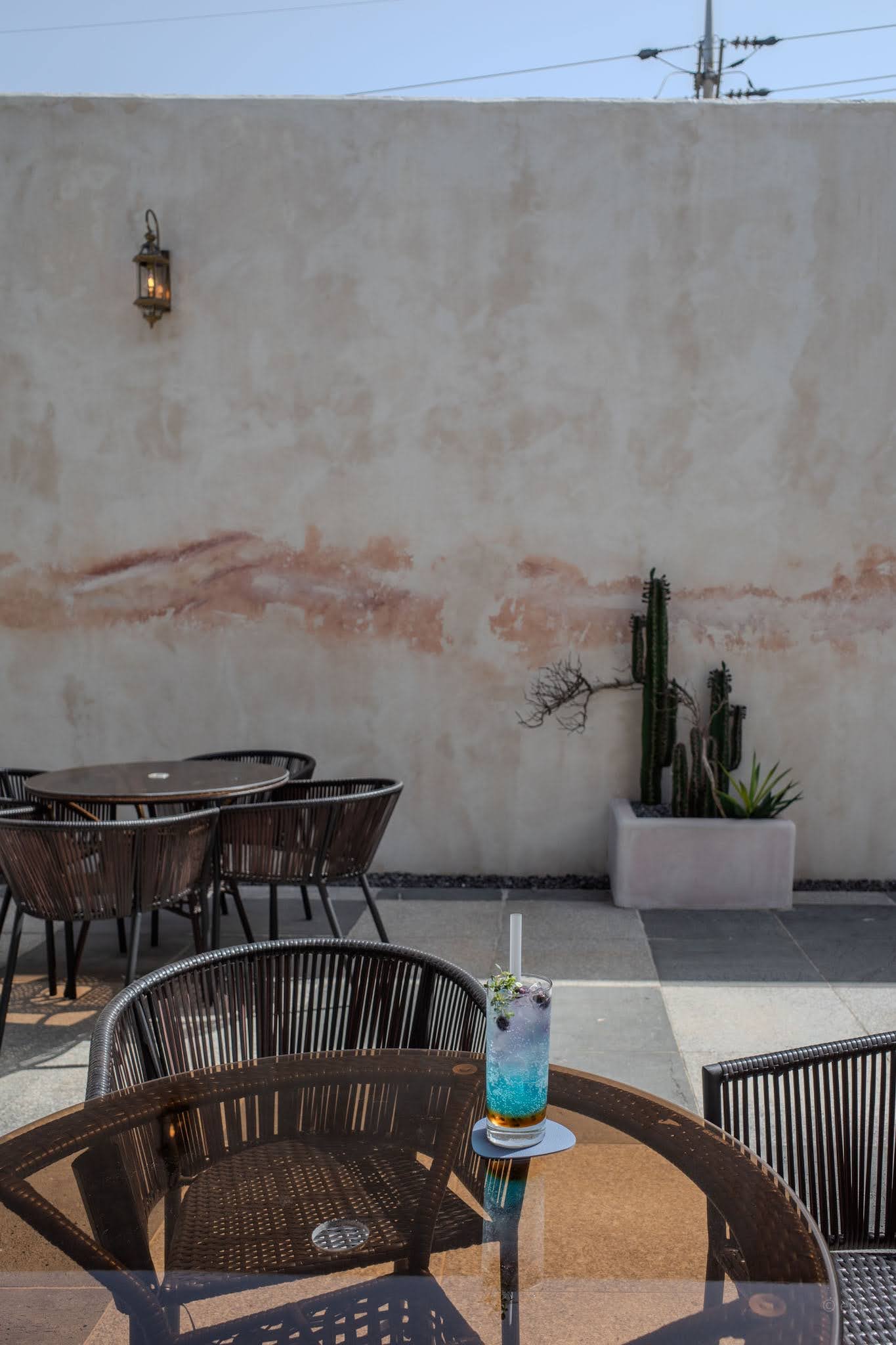
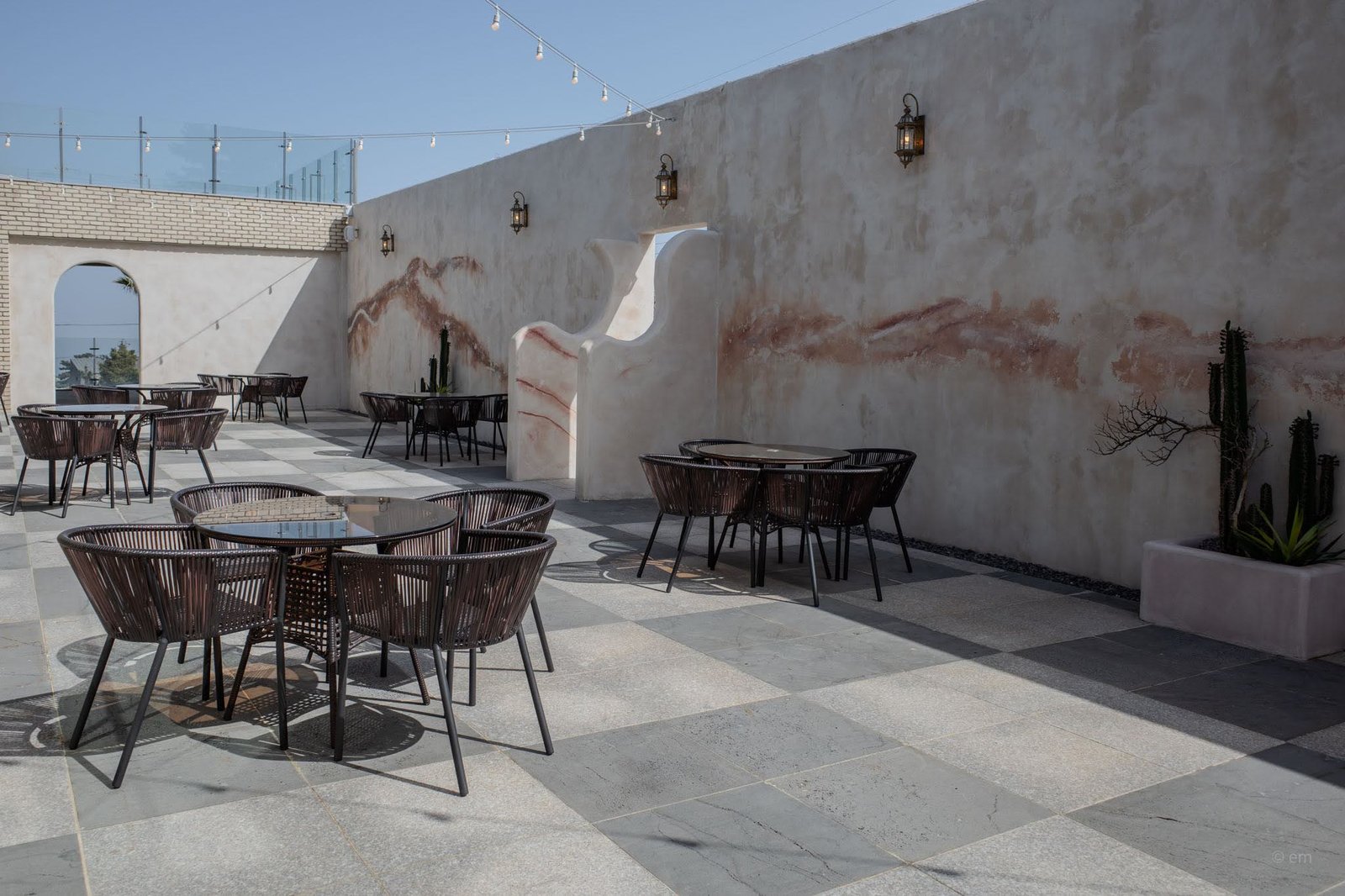
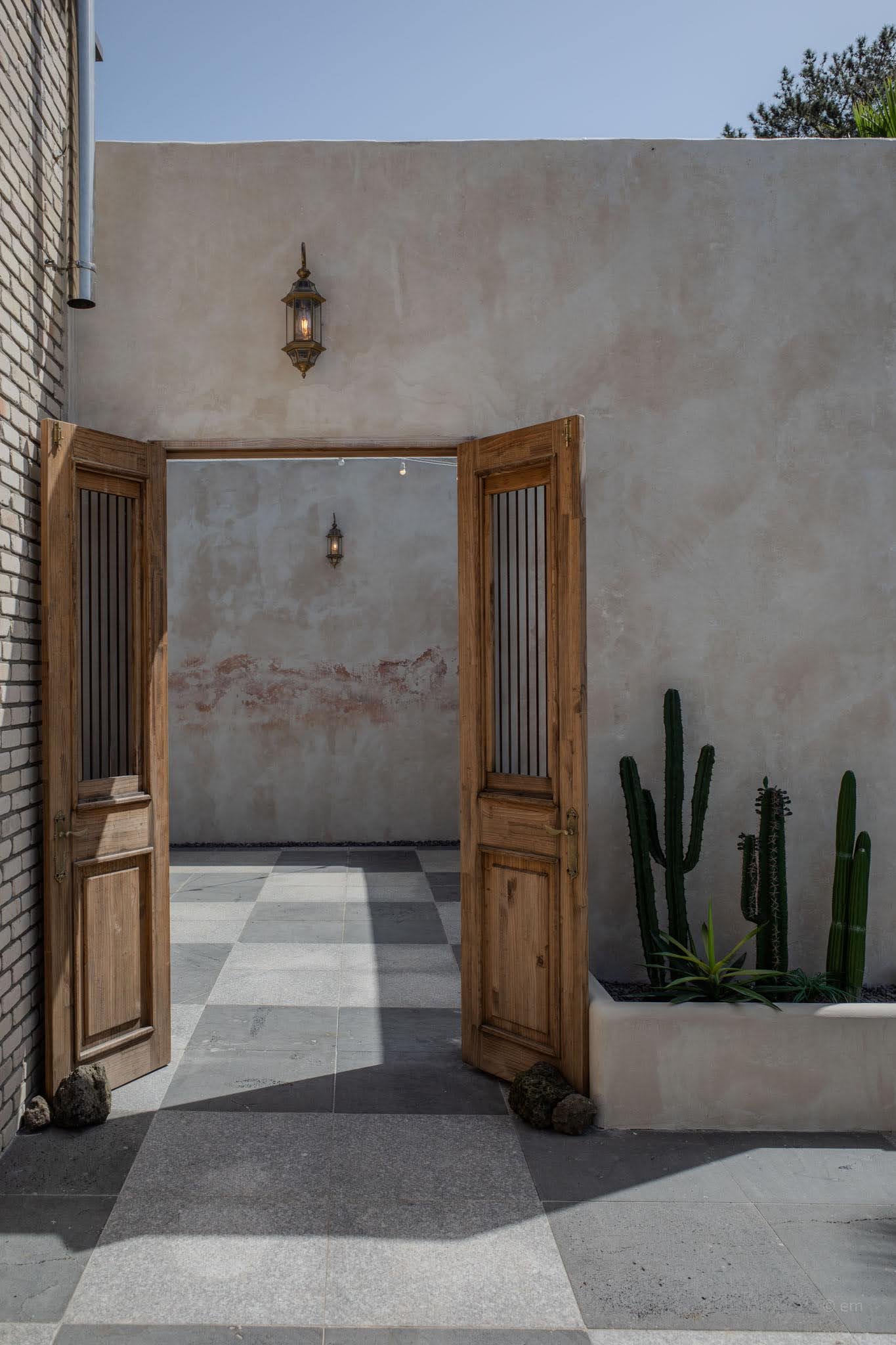
Up a flight of white steps, through a set of heavy wooden double doors with iron detailing, the open-air terrace unfolded. Enclosed on all sides by high white stucco walls, it read like a private courtyard plucked from somewhere along the Mediterranean coast of North Africa — Tangier, perhaps, or an unnamed coastal town where the centuries have rubbed everything smooth.
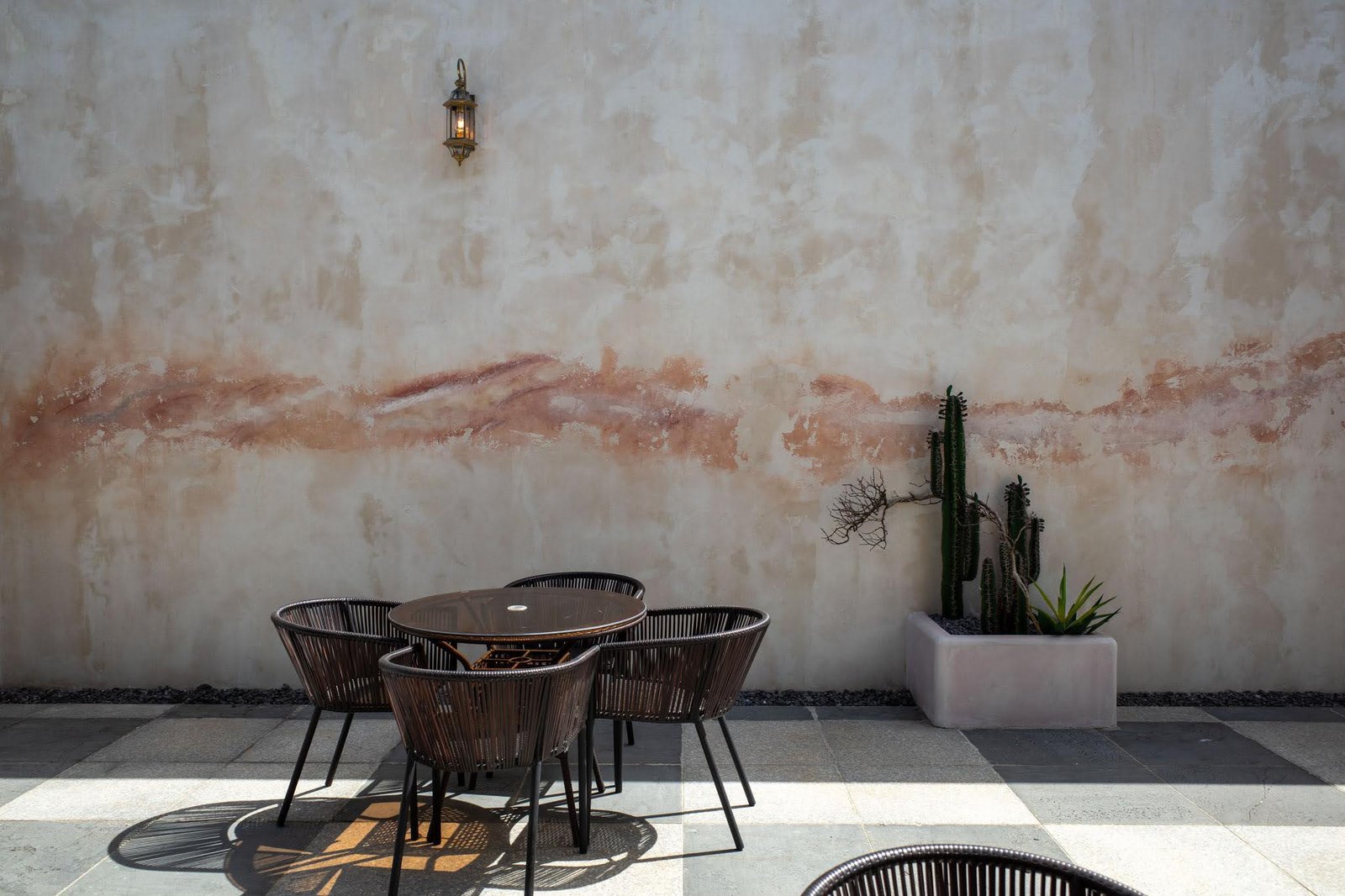
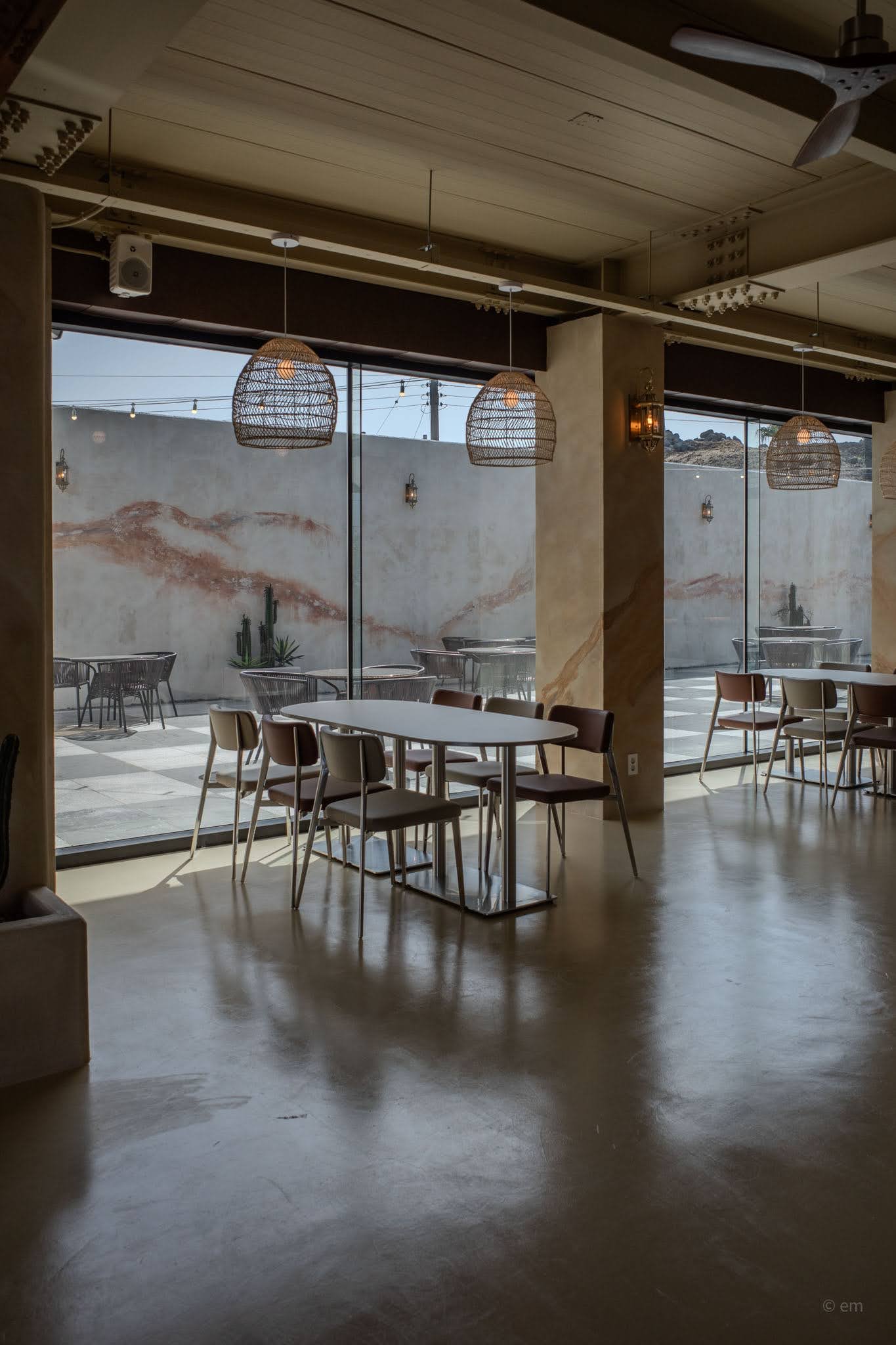
The floor was laid in oversized granite tiles alternating light and dark in a checkerboard pattern. Against the walls, Moroccan-style iron lanterns were mounted at intervals, and the walls themselves were marked with long horizontal sweeps of terracotta pigment — not painted precisely, but applied in the way desert wind moves sand across a surface, suggesting dune and horizon without stating either. White sculptural elements, molded in the same organic language as everything else here, rose from the walls like forms half-excavated from earth. Globe string lights strung overhead on clear wire completed the picture: a place designed to be best at dusk, when the lanterns warmed and the sky above turned the color of the walls.
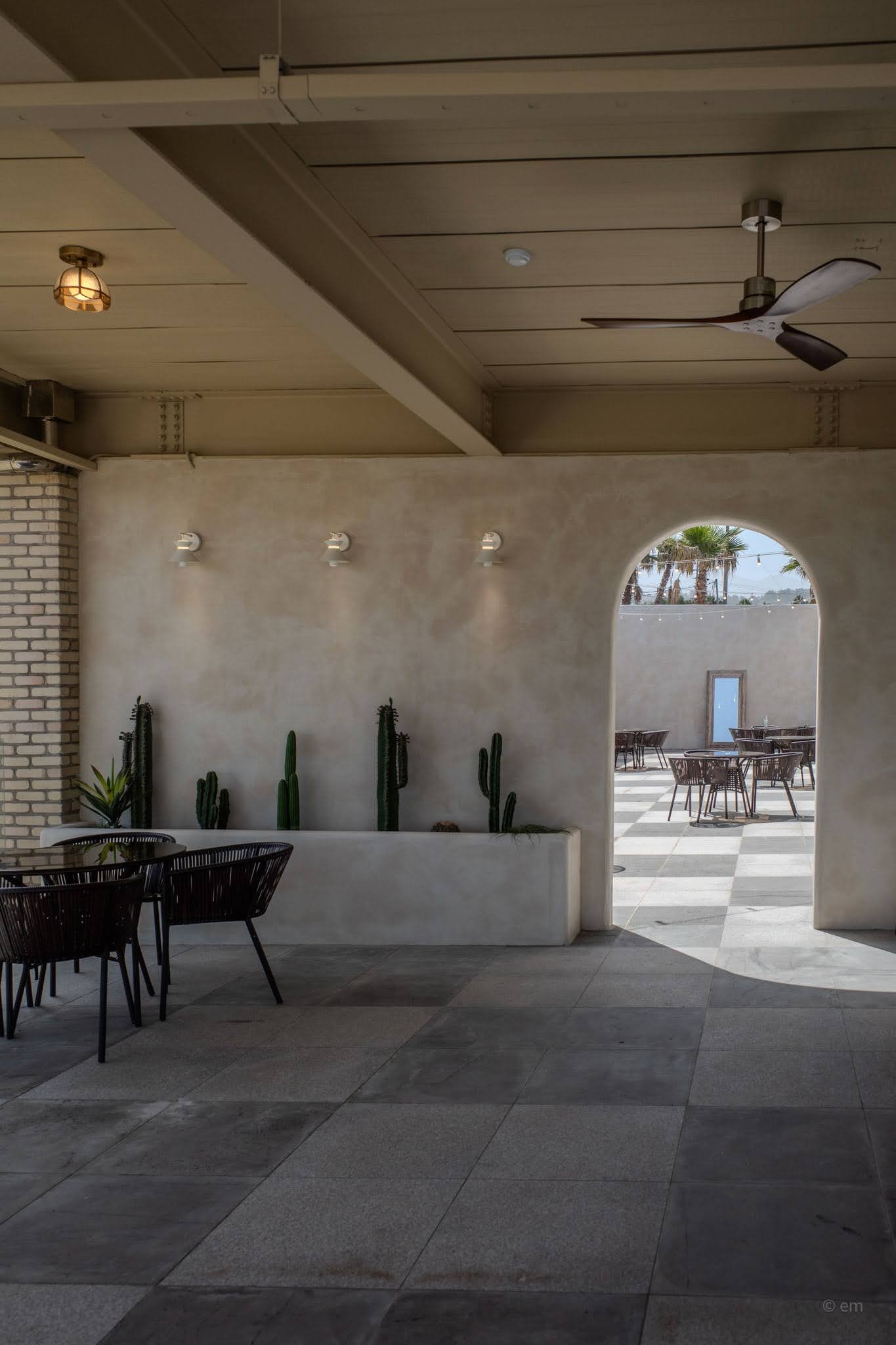
Arched openings cut through the enclosure at deliberate points, each framing a view beyond — palms, sky, a fragment of sea at the edge of the visual field.
Inside
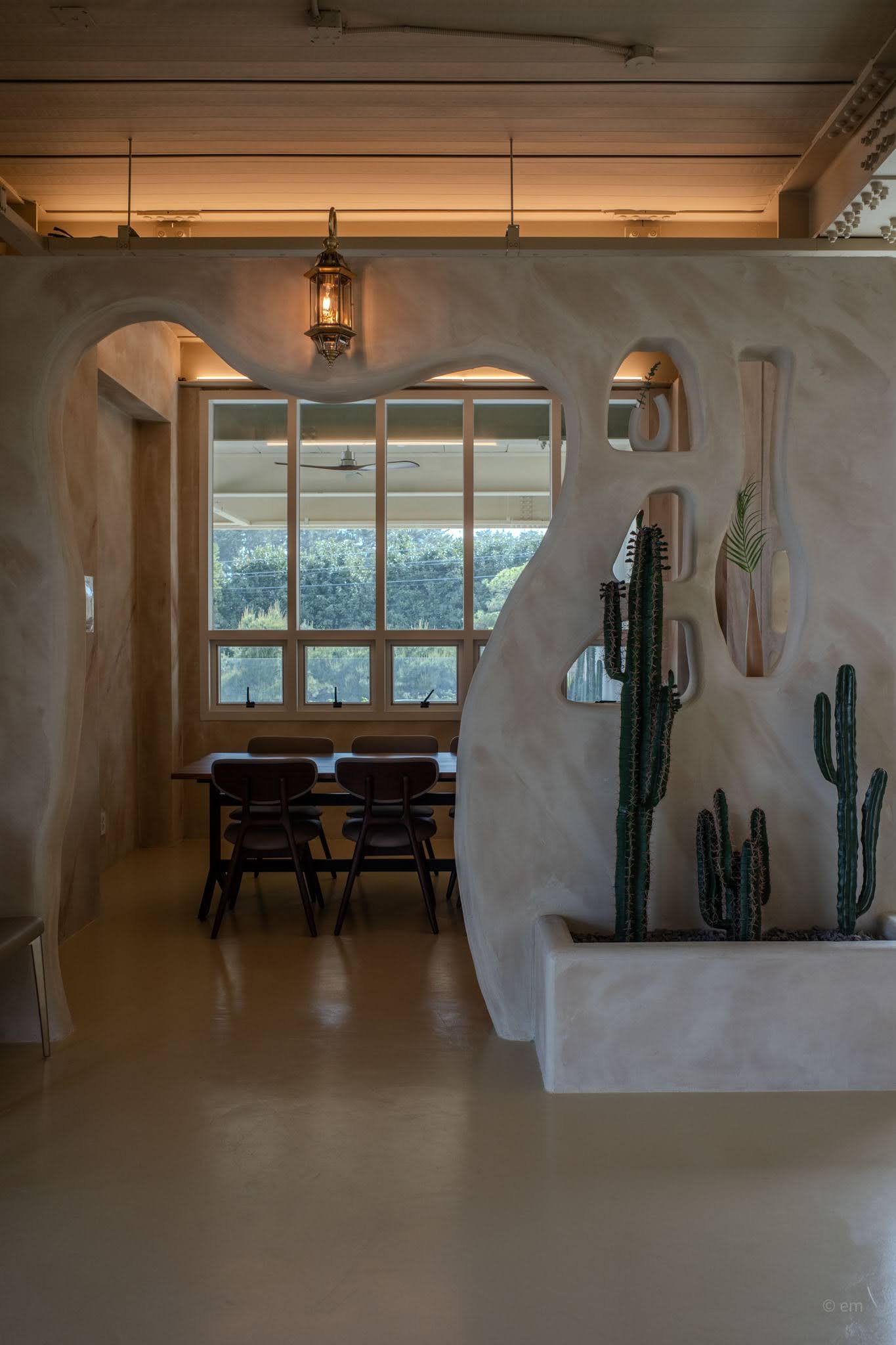
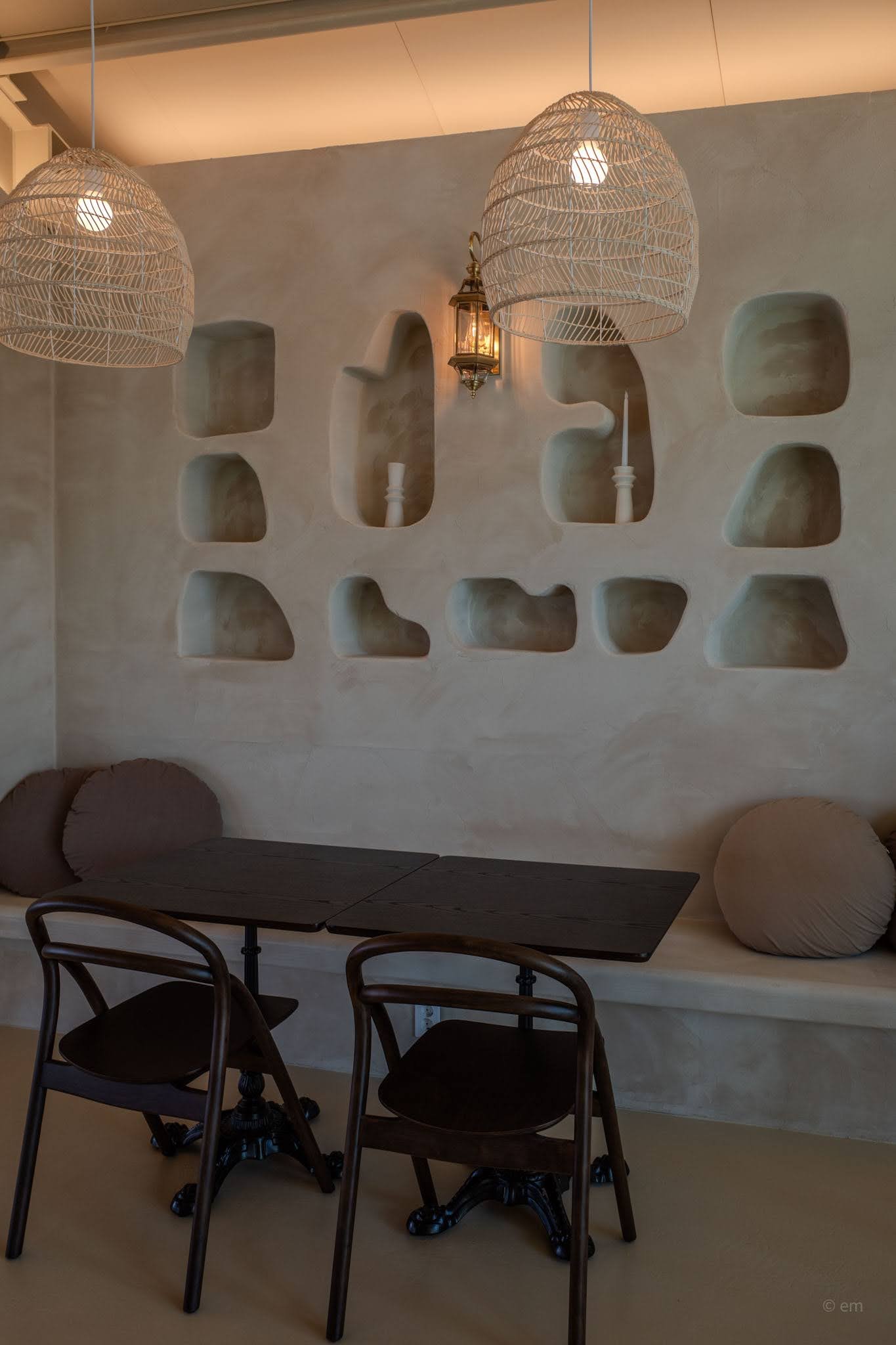
The first floor opened inward from the courtyard through glass — a wide, light-filled hall where the view back through the walls to the terrace became the primary orientation. A sculptural plaster dividing wall bisected the space in an organic profile, its flowing form interrupted by a large planter bed of columnar cacti at one end, by biomorphic archways at the other. Against the facing wall, rows of irregular niches — rounded, scooped, each a slightly different shape — held white pillar candles. Wicker dome pendants hung above, filling the room with a warm woven light.
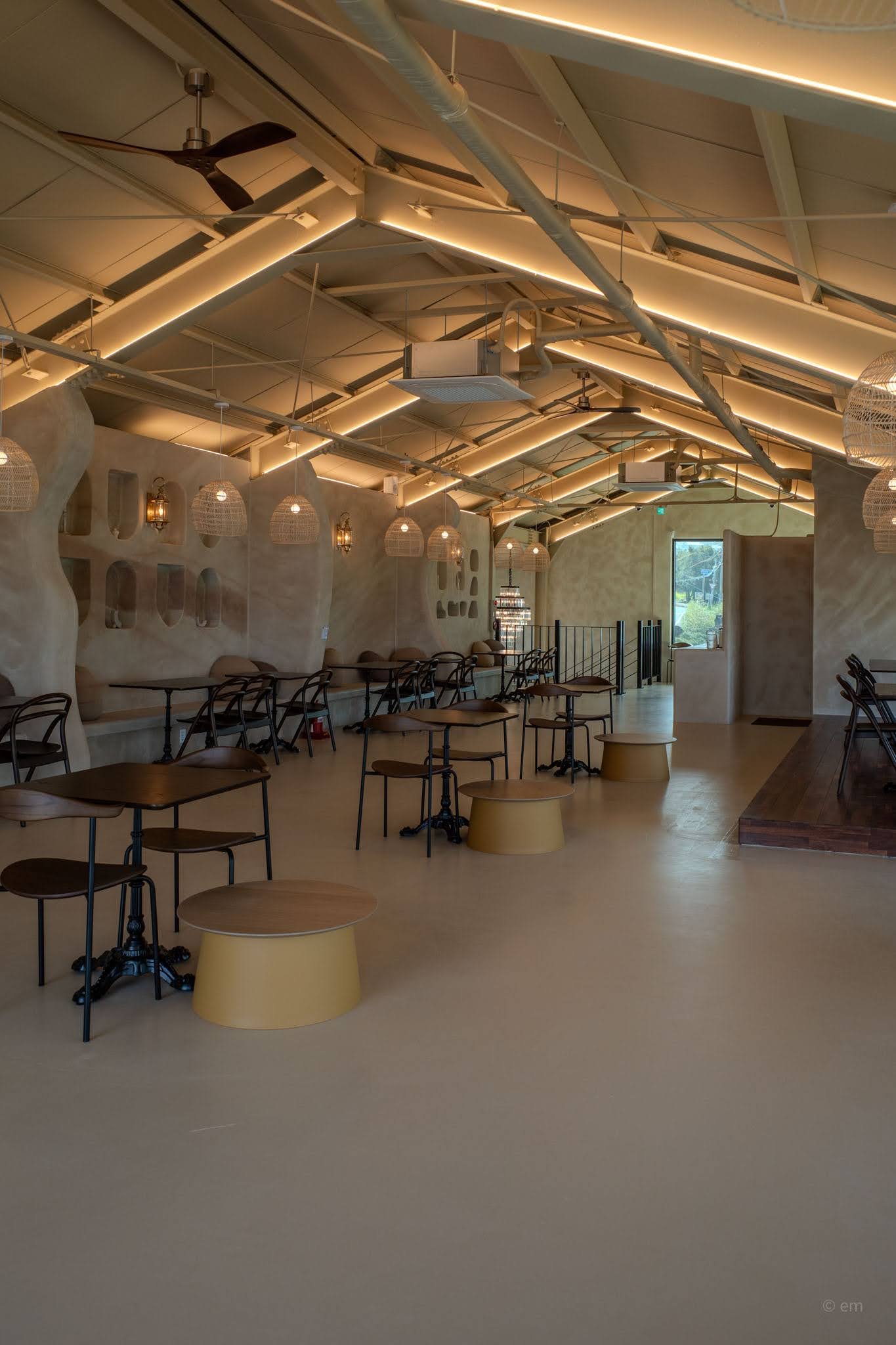
The staircase at the far end led up to the second floor, where the building revealed itself fully. The barn-pitched roof opened overhead in exposed beams, each one edged in LED strips that ran the full diagonal length of the structure, amber against raw timber. Industrial ceiling fans turned in the peak of the vault. The floor was polished concrete the color of pale sand, spread with low drum stools in the same warm yellow, and scattered tables of different configurations across its breadth.
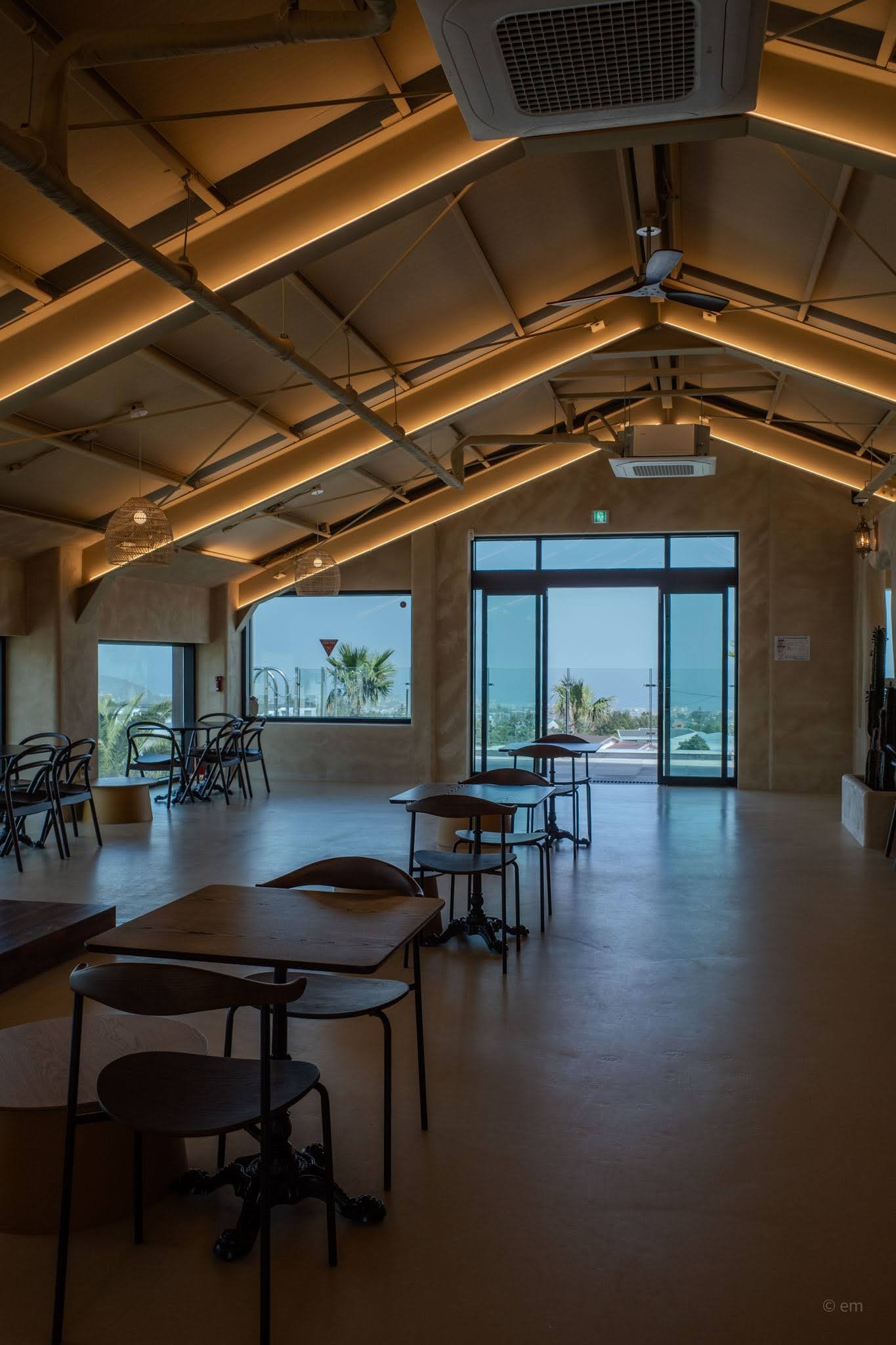
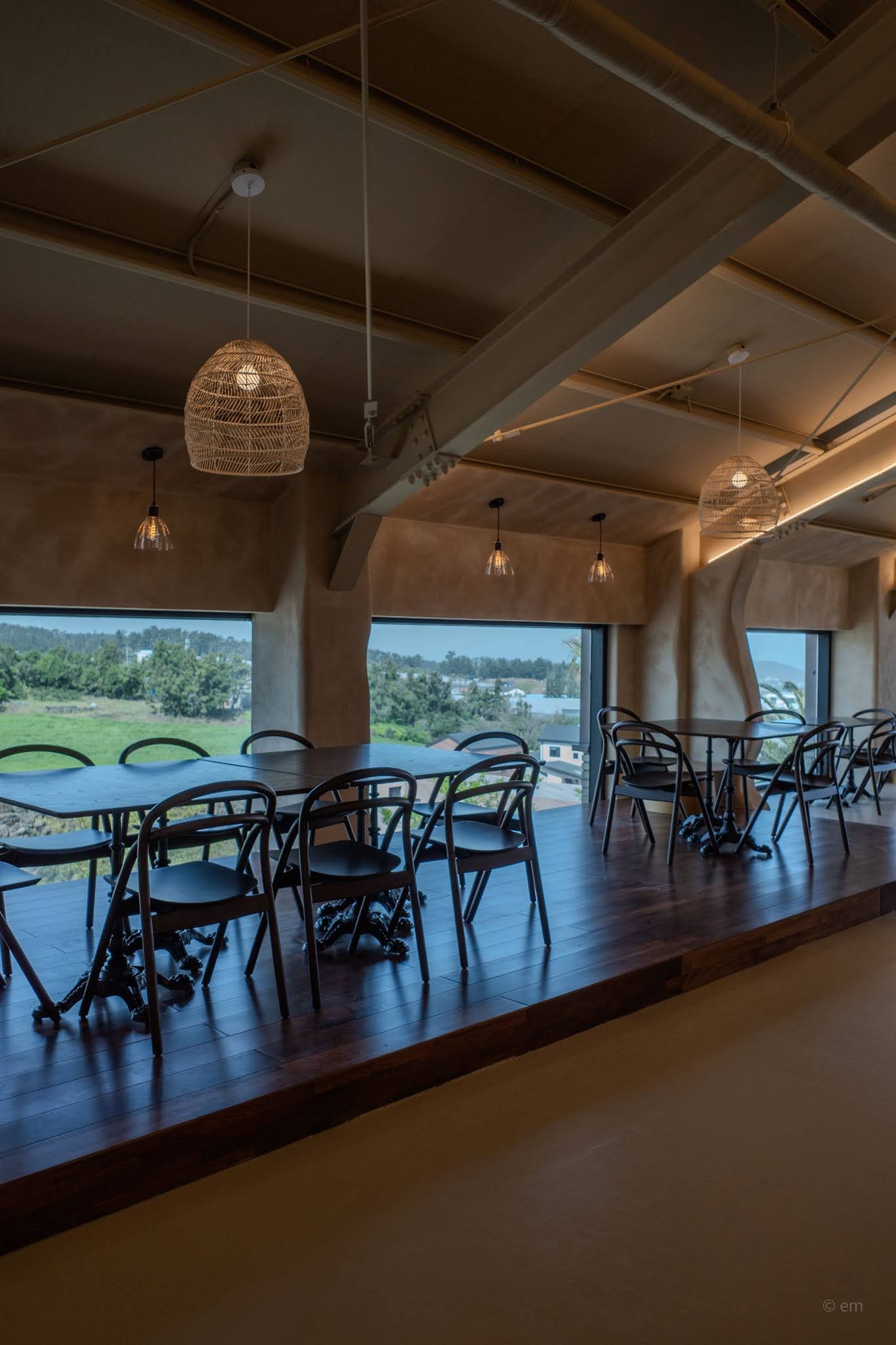
At the far end of the second floor, the space stepped up onto a raised platform in dark wood — a different register, quieter, more deliberate. Horizontal windows ran the length of this section at a low pitch, framing strips of Jeju countryside: green fields, tree canopy, rooftops, and beyond them a sliver of sea. It was the one place in the building where the island pressed back through.
Gone
Maison de BaBa closed not long after it opened. The specific circumstances of its closure were never widely recorded — it happened too quickly, in the way that some places disappear before they have fully become themselves in the public memory. The fountain was likely still running.
What the photographs hold is a space that understood, precisely, what it was trying to do: transport without betraying. Jeju’s volcanic landscape doesn’t look like Morocco or the American southwest or any of the desert traditions it was drawing from — and Maison de BaBa never pretended it did. The basalt gravel in the forecourt, the sea visible through the courtyard apertures, the palm species that grow wild on the island — these were local registers threaded through a borrowed aesthetic language. Be one with Jeju. It meant something.
It just didn’t get enough time to prove it.
Maison de BaBa Address: 416 Hagwang-ro, Aewol-eup, Jeju-si, Jeju-do
Status: closed, 2024 Instagram: (account no longer active)
The oasis was real. The mirage was always that it would stay.
![[Lost] Califhouse, Dosan: A Beverly Hills Dream, Now Closed](https://hiddencollector.thesensitiveways.com/wp-content/uploads/2026/04/R0004011-2-200x300.jpg)
![[Lost] Lujain Espresso Bar, Yangjae-cheon](https://hiddencollector.thesensitiveways.com/wp-content/uploads/2026/03/R0018314-200x300.jpg)
![[Lost] Pink Mellow](https://hiddencollector.thesensitiveways.com/wp-content/uploads/2025/08/pink-mellow-200x300.png)